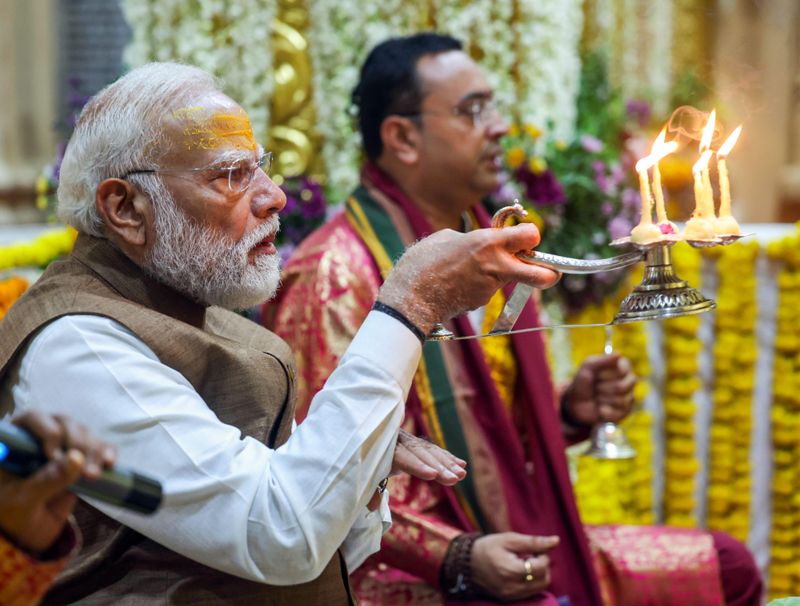

Prime Minister Narendra Modi on Monday hailed the Pokhran tests conducted in 1998 as a sign of India’s resolve in the face of global backlash, saying no power in the world could pressurise or overawe India.Speaking about the series of nuclear tests conducted on May 11 and 13, 1998, under then PM Atal Bihari Vajpayee, Modi said the whole world was out to squeeze India and threaten it with sanctions but Vajpayee exhibited political will and showed the world that no one could pressurise India into submission.The PM was speaking at the ‘Somnath Amrut Mahotsav’, marking 75 years since the inauguration of the reconstructed shrine dedicated to Lord Shiva, in Gujarat. He described the temple as a “beacon of unwavering faith, divinity and a sacred symbol of India’s eternal soul”.The PM said, “Today, I want to remind the gathering that May 11 also marks the anniversary of India’s Pokhran nuclear tests conducted in 1998. India carried out three nuclear tests on May 11, showcasing the capabilities of Indian scientists, while the subsequent tests on May 13 reflected the country’s unwavering political resolve.”“At that time, the entire world was pressuring India, but under the leadership of Atalji, the government demonstrated that for us, the nation comes first. No power in the world can make India bow or force it under pressure,” he addedModi further said the Pokhran tests were named ‘Operation Shakti’ because the worship of ‘Shakti’ along with Lord Shiva has always been a part of our tradition.Addressing a large gathering at the temple complex in Prabhas Patan, he said the reconstruction of the Somnath Temple in 1951 represented far more than a religious event, and symbolised the resurgence of India’s civilisational consciousness after Independence.“The restoration of the Somnath Temple on this exact day 75 years ago was no ordinary occasion. If India attained Independence in 1947, the consecration of Somnath in 1951 proclaimed the independent spirit of India,” Modi said.In a veiled dig at the Congress, the PM said the issue of national self-respect had often become a subject of political contestation in the country. “In our country, politics continues to be played even over matters concerning national self-respect. Somnath itself stands as the prime example of this,” he said.“Following our Independence, one of the very first duties undertaken was the restoration of the Somnath Temple. That is why Sardar Vallabhbhai Patel and Dr Rajendra Prasad devoted such immense effort to this cause. Yet, we all know the extent of the opposition they had to face from Jawaharlal Nehru,” he said.Drawing a parallel between cultural resurgence and national development, PM Modi said India must move forward by balancing “development and heritage”.He also highlighted recent initiatives such as the reconstruction of Kedarnath, the Kashi Vishwanath corridor, Mahakal Mahalok in Ujjain, the Chardham project, the Kartarpur Corridor and the Buddhist Circuit as examples of integrating spiritual heritage with economic growth and tourism.He also praised Sardar Patel for integrating more than 500 princely states into one India, and said the rebuilding of Somnath showed the world that India was not only politically free but also reclaiming its cultural pride.Modi added that serving as chairman of the Somnath Trust gave him the opportunity to contribute to the temple’s development and transformation, which people could now witness directly.The PM further said, “As the world returns toward natural and sustainable lifestyles, India must recognise its own traditional strengths. He emphasised the need to preserve the dignity of temples and pilgrimage sites while adopting lifestyles that protect nature and environment.”