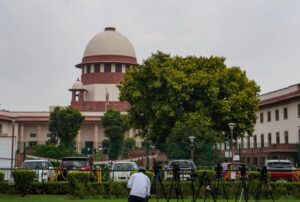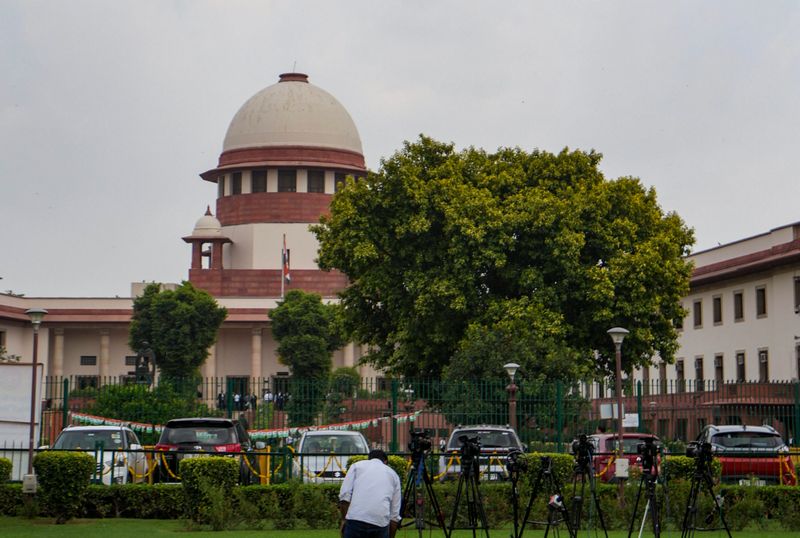

The Muslim side has moved the Supreme Court challenging the Madhya Pradesh High Court’s recent order declaring the disputed Bhojshala complex – an 11th-century archaeological monument in Dhar District of the state — a temple dedicated to Goddess Saraswati.The high court had said the Centre and the Archaeological Survey of India (ASI) can decide on Bhojshala Temple’s administration and management.The Hindus believe the Bhojshala complex is a temple dedicated to Goddess Saraswati, while Muslims calls it Kamal Maula Mosque. The complex is protected by the ASI.In its May 15 order, the high court had also quashed the ASI’s April 7, 2003, order that allowed Muslims to offer namaz inside the Bhojshala complex every Friday. The Muslim community may approach the Madhya Pradesh Government for the allotment of separate land in the district for the construction of a mosque, it had said.Now, Kamal Maula Mosque’s caretaker Qazi Moinuddin has challenged the May 15 order of the high court.In its much-awaited verdict in the Bhojshala Temple-Kamal Maula Mosque complex dispute, the high court had said that there were indications of a Sanskrit teaching centre and a temple of Goddess Saraswati existing in Bhojshala. It had referred to the principles laid down in the Supreme Court’s judgment in the Ayodhya Ram Janmabhoomi-Babri Masjid dispute case.Acting on a petition filed by ‘Hindu Front for Justice’, the high court had on March 11, 2024 ordered the ASI to conduct a scientific survey of the complex. The ASI began the survey on March 22 and after a 98-day survey, submitted its report to the high court on July 15, 2024.The ASI report had concluded that the existing structure of a mosque in the Bhojshala Complex at Dhar in Madhya Pradesh was made from parts of an earlier temple that can be dated to the Paramara period-almost 1,000 years ago.“Based on scientific investigations, survey and archaeological excavations conducted, study and analysis of retrieved finds, study of architectural remains, sculptures, and inscriptions, art and sculptures, it can be said that the existing structure was made from the parts of earlier temples,” the ASI had said in its 10-volumn report that alluded to predominantly Hindu character of the structure.“Total 94 sculptures, sculptural fragments, and architectural members with sculptural depictions were noticed during the investigation. They are made of basalt, marble, schists, soft stone, sand stone, and limestone, the ASI had said. “Sculptures of four-armed deities were carved on windows, pillars and beams were used in the existing structures. Images carved on these included Ganesh, Brahma with his consorts, Narsimha, Bhairava, Gods and Goddesses, human and animal figures. Images of animals in different mediums include – lion, elephant, horse, dog, monkey, snake, tortoise, swan and bird. Mythical and composite figures include a variety of kirtimukhas – human face, lion face, composite face; Vyala of different shapes, etc,” the ASI had stated.“Based on existing inscriptions in the complex, it can be said that these inscriptions contained literary works composed by some of the Parmara kings or works composed or copied during the Paramara rule,” it had stated.