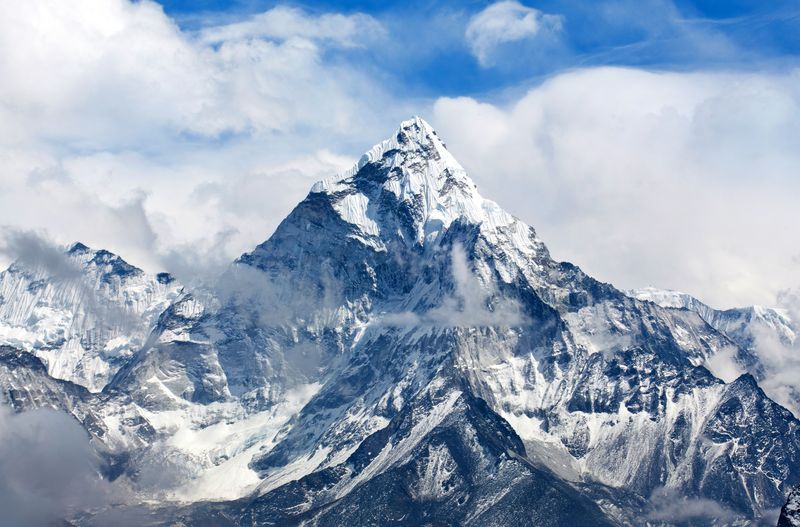

A joint China-Nepal scientific expedition has completed the first full-depth ice core drilling at the summit of Mt Everest to collect samples for understanding climate and environmental changes in ultra-high-altitude areas.Members of the joint expedition conducted scientific sampling work, including ice core drilling, on the world’s tallest mountain at an altitude of 8,848.86 metres.It took about two hours for the expedition team on Thursday to complete the first-ever full-depth ice core extraction from the summit, China’s state-run Global Times reported.The team collected ice core and snow core samples across multiple altitude gradients on the way down.The samples will be transported to laboratories under low-temperature preservation conditions for research on climate and environmental changes in the world’s highest region, cryosphere evolution, and atmospheric records at extreme altitudes, the newspaper said.The collected samples are expected to help researchers better understand climate and environmental changes in ultra-high-altitude areas, the boundary of the Indian monsoon’s influence, the transport pathways of pollutants into high-altitude regions, and differences in climate responses between the northern and southern slopes of Mt Everest, the report quoted Chinese scientists as saying.Studying the Earth’s tallest mountain is imperative as it is undergoing unprecedented and largely irreversible change caused by global warming. In May 2023, inter-governmental International Centre for Integrated Mountain Development (ICIMOD), with headquarters at Nepal’s Kathmandu, pointed out that 79 glaciers surrounding Everest have thinned by over 100 metres in just six decades, and the thinning rate has nearly doubled since 2009.In the Tibetan language, Mount Everest is known as Mount Qomolangma. China and Nepal settled their border dispute in 1961 with the boundary line passing through the summit of Mt Everest.According to the Guinness World Records website, an ice core was extracted at 8,020 metres (26,312 feet) above sea level from the South Col glacier on Mt Everest – just above the Camp IV and 828 metres below the summit in May 2019.