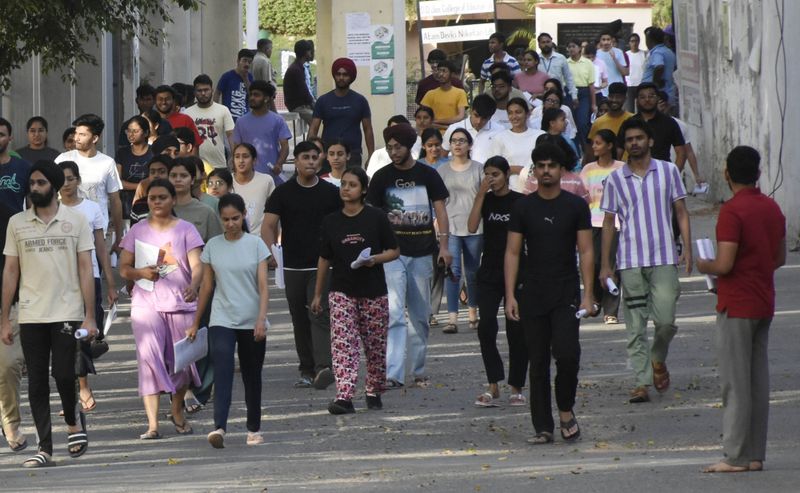

The cancellation of National Eligibility Cum Entrance Test (NEET-UG), held on May 3, following a paper leak has left lakhs of aspirants across the state and the country battling anxiety, eroded confidence and months of wasted preparation.With the re-examination scheduled for June 21, Union Education Minister Dharmendra Pradhan has announced stringent security protocols. According to the minister, plans are also afoot to switch the exam to computer-based test (CBT) mode from 2027. He has directed monitoring of social media to curb rumours. However, students, parents and mentors are sceptical, pointing out the proposed solution “fails” to address systemic corruption and logistical challenges unique to the NEET.With 46 major examination leaks reported nationwide in the last seven years — including the NEET-UG and cancellation of National Eligibility Test (NET) in 2024 — critics argue merely changing the examination mode would not restore trust.Unlike the Joint Entrance Exam (JEE), which caters to 12 to 13 lakh candidates and is conducted in multiple sessions with different question sets, NEET has over 23 lakh applicants appearing in one go. Experts say conducting it simultaneously in CBT mode would require an unprecedented number of secure centres, computer terminals and unique question papers per shift — effectively doubling the infrastructural burden and raising a whole another set of concerns regarding fairness.Satyam Vashist, a NEET aspirant from Amritsar and the first in his family to appear for the exam, said the leak dealt a “body blow” to his year-long preparations. “I believe there is no point sulking now. This leak and cancellation should not have happened, but they did. I had put all my hopes and hard work into the exam. I am preparing again for June 21, and hope the agencies ensure there is no irregularity this time,” he said.Another aspirant, 18-year-old Anhad Singh from Ludhiana, highlighted the psychological impact of the events that unfolded. “It is not the students’ fault the paper was leaked. Most of us are under immense stress, fearing the same thing could happen again. Online or offline, there is no guarantee. Students are losing time as well as confidence,” he said.Second-generation aspirant Vidhisha Gupta questioned the wisdom behind switching to online mode without fixing core issues. “Changing the mode doesn’t fix corruption. JEE is conducted online in multiple phases and still faces percentile controversies. For NEET, they may need around 10 shifts, which will only increase fairness concerns,” she said.Dinesh Kanungo, a competitive exam mentor based in Chandigarh, was blunt in his assessment. “As things stand, setting up enough test centres with computer terminals for all candidates at once is impossible. There is also the digital divide and the risk of technical glitches, which occur frequently, even in the JEE,” he said.The biggest worry, however, remains the normalisation process for percentile if the exam is held in multiple shifts. NEET is extremely rank-sensitive — where a difference of just one or two marks can translate into thousands of ranks — and any variation in paper difficulty could trigger controversies, said Uttamjit Singh, an Amritsar-based JEE and NEET mentor.“Variations in difficulty levels are inevitable when an examination is conducted in multiple shifts. Normalisation becomes controversial and students lose faith in the system,” he added. According to him, students also fear server crashes, power failures, login issues and poor centre management, adding to their pre-exam anxiety.The Radhakrishnan Committee, headed by former Indian Space Research Organisation (ISRO) chief K Radhakrishnan, had recommended a gradual shift to CBT or hybrid mode after the 2024 NEET controversy, along with better encryption, secure centres and structural reforms in the National Testing Agency (NTA). However, implementation has at best been patchy so far.For millions of medical aspirants already scarred by repeated scandals, the question lingers: can the system deliver a truly leak-proof, fair and logistically viable online NEET?Until deep-rooted issues of security, infrastructure and institutional accountability are resolved, the shift to computer-based testing may not prove to the magic bullet it is touted to be.