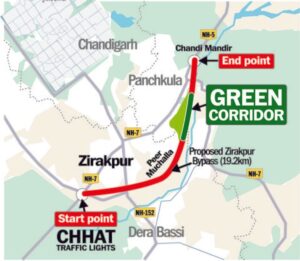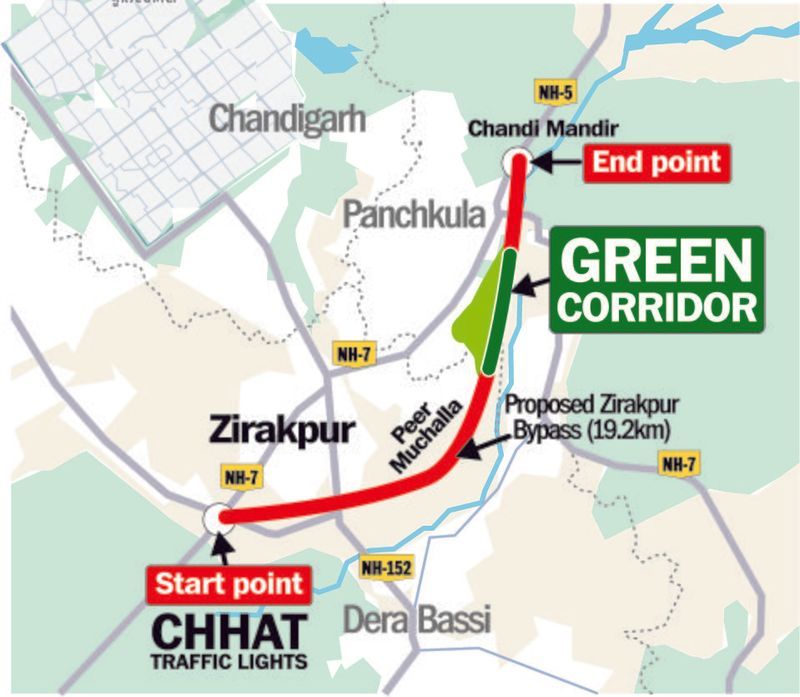

Barely weeks after clearing a critical defence land hurdle, the long-delayed and much-awaited 19.2-km, six-lane Zirakpur-Panchkula bypass has run into fresh legal trouble.The Punjab and Haryana High Court has stayed the felling of trees — including approximately 5,000 along the bypass corridor — in the entire state of Haryana without the court’s express permission, putting a question mark on the ground-level start of one of the most consequential highway projects in the Chandigarh Tricity.The case is listed for hearing on Tuesday.WHAT NHAI SAYSA total of 2,790 forest trees are proposed to be felled along the 19.2-km bypass corridor — a figure that appears to differ from the approximately 5,000 cited in the PIL. NHAI has filed a detailed reply before the court in compliance with its directions.NHAI’s position is that the project has already obtained all statutory clearances from MOEF&CC Govt of India required under forest laws — both Stage-I and Stage-II Forest Clearances — and that Wildlife Mitigation Plan for the corridor has been reviewed and vetted by Wildlife Institute of India, Dehradun ensuring an independent and professional assessment of the project’s ecological impact.On compensatory afforestation, the tree loss is far more than offset by what has been planned: 27,770 trees under statutory compensatory afforestation schemes, 12,000 trees as avenue plantation along the bypass, and 7,992 shrubs within the corridor — totalling over 47,000 plantings against approximately 2,790 trees to be felled, a ratio of more than 10 times. The requisite funds for Compensatory Afforestation and Net Present Value (NPV) have already been deposited with the Ministry of Environment, Forest and Climate Change.The bypass has been designed as an elevated corridor through forested stretches, specifically to minimise the number of trees that need to be cut. Post-construction greenery restoration, including plantation beneath elevated sections, is part of the project’s environmental plan.WHY THIS PROJECT CANNOT WAITThe Zirakpur-Panchkula bypass is not simply a traffic project. It is a national infrastructure imperative — and its delay has real costs that go well beyond commuter frustration.Zirakpur is today the single most choked junction in the entire Tricity. Every vehicle heading from Delhi, Ambala or Patiala toward Panchkula, Shimla, Baddi or Chandigarh must crawl through its congested urban grid — a town whose narrow roads carry the load of a national highway interchange. The bypass, with its 6.195-km elevated section, multiple flyovers and a railway overbridge, will create a dedicated six-lane, access-controlled corridor that allows all through-traffic to leapfrog Zirakpur and Panchkula city entirely — dramatically cutting travel time and emissions, and ending the daily gridlock on NH-44, NH-205A and NH-152.There is a strategic dimension too. The bypass originates near the Chandigarh Airport, which doubles as an Indian Air Force Station, and terminates at Chandimandir, Panchkula — the headquarters of the Western Command of the Indian Army. The corridor provides a congestion-free, access-controlled route for the rapid movement of defence personnel, equipment and logistics between two critical defence installations. In a border state like Punjab, where swift military mobilisation may be required at short notice, this is not an incidental benefit — it is a national security asset. Existing routes between these two establishments run through densely built residential and commercial areas, with multiple traffic intersections that materially affect travel time and emergency response.A PROJECT REPEATEDLY DELAYEDThis is not the first time the Bypass has been stalled. Conceived in 2020, the project spent years waiting for forest clearances, land acquisition completions and bureaucratic approvals. The connecting 10.3-km Spur — the last uncleared link in 244-km Tricity Ring Road that ties the bypass to the Ambala-Chandigarh Expressway — was approved by the Union Government as recently as February this year, with its estimated cost having ballooned from Rs 940 crore to Rs 1,464 crore — a jump of nearly 56 per cent — in the intervening years of delay.Just weeks ago, the Ministry of Defence granted NHAI working permission for 2.7461 acres of Army land at Chandimandir Military Station.When NHAI and its two awarded contractors — RKCPL Limited (Bypass, Rs 1,380 crore, two-year deadline) and Ceigall Infra Projects Pvt Ltd (Spur, Rs 603 crore, 18-month deadline) — were preparing to mobilise on ground, the high court stay now introduces fresh uncertainty into that timeline.