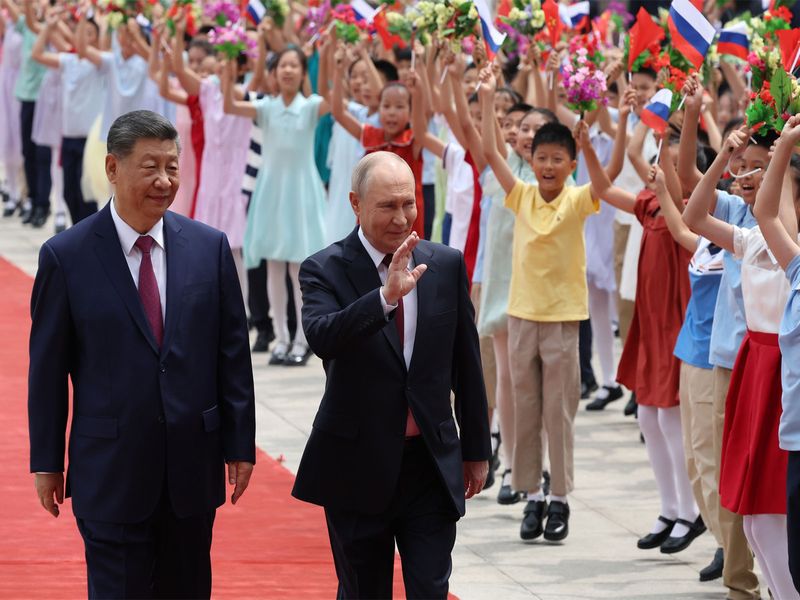

Hong Kong, May 28 (ANI): Just four days after saying farewell to US President Donald Trump, May 15, and even before the red carpet could be rolled up and stashed away, the Chinese leader Xi Jinping welcomed his Russian counterpart Vladimir Putin to Beijing from May 19-20.The close proximity of the state visits was unmistakable, as Chairman Xi Jinping and Vladimir Putin doubtlessly swapped notes about their arch-nemesis, the USA. Some reports say Xi will visit North Korea very soon, too, his second-ever trip to Pyongyang. This certainly gives the appearance of a triumvirate comprising China, Russia and North Korea.Putin has made a staggering 25 visits to China. Furthermore, the two leaders have met in person more than 40 times since 2013, when Xi rose to lead China.Malcolm Davis, Senior Analyst at the Australian Strategic Policy Institute, opined, “Just before Russia’s second invasion of Ukraine in February 2022, Putin visited with Xi in China. Putin is in Beijing again now to meet with Xi, just as Russia escalates hybrid warfare against NATO, and tries to create a false-flag opportunity for an attack on the Baltic states in the same way it did against Ukraine. History rhymes, but on this occasion, US support for NATO is no longer guaranteed, and the Trump administration is turning away from the alliance and turning towards Moscow and Beijing.”Reading the tea leaves, Davis suggested Putin and Xi might be coordinating their actions in Europe and the Indo-Pacific. He added, “Trump’s moves to effectively walk away from supporting Taiwan echo his moves to walk away from Ukraine and from NATO. Both encourage Putin and Xi to be more aggressive and take risks.””We’re entering truly perilous times. We must be ready for worst-case scenarios. We’re in a pre-war period, in some respects akin to the late 1930s,” Davis warned.However, analysts should not be too carried away by the optics of Putin and Xi together, as they chatted over tea, visited a photo exhibition or witnessed the signing of agreements. Instead, Dr. Yu Jie, Senior Research Fellow on China at Chatham House’s Asia-Pacific Programme, pointed out that “geopolitics is rarely driven by personal warmth or political ‘bromance’. It is shaped by strategic interests, calculations of power and national priorities.”She explained, “This latest meeting between Xi and Putin was designed to send a message to the world: Beijing and Moscow remain strategically aligned in their effort to reshape the international order. A joint summit declaration, advocating a ‘multipolar world’ and a ‘new type of international relations’, underscored the durability of the China-Russia partnership at a moment of mounting global fragmentation.”Indeed, the two nations issued their joint declaration on the Establishment of a Multipolar World and a New Type of International Relations on 20 May. It stated, “Negative neocolonial tendencies such as unilateral forceful approaches, hegemonism and bloc confrontation are on the rise. Fundamental, universally recognised norms of international law and international relations are regularly violated, and it is becoming more difficult for states to coordinate their actions and resolve conflicts within global governance institutions, many of which are losing their effectiveness.”It warned that this will lead to the law of the jungle. To prevent this, China and Russia called for the following: a principle of openness in the world for inclusive and mutually beneficial cooperation; a principle of indivisible and equal security; a principle of democratisation of international relations and improvement of the global governance system; and world civilizational and value diversity.It is paradoxical that the joint statement said: “the security of one state cannot be achieved at the expense of another”. Russia’s invasion of Ukraine illustrates how hollow these words are. They added that “disagreements and disputes should be resolved peacefully, addressing the root causes of conflicts”. Again, not something Moscow is doing in Ukraine or China in the South China Sea.The joint statement also warned, “It is necessary to resolutely oppose the use of human rights as a pretext for interference in the internal affairs of other states.” This is alarming, for the two countries want a “new type of international relations” where governments are free to tyrannically ride roughshod over human rights.Putin described Xi as his “long-time good friend,” and they hailed a “new stage” in their relationship “based on equality, mutual respect, good faith and win-win cooperation”. Xi stated, “The China-Russia relationship has entered a new stage of greater achievements and faster development.”China and Russia signed the Treaty of Good-Neighbourliness and Friendly Cooperation 25 years ago, plus 2026 is the 30th anniversary of the establishment of the China-Russia strategic partnership of coordination. Bilateral trade blossomed to US$228 billion last year, the third consecutive year in which trade exceeded US$200 billion. China has been Russia’s largest trading partner for 16 consecutive years now.Putin added that Russia-China relations “have reached a truly unprecedented level,” and that they “supported each other on matters affecting the core interests of both countries, including protection of sovereignty and state unity”. Putin remarked too, “The close strategic relationship between Russia and China plays a major, stabilising role globally. Without allying against anyone, we seek peace and universal prosperity.”The thing to remember is that this is alignment, not trust, between the two neighbours who share a 4,300km-long land border. Dr. Yu pointed out that the recent summit revealed two truths: China and Russia are a strategic duo on the world stage, but their partnership is one of pragmatic alignment rather than full alliance.One of their shared interests, for instance, is opposing Western “hegemony”. Of course, when they talk about a “more just and equitable” international order, this reflects their combined efforts to weaken the dominance of US-led institutions and to create alternative centres of power where they hold a monopoly.Putin’s state visit was therefore a carefully orchestrated facade, just as Trump’s was. The television images hid deeper differences between Beijing and Moscow, as Yu noted: “Yet beneath the appearance of unity lies a more complicated reality. China and Russia remain bound together by geography, by shared opposition to Western dominance, and by a partially overlapping strategic agenda.”The academic explained that the partnership is not limitless. Beijing is concerned over excessive dependence on Russian energy, for example, and its broader global ambitions continue to place boundaries around how far the relationship can evolve”.Chinese over-reliance on Russian energy supplies could become a future strategic vulnerability, but Beijing can also leverage its influence over Russia by negotiating cheaper oil prices. Interestingly, China has more to lose than Russia, because it is more deeply integrated into the global economy. That is why global disruptions, such as the closure of the Hormuz Strait, are more troublesome for Beijing, especially as its domestic economy stalls.This explains why Xi restated that hostilities in the Middle East must cease immediately, to ease disruptions to oil and gas supplies and help restore orderly international trade. Moscow wishes to stir up antipathy towards the USA, whereas Beijing seems more concerned about calming points of friction.Some claim China is ready to seize the opportunity afforded by the Iran war and American distraction to assert leadership in the Middle East or to seize Taiwan. However, this seems to be misreading Chinese ambitions.Ryan Hass, Director of the John L. Thornton China Center at the US-based Brookings Institute, interrogated such assumptions, “Beijing wants a durable ceasefire and an end to disruption of flows through the Strait of Hormuz. It wants the conflict to end. China does not currently want to assume the burdens of global leadership or the role of security guarantor in the Gulf. China is focused on clearing a path for its continued rise. The current uneasy calm in US-China relations serves this function. Beijing also is betting that its economic and tech strength will pull other countries closer and compel them to view China as a rising leader.”Nor does China have to make any dramatic move to bolster its position on the world stage, especially as Trump continually undermines the USA’s standing. Hass concluded, “This gives China confidence to patiently wait for the world to call on Beijing to take on a greater role. It’s assuming that America’s internal dysfunction and external indiscipline will clear a path for its rise. Time will tell whether that bet pays off.”Yu said both countries want a multipolar order for different purposes. In Russia’s case, it sees it as a pathway out of isolation and to gain recognition that it is still a major power. For China, it wants a transition away from American dominance and a world more amenable to its influence.She elaborated: “This convergence has produced a durable strategic partnership. China has provided Russia with crucial economic lifelines since the war in Ukraine began. It has expanded bilateral trade, increased purchases of Russian oil and gas, and sustained technology and industrial exchanges – straining its ties with Europe in the process. Russia, in turn, has offered China discounted energy supplies, military cooperation and diplomatic backing on issues ranging from Taiwan to critiques of NATO’s intentions in Asia.”This support includes military assistance, no matter how much Beijing denies it. For instance, Reuters reported China secretly trained around 200 Russian soldiers who later deployed to Ukraine. This exchange was based on a 2 July 2025 agreement between Beijing and Moscow to conduct reciprocal training in both countries. Reuters said the China-based training focused on drone and counter-drone warfare, as well as electronic warfare, army aviation and armoured infantry.Chinese experts, such as those published in state media, took a celebratory view of Trump’s visit to China. Reporting was generally positive, even more so than in the USA itself. This was for several reasons, according to Hass of the Brookings Institute. One reason was that Trump elevated Xi to a new level as a true peer. Next, the two leaders reportedly worked constructively together, which was supported by Trump’s apparent acceptance of a new framework of “constructive strategic stability”. Finally, Trump echoed some of Xi’s framing on Taiwan when he met with his own press. In many ways, Trump scored an own goal there.Hass commented, “Personally, I was struck by: 1) how much the overall relationship depends on the personal relationship between Trump and Xi; 2) how much both leaders appear focused on avoiding confrontation and buying time; and 3) how little overlap there was between each leader’s agendas. So long as both leaders remain invested in extending the uneasy calm, this arrangement can hold. Count me sceptical, though, that Trump or anyone around him believes the concept of ‘constructive strategic stability’ has set boundaries that will alter the relationship.”It appears Trump has indeed paused arms sales to Taiwan, without receiving any concessions from China. This makes the USA look like it is taking a conciliatory and accommodating approach to China. No wonder Chinese media and experts were viewing the Trump-Xi summit positively.Returning to Sino-Russian relations, Yu concluded: “The latest Xi-Putin summit therefore showcased a relationship defined less by ideology than by calibrated strategic utility. Both sides benefit from appearing united. Russia gains the appearance of having a powerful partner despite Western efforts at isolation. China maintains a reliable geopolitical counterweight to the US and an important partner in promoting alternative visions of global governance.”The relationship is not rooted in a formal treaty, but rather a resilient form of pragmatism. Nonetheless, the Chatham House academic reported, “The Xi-Putin relationship remains one of the most consequential strategic partnerships in the world. Yet its durability lies not in limitless friendship, but in carefully managed limits.” (ANI)(This content is sourced from a syndicated feed and is published as received. The Tribune assumes no responsibility or liability for its accuracy, completeness, or content.)