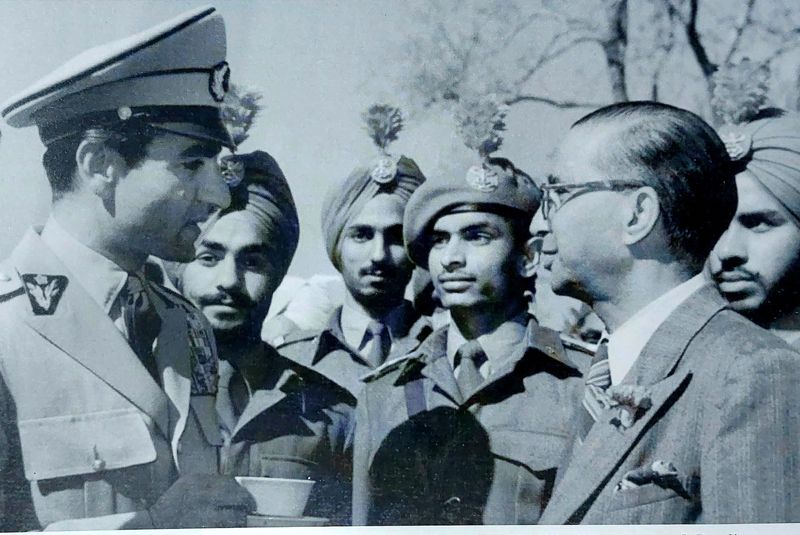

Ever since the launch of Operation Epic Fury, my memory has remained fixated upon an early morning of mid-February 1956. My batchmates and I, in the final term at the Indian Military Academy in Dehradun, were practising for the Passing Out Parade (POP) when we were brought to an abrupt halt. The be-medalled Adjutant of the Academy, mounted on his White Charger, announced that Their Majesties, the Shah of Iran and Queen Soraya, would shortly be on a State Visit to India. After a deliberate pause, he further stated that the Academy would honour them with a Ceremonial Parade (an abridged version of the POP) which we would practice to perfection over the days ahead. Then, in menacing tones (as is the purport of the entire tribe of Adjutants), he warned that should there be a single mis-step by any one of us, the “wrath of hell” would descend upon the entire lot!Maintaining his put-on fearful visage, the Adjutant pirouetted the White Charger on its hind legs and galloped off the Parade Ground. We were left agog, pondering for a while on this brouhaha — to parade for an Oriental King and Queen when we had just broken free from subjugations of the Continental British King and Queen? However, the very next moment, our spirits lifted sky high with the youth’s fancy that we would have the good fortune to at least catch a glimpse, maybe even a handshake, of Queen Soraya, one among the five most beautiful women of the world, in a class of our own Maharani Gayatri Devi of Jaipur!As I understand now, that Ceremonial Parade was among the several deliberate and far-sighted diplomatic outreaches by India’s first Prime Minister, Pandit Jawaharlal Nehru. The Prime Minister, who had authored ‘The Discovery of India’ among other accomplishments, would surely have known about the chance discovery of a petroleum source in the Brahmaputra valley at Digboi (Assam) around 1790s, later upgraded as an oil refinery in 1901, the first and only in Asia then! And also that it was a mere statistic, with a maximum annual output of just 1 tonne of crude, woefully insufficient for India, newly born as a sovereign nation “at the stroke of the midnight hour”.Propelled by those compelling national energy security interests, the visit was spread over 28 days, the longest in the annals of world diplomacy because Iran at that time had an annual commercial output of 1-1.3 million barrels per day peaking to 6 million by 1974!For a start, Their Majesties were received at the Delhi airport itself by President Dr Rajendra Prasad and Prime Minister Nehru and then feted for four days in the colonial opulence of the Rashtrapati Bhavan. Similar regal courtesies at potentate levels were again orchestrated through the Nawab of Hyderabad. By the 1960s, India had an assured supply chain of petroleum and crude, on the most favourable trade terms in Indian currency, and subsequently an assured export market for India’s wheat, rice, tea, etc.On our part, we Gentleman Cadets had spared no effort in marching past the Ceremonial Saluting dais to perfection in that once-in-a-lifetime kind of duty. As rehearsed, we of the senior batch alone had gathered in groups of 10 to 15 on the adjoining vast lawn a few paces away when, to our sorrow, we learnt that Queen Soraya was indisposed with a touch of food infection, shattering our dreams of seeing her in person. Nevertheless, we were charmed by the persona of the handsome Shah Reza Pahlavi, who moved from group to group with practised poise, making polite conversation. I happened to be in the group which also had the senior civilian instructor who taught military history and comfortably engaged the Shah. The Commandant, Brig Apji Randheer Singh, looked for a suitable pause in conversation to wean the Shah to the next group.Now, coming back to 1941, when Hitler had invaded Russia, Churchill in collusion with Stalin attacked Persia with Indian army’s 10 Infantry Division as the spearhead, luckily leading to capitulation without a shot fired. The ruling Shah was exiled and his 21-year-old son, Reza Pahlavi, made the puppet Head of State. Learning from that humiliation, he first set about creating formidable armed forces, equipped with the most lethal weaponry purchased almost entirely from USA, and then nationalised the UK-owned Anglo-Iranian Oil Company. The subsequent two decades of oil boom had filled the coffers of Iran with unlimited wealth and the Shah wisely ploughed it to modernise Iran and uplift its population in all walks of life.However, the prevalence of hubris, coupled with counsels of sycophants, eventually misled the Shah to organise a Grand Durbar in 1971, culminating in Pahlavi re-crowning himself with the new fabulous creation by Cartier of Paris.The seeds of a bloody revolt, led by the Paris-exiled cleric Ruhollah Khomeini, sprouted rapidly, reaching its zenith around the mid-1970s, which brought my fleeting association of the Ceremonial Parade for the Shah at IMA eventually to full circle at Tehran! By the sleight of kismet, I was on an assignment at the Imperial Iranian Command and General Staff College, Tehran, and so happened to exchange another salute in October 1978, by the then Shahenshah. Following two months of bloodbath, the Shah and family were flown out to USA on January 16, 1979.“Those who live by the Sword, shall perish by the Sword”— Anonymous