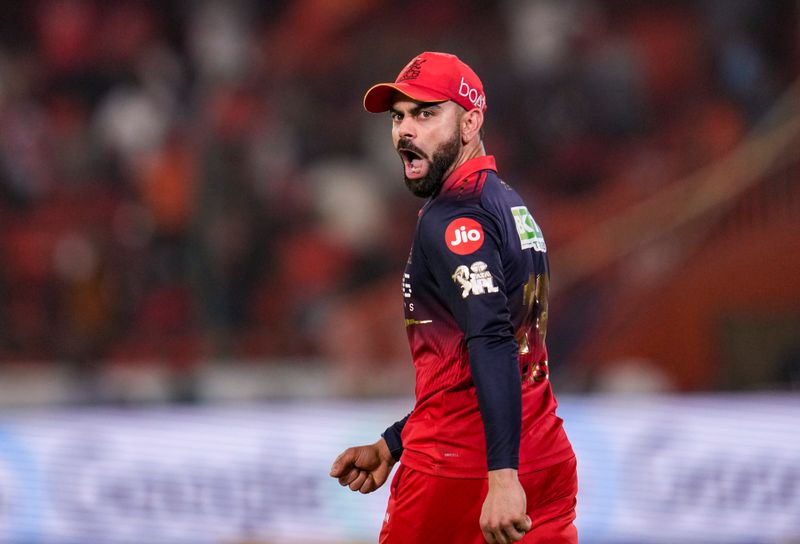

Virat Kohli, that epitome of cricketing perfection and celebratory excess, seems to have had enough of the incessant camera scrutiny. Ah, for a moment away from its constant gaze, a gaze that intrudes and inhibits his private space, even extending into his training sessions. In a recent interview that revealed a sensitive mind and refined eloquence, Kohli made a quiet appeal to the roving eye: please leave me alone.For someone who represents an age that celebrates triumph as an emotion needing assertion through aggressive, intimidating body language, something must have disturbed his inner space for him to make such a lament. When the prowling sweep of an intrusive camera invades the interior world of a sportsperson, it may be time to cry foul.We are all shaped by the times we inhabit. In the historical arc of cricket and the exposure of its captains to the world, even a cursory study of changing behavioural patterns can be revelatory. We are, after all, what we are repeatedly fed. What follows is an admittedly amateurish exploration of that historical arc, prompted largely by Kohli’s earnest appeal.A chuckle and a brief clasp of hands marked celebrations when the fiery Sardar of Spin, Bishen Singh Bedi, led India in the Seventies. The all-pervasive camera was still in its infancy and the public remained largely dependent on published photographs to recognise their heroes. Even that easy chuckle represented a dramatic departure from the impassive, almost inscrutable, presence of Mansoor Ali Khan Pataudi in the 1960s.Jattvibeil Gavaskar’s pragmatic aloofness, Kapil Dev’s earthy sermons — the long line of Indian captains belonged to a less demonstrative age, before the inquisitive eye sharpened itself. Unlike today, it was an age in transition when dignified, muted celebrations were the norm.Sachin Tendulkar took over the captaincy from the reluctant, introverted Mohammad Azharuddin and by the time he handed it to Sourav Ganguly, the public eye had begun shifting its gaze, growing steadily more invasive.The reticent Tendulkar created a persona where distance deepened reverence. He revealed little of himself beyond the bat, remaining at heart a private, almost reclusive, figure whose silence only enlarged his myth. His flickering uncertainty in dealing with the media reflected a man uneasy around people he did not trust, yet careful not to offend. The obtrusive camera arrived late at the scene when Tendulkar’s name already carried weight whose burden he alone could bear. His aura had, in a sense, sanitised the surroundings that “forced” everyone to be careful and not trespass upon his privacy.The irreverent Sourav Ganguly didn’t care what the world thought of him and revelled in the blurring of private and public spaces. He confronted and even courted controversy without getting unduly hassled by it. In changing times, a thick skin was necessary to remain insulated from outside noise, a “quality” his successor Rahul Dravid, perhaps, lacked. Dravid was too engrossed in building his solid wall of milestones. Captaincy, for him, was an irritant and he quietly walked away from its tedious managerial chores.MS Dhoni seemed to intuitively grasp the threatening nature of the “demon” the camera was becoming. He evolved a new grammar to subdue and disarm its intimidating presence. A crisp, measured manner of speaking that often bordered on silence became central to his persona. Those chasing a story or a scandal seemed, almost by magic, to withdraw on their own. His reserved yet affable demeanour, which muted the noisy surroundings, will remain a case study in how to maintain distance without creating enemies.Anything that came after the high decibel, emotional outbursts and verbal release of a suppressed rage that defined Kohli’s frustrations — and, surprisingly, even his celebrations — was bound to feel like an anti-climax. Rohit Sharma was stepping into the shoes shaped by a long history of behaviour patterns that modern cricket had both encouraged and normalised. Rohit was like the schoolmaster who pretends to be strict but at heart remains an endearing figure whose barbs directed at his players never quite seem offensive.From striving for excellence to eventually being acclaimed as an icon and a celebrity, a successful sportsperson once followed a fairly well-defined path. In the times we live in, however, such a trajectory appears almost too staid, even boring. It neither titillates, nor draws eyeballs. The cricket field itself has expanded. Public is private and the private is public. The contest increasingly resembles a pantomime in which the lead actors must perform, becoming reel-makers even beyond the game itself.When the more reflective Kohli speaks of privacy, he may be missing the larger reality that marketing of the modern sport has created. He is that captivating figure whose achievements, petulance and anger-fuelled antics act like a magnet. So what if he has grown wary of media scrutiny? Our appetite for theatre and the theatrical has become so voracious that had there been no Kohli, we would have invented one.The stars of the present age live by the camera and die by the camera. It is their window to fame, one that can eventually turn into a vulture that devours them.— The writer is the author of ‘Not Quite Cricket’ and ‘Not Just Cricket’