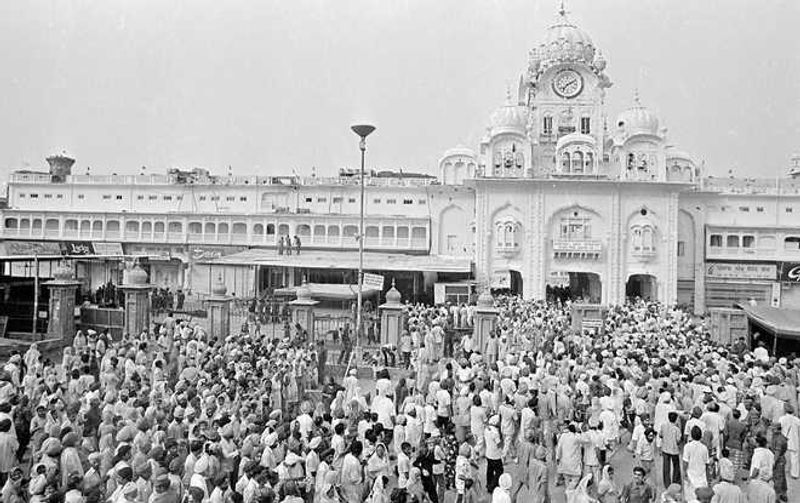

Forty-two years have passed since Indian Army tanks rolled into the Golden Temple complex in Amritsar in an operation called ‘Operation Blue Star’, which ended on June 6, 1984.The name ‘Blue Star’ has always invited speculation. Was it chosen to reference the blue attire of devout Sikhs? Did it carry some deeper military or strategic symbolism?Related News:Operation Blue Star anniversary marked with prayers and kirtan at Akal TakhtLt Gen V.K. Nayar, who served as Deputy Director General of Military Operations in 1984, disclosed how the operation got its name in his book, From Fatigues to Civvies: Memoirs of a Paratrooper, published by Manohar Publishers in 2013.He writes that planning for the operation had been under way for weeks. The military machinery was in motion, but a codename had yet to be finalised.One evening, while driving home after a long and exhausting day in the operations room, Nayar spotted a roadside signboard. It was advertising Blue Star, the refrigerator and air-conditioner brand that was among the most recognised names in pre-liberalisation India. He simply thought: let’s go with it.Senior journalists Kanwar Sandhu and Shekhar Gupta have also written about the naming of the operation.A retired Army officer, wishing not to be quoted, said military operations routinely use neutral and arbitrary codenames to maintain secrecy. The name generally has nothing to do with the operation and cannot reveal any aspect of the planning.The other operations in the same campaign followed the same principle. The follow-up sweeps across Punjab were called Operation Woodrose, while the targeted action against Bhindranwale’s inner circle was named Operation Metal.The Indian Army launched Operation Blue Star from June 1 to 10, 1984, to flush out armed Sikh militants led by Jarnail Singh Bhindranwale.The operation ended with Bhindranwale dead, the Akal Takht badly damaged, and hundreds of casualties among militants, soldiers and civilians.The political and human cost that followed was staggering. Indira Gandhi was assassinated by her Sikh bodyguards in October 1984. The anti-Sikh riots that erupted in Delhi and elsewhere claimed thousands of lives. The wounds have never fully healed.The name that became inseparable from all of this came from a signboard on a Delhi road on a tired evening in 1984.Nayar’s memoir is still considered the most authoritative insider account of how the codename was chosen.