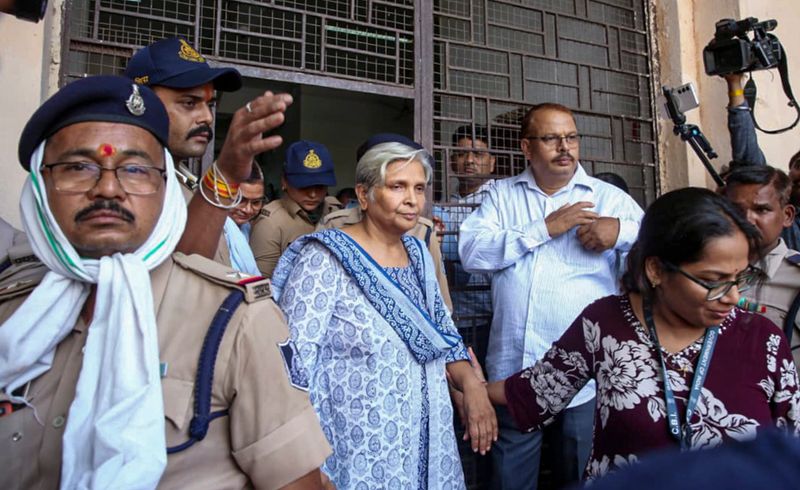

Every generation of Indian women seems to inherit its own cultural villain. For our grandmothers, it was Lalita Pawar’s cold glare. For the early 2000s, it was Ramola Sikand adjusting her bindi while psychologically terrorising daughters-in-law. And now, in 2026, thanks to social media, the kitchen villain is dead.India has found a new archetype: the corporate saas villain. She is English-speaking. Educated. Accomplished. Financially independent. Legally savvy. She does not stir poison into kheer. Her power comes from respectability, social capital, and her ability to weaponise systems that were designed to protect families.And no figure embodies this evolution more than Giribala Singh. If the sari-clad saas was the villain of the television age, Giribala Singh represents the rise of the suit-clad saas — the modern matriarch whose violence is no longer loud, emotional, or obvious. It is strategic. Documented. Sanitised.For decades, Indian popular culture portrayed the “evil saas” as a bitter, insecure woman guarding her domestic territory from a younger rival. She was controlling, manipulative, emotionally cruel, but ultimately confined to the private space of the home. Her weapons were guilt, taunts, emotional blackmail, and family politics. The damage she caused was intimate, invisible.But the modern version is far more sophisticated. Today’s powerful matriarch is often educated, articulate, and fully aware of how institutions work. She knows the language of legality, respectability, and public perception. She understands that power in the 21st century is not exercised through open confrontation. It is exercised through narrative.And that changes the nature of control entirely. Because when legal knowledge, social status, and professional authority combine with patriarchal conditioning, oppression no longer looks loud or dramatic. It becomes procedural, strategic, sanitised.That is what makes Giribala Singh so culturally unsettling. She represents an evolution of a very old Indian archetype. That is why discussions surrounding her online are not merely outrage over allegations of cruelty. It is something deeper. Women recognise a familiar pattern: a type of power they have encountered in drawing rooms, family WhatsApp groups, wedding negotiations, and inheritance disputes.The horror is not simply the possibility of wrongdoing. It is the perception that education and legal expertise are allegedly being used not to pursue truth but to shape narrative. To manage optics. To protect the son. To undermine the dead woman. To create enough doubt around her character that sympathy itself becomes negotiable.The traditional mother-in-law stereotype was rooted in jealousy, insecurity, and domestic control. This newer version feels institutional. She is not merely controlling the kitchen anymore. She understands media language, strategic statements, anticipatory bail, and the extraordinary power of appearing respectable while dismantling another woman’s credibility piece by piece.The victim-blaming. The character assassination. The sanctimony. The emotional manipulation wrapped in access, influence.Women are increasingly realising that some of the harshest policing of female behaviour does not always come from men directly. Sometimes it comes from women who uphold patriarchal systems on men’s behalf. That is what makes this moment culturally uncomfortable.For years, Indian women have been told that education is liberation. And it is. But education alone does not guarantee empathy. Power without empathy simply creates more sophisticated forms of oppression.A woman with social capital, legal knowledge, and family influence can become extraordinarily effective at silencing another woman while still appearing reasonable, respectable, and even righteous to society.Perhaps that is why the public conversation keeps returning to the same troubling pattern. Whenever a woman dies under suspicious or tragic circumstances, the spotlight quickly shifts away from the environment she inhabited and toward her own character. Was she emotional? Unstable? Difficult? Was she modern? Ambitious? Dramatic?Her personality becomes courtroom evidence. Her photographs become moral testimony. Her private life becomes public property. Meanwhile, the systems around her often escape the same level of scrutiny.Indian television did not invent the evil saas trope out of thin air. It survived because it reflected something millions of women quietly experienced behind closed doors. What has changed is not the existence of that struggle. What has changed is its packaging.The sari has been replaced by the power suit, the kitchen by institutions. The taunt has been replaced by the carefully crafted statement, the family whisper by narrative management. And perhaps that is why so many young women are watching these conversations with growing anxiety.They are no longer asking only one question before marriage: “Is he a good man?” They are asking something much larger. What kind of family am I marrying into? Will I be safe there, believed there? If something goes wrong, who will society protect? And perhaps most importantly: Who will control the story?That is not cynicism. That is survival.— The writer is an acclaimed author