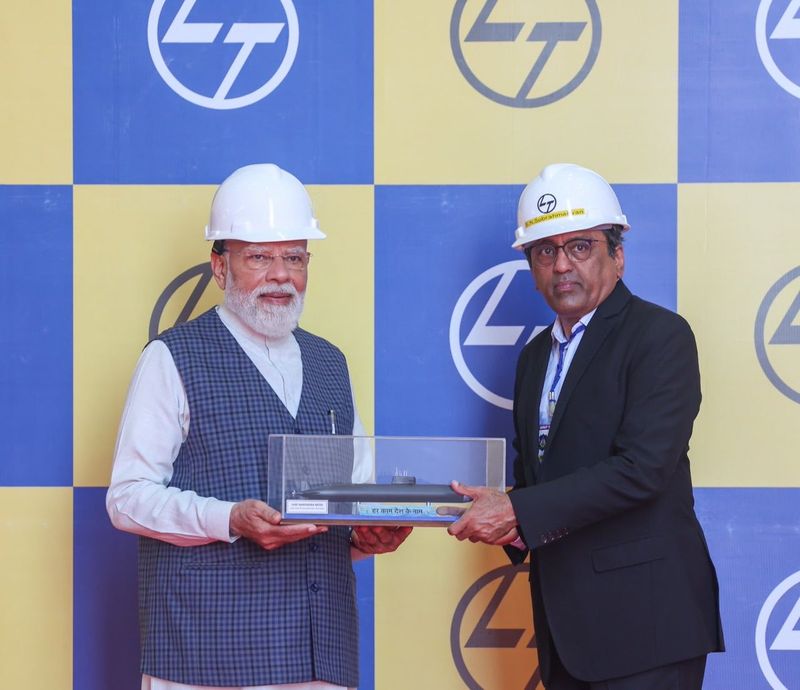

Prime Minister Narendra Modi’s visit to Larsen & Toubro’s (L&T) facility at Hazira, Gujarat, marked a ‘moment’ for India’s undersea warfare ambitions.L&T chairman and managing director SN Subrahmanyan presented a scaled-down model of the upcoming ‘Project 76’ to the PM on Friday, India’s indigenous conventional submarine programme.India’s submarine force is structured across Project 75, Project 75-I, Project 76 and Project 77. Project 75 includes six Kalvari class submarines that has been completed in collaboration with Naval Group of France; Project 75-I which is soon to be signed to make six next-generation subs with German firm ThyssenKrupp Marine Systems (TKMS) and Project 77 covers indigenous nuclear powered submarines — known as SSN.These are part of the Indian target to 24 submarines of credible deterrence. The Navy presently has 16 conventional submarines, other than the six Kalvari class, the others are more than 30-year old.As PM Modi posted a picture of receiving the model of the submarine, industry insiders quickly identified the distinct design lines of the submarine being from what would be the future — a conventionally powered diesel-electric attack submarine, but with a new technology called air independent propulsion (AIP) — which allows a vessel to remain submerged for longer periods.The Project 76’s detailed design completion could be done within this fiscal. For decades, India has relied on foreign original equipment manufacturers (OEMs) for conventional submarine designs like the French for the Kalvari class, the Germans for the next one or Russian for the Kilo class of the 1980s.Under Project 76, the Navy is aiming for an initial indigenisation rate of around 75 per cent, which will eventually scale up past 90 per cent. Everything from the sonars, communication suites, periscopes and weapon control systems to the actual structural steel are aimed to be entirely homegrown.While the current AIP modules are scheduled to retrofitted onto the Kalvari class, the one for the Project 76 vessels would have greater output to support powering of a larger hull.The Project 76 is being designed to utilize high-end indigenous lithium-ion battery banks, dramatically boosting underwater sprint speeds and energy retention.The L&T, for the past three decades has been part of the Advanced Technology Vessel (ATV) project that delivered three Arihant-class nuclear-powered ballistic missile submarines (SSBNs), with fourth one set to be commissioned.