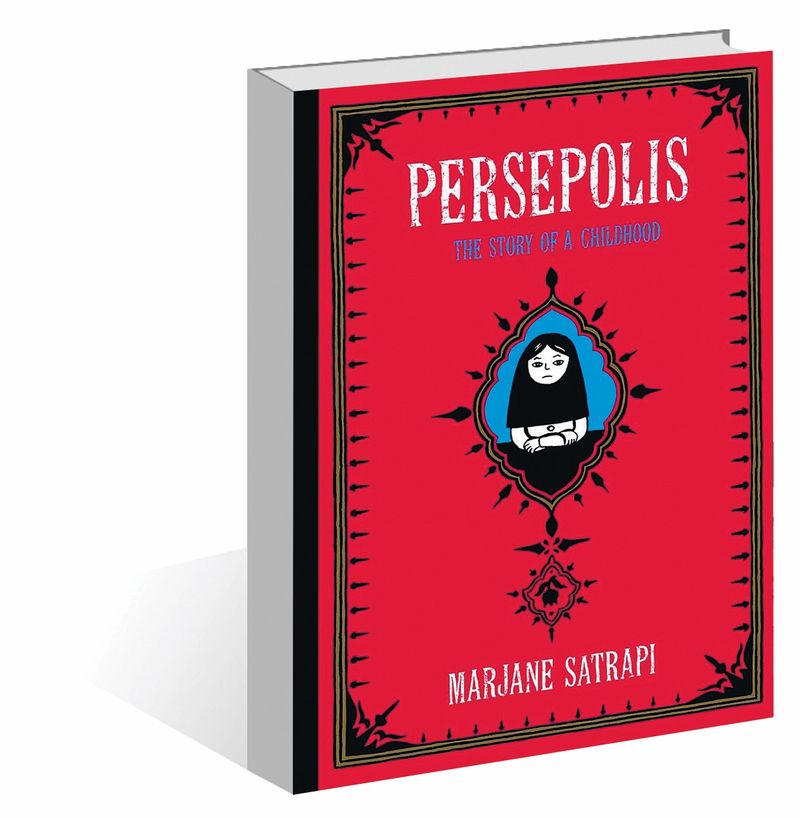

“I’ll be a prophet.” In ‘Persepolis’, a young Marji tells anyone who asks her what she wants to be. At 56, its author Marjane Satrapi, who died of “sadness” on June 4, would have made her younger self proud. “I wanted to be justice, love and the wrath of God all in one,” young Marji dreamt.Fearless, an icon for the cause of women, freedom and Iran, Marjane fought for justice and love — and lost. Her wrath, powerful as it was, did not lead to revolution. Nor did the hundreds of Iranian women who died. But as she said in the bio-note of her last book, ‘Women Life Freedom’, she did try to move heaven and earth.Her graphic memoir of growing up in revolutionary Iran burst on the literary scene in 2002 to become a cult. ‘Persepolis’ was unique — raw, tender, funny, wise and heartbreaking, all at once; a voice so powerful, it knocks you out. Marjane single-handedly, with the swish of her line drawings, changed the way Iranians were seen. Not as terrorists, but as listeners of punk rock, witty, gossip traders, secret dancers hiding in basements to prevent being caught by the moral police, to party, to eat.They were defiant, they were funny; and not all of them were fundamentalists. They were ordinary, relatable and real. The book sold in millions. It would later be turned into an animated film and go to the Oscars. Her silence is — and will be — deafening.For Marjane, the personal was political. In her monochrome world, you found her colourful grandmother who tucked jasmine in her bosom. ‘Embroideries’ was her memoir about women sipping tea in the afternoon, talking about love, sex and marriage — a love letter to the feistiness of her grandmother who had three husbands. Her mother smoked, a habit Marjane later acquired. She wrote about her father who drove a Cadillac before the revolution; her revolutionary uncle Anoosh, who was executed. “Our family memory must not be lost,” he tells Marji, turning her into a chronicler.“I believe that an entire nation should not be judged by the wrongdoings of a few extremists,” she wrote in the Preface of ‘Persepolis’. “I also don’t want those Iranians who lost their lives in prisons defending freedom, who died in the war against Iraq, who suffered under various repressive regimes, or who were forced to leave their families and flee their homeland to be forgotten.”Ink-black hair, red lipstick, puffing away at a cigarette… even on stage, Marjane was a rebel. She turned rebellion into a black and white memoir of growing up in Iran. She chafed against the headscarf, being invisible, or being docile protesting on the streets. In Iran, she fought the imposition of the religious orthodox, throwing her weight behind the women’s uprising in 2020 that erupted over the refusal of wearing the headscarf. And when France, where she lived in exile, banned hijabs in public spaces, she fiercely opposed it.“On one hand, I hate the veil because they force me to put it on my head and I hate it,” she told actress Emma Watson in an interview to Vogue. “On the other hand, who am I to say to somebody who wants to put a scarf on her head, ‘Don’t do it’?” She would refuse the Légion d’honneur, France’s highest order of merit, because of “hypocritical attitude toward Iran”.Intimately acquainted with loss, she lived in exile in France, but Iran would remain home — a place she could never return to. She left home at 14. It was the only way to keep her safe. She returned to Tehran later, broken and after spending three months on the streets in Europe to a country bleaker than before. “I learned something essential: we can only feel sorry for ourselves when our misfortunes are still supportable… Once the limit is crossed, the only way to bear the unbearable is to laugh at it,” says Marji in ‘Persepolis 2’.Heartbreak — whether it was the kind that her uncle Anoosh lived with away from his girls; or what her uncle Nasser Ali Khan, a musician who chooses to give up on life after his favourite violin is broken (‘Chicken with Plums’), felt — is palpable in her pages. In many ways, her stories mirrored her own proof that sadness is carried, inherited and lived with. She had learnt to fashion it into courage, turned humour her defence and ultimately succumbed to it.Her inspiration was Madame Curie. In 2019, she made a film, ‘Radioactive’, with Rosemary Pike, to honour the scientist. “I wanted to be an educated, liberated woman and if the pursuit of knowledge meant getting cancer, so be it,” says Marji in ‘Persepolis 2’. Her dream was fulfilled in its entirety. She lived with the pain of her husband Mattias Ripa dying of cancer. Poignantly, the only 10 posts on her Instagram account are dedicated to Mattias: I-lost-the-love-of-my-life-Mattias. They had been together since 1996. Her last post was from earlier this year to announce the creation of the Mattias and Marjane Ripa-Satrapi Cinema Foundation to support foreign students to study film in Paris. She died a year after him, of sadness, as her family described it — a poetic word hiding in elegance but speaking of the unbearable pain she could not live with.Her life has now been reduced to just the circumstances surrounding her death. The reason for her passing eclipsing her brief, blindingly bright and bold life. Marjane’s life needs to be celebrated. She was unique, authentic and hard to put in a box. Her death is a reminder of the fragility of life, the fatality of love sometimes and the finality of death — and a woman who, as she told Watson, wanted to live.“So I have only this one life to live,” she said. “I cannot just sit and be depressed because… I’m going to die. Very soon… And there are things that I want to do, there are things that I want to eat, there are laughs that I have not had. I hope that I will meet lots of new people. I hope that I will have two or three other professions.”— The writer is a literary critic