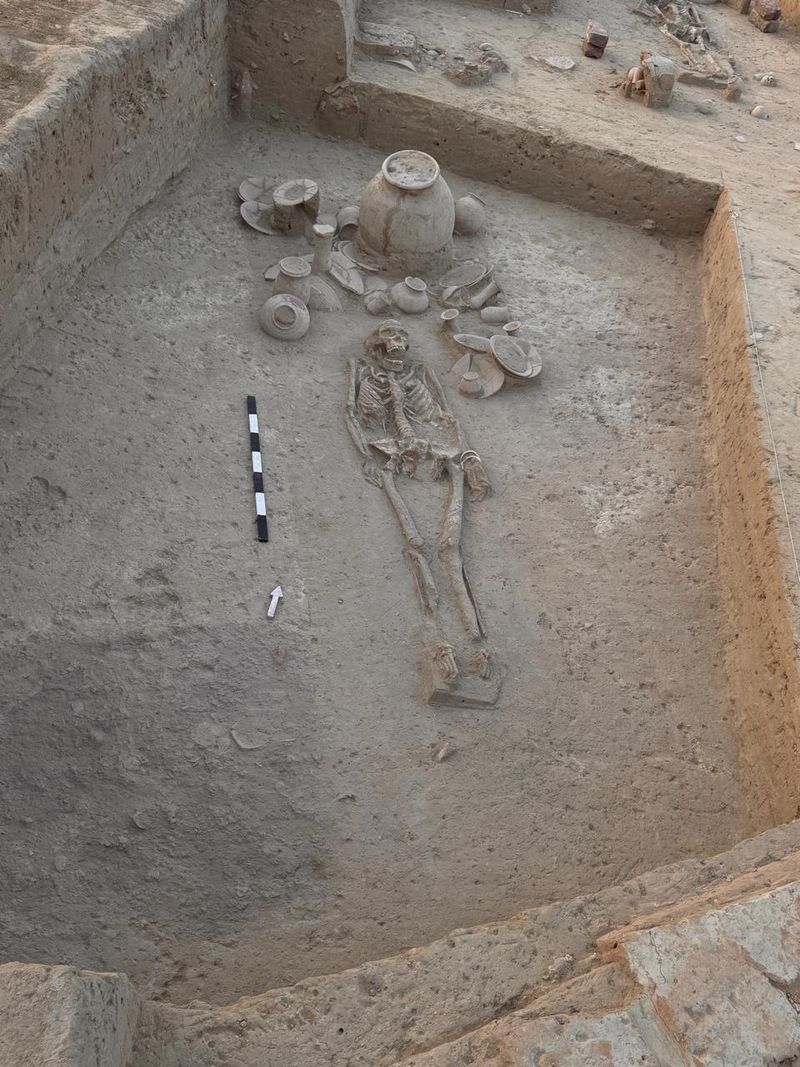

The Archaeological Survey of India (ASI) has made a significant discovery during excavations at Rakhigarhi, believed to be the largest site of the Indus Valley Civilisation (IVC), with the recovery of eight skeletons from a mature Harappan burial site at Mound No. 7.Manoj Saxena, Superintending Archaeologist, ASI, told The Tribune over the phone that five skeletons had been retrieved from the burial site so far. Three of these had been sent to the Anthropological Survey of India (AnSI) in Kolkata for examination and analysis, while samples from one skeleton had been sent to the Birbal Sahni Institute of Palaeosciences (BSIP), Lucknow, for DNA extraction and analysis, he said.Saxena said the AnSI collected the skeletons yesterday and was expected to prepare its analysis report within two to three months. Two of the skeletons were of women in their 40s, while one was that of a male. “The bodies were found in the cemetery at Mound No. 7. For the first time, we found nearly 40 pottery offerings with each of these bodies. Earlier, the highest number of pottery offerings found with any skeleton was 27. We also found shell bangles on the hands of female skeletons and gold beads around them,” he said.He added that three of the skeletons were found damaged, apparently due to agricultural activities carried out at the site over the years.Excavators from the ASI and Deccan College, Pune, have recovered around 70 skeletons from the site over a couple of decades. The ASI began excavations at the 550-hectare site on February 22 this year and concluded the exercise earlier this month. The official said excavations at Mound No. 7, the cemetery area, began in May and the skeletons were recovered during the course of digging.He said the excavation also yielded pottery, hearth remains and domestic-use materials, offering a glimpse into the lives of people who lived there around 4,000 to 5,000 years ago.For the first time, the ASI also carried out excavations at Mound No. 5, where it discovered residential structures, beads, pottery and objects of daily use, suggesting that the area was an important social, economic and cultural hub of its time.According to ASI officials, all skeletons and artefacts recovered during the excavation season will undergo scientific analysis. They said many more secrets remained buried beneath Rakhigarhi, with the potential to further enrich understanding of one of the world’s earliest urban civilisations.