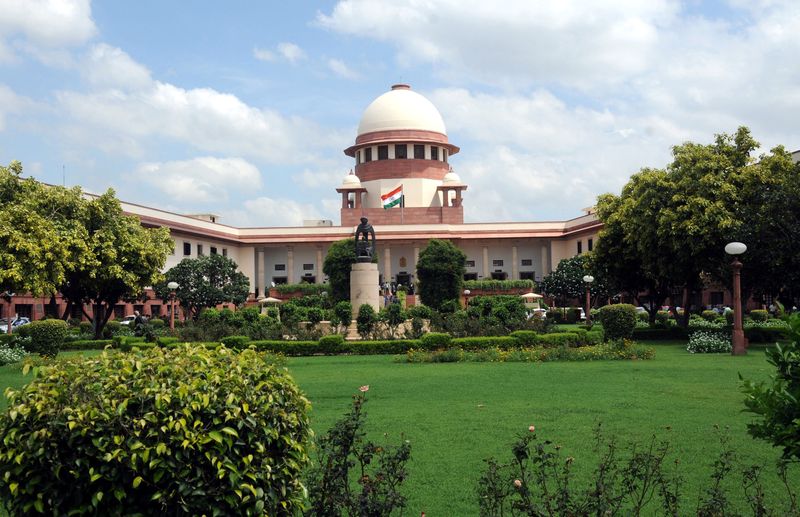

A remission policy framed by a state government under the Governor’s powers under Article 161 of the Constitution shall override a statutory policy framed under provisions of the CrPC, the Supreme Court has ruled.A bench led by Justice Sanjay Karol on Wednesday held that Haryana’s 2002 remission policy based on the Governor under Article 161 will hold the field despite the state framing a new policy in 2008 using its statutory powers under Sections 432 and 433 of the CrPC.“Since the 2002 policy stood framed under the Constitution and such power is to be exercised by the Governor himself, the subsequent Policy of 2008, cannot deter the effect of the former and the observation that it supersedes the 2002 policy, is untenable in law,” said the bench which also included Justice N Kotiswar Singh.Writing the judgment for the bench, Justice Karol said, “It need not be said that a statutory policy cannot override an exercise of power under Article 161, for that power is distinct and independent, uninfluenced by any other power, more so statutory in nature.”The top court, however, clarified that its findings in this case shall apply prospectively and shall not operate to reopen any applications for remissions that had already been decided.“In effect, now the respondent state shall have two distinct and separate policies functioning. How it is that the state wants to proceed further is for them to decide,” it said.On a petition filed by one Parveen Kumar alias Parveen Chauhan, the top court examined if his application for grant of remission will be governed by the State of Haryana’s ‘Policy Regarding Release of Life Convicts 20021’ dated April 12, 2002 or the subsequent policy dated August 13, 2008 termed as ‘Premature Release of Life Convicts 2008’ as notified by Jails and Judicial Department, Government of Haryana.Allowing Chauhan’s appeal, the top court directed the Haryana Government to take a decision regarding his remission application consistent with this judgment within four weeks. “Let a copy be sent to the Chief Secretary, Government of Haryana, by the Registry of this Court within four days for onward action to be taken by the appropriate authority,” it ordered.Chauhan was convicted of murder of a 12-year-old child, on January 4, 2009 in connection with FIR No. 670 of 2007 dated September 25, 2007 lodged at PS City, Gurgaon. He was sentenced to life imprisonment under Section 302 IPC, five years of imprisonment under Section 365 IPC, and two years under Section 201 IPC.The Punjab and Haryana High Court July 16, 2013 partly allowed his appeal and set aside the conviction under Section 365 IPC. The Supreme Court dismissed his appeal against the high court’s judgment on September 15, 2015.On May 26, 2022, Chauhan filed a representation seeking his release on the basis of the 2002 Policy, having served 14 years of actual imprisonment. As he received no response, he filed a writ petition against his pending representation, which was disposed on August 16, 2022, directing the prison authorities to decide the same within a period of three months.The prison authorities rejected his representation on October 20, 2022, saying his case would be governed by the 2008 policy and not the 2002 Policy. They said as per the 2008 Policy he had completed only 13 years 7 months and 16 days of actual imprisonment and 16 years five months and 16 days of total imprisonment as on 21st September 2022 and as such was not eligible for remission as he had not completed the requisite period of twenty years of actual sentence and 25 years of total sentence.He then filed another writ petition challenging the decision by placing reliance on State of Haryana v. Jagdish (2008). The high court dismissed his petition.