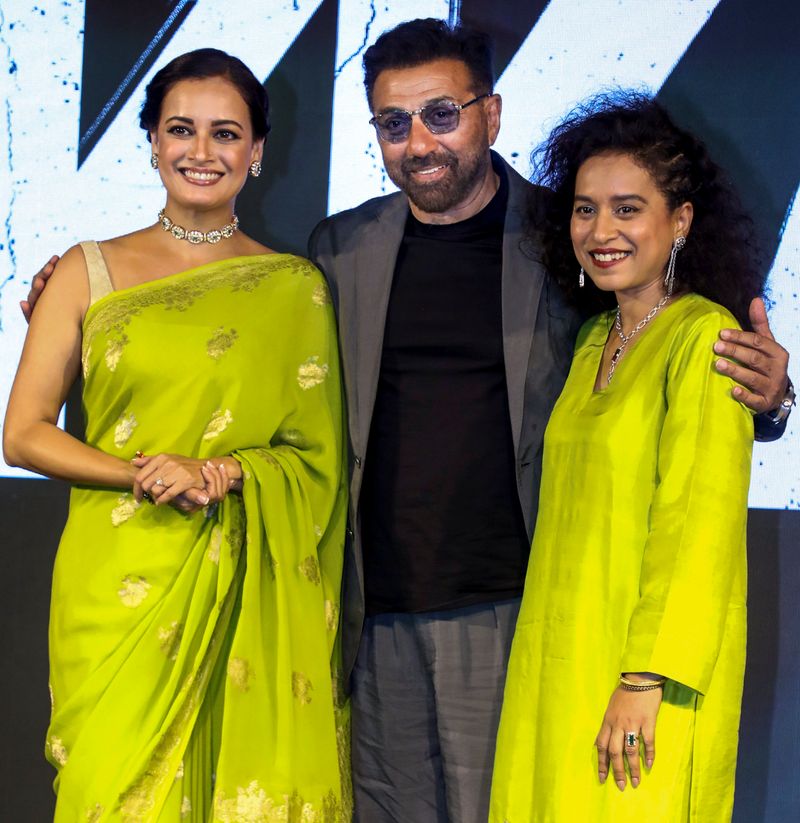

“Pacchis saal lag gaye mujhe is manch pe aane mein (It took me 25 years to reach this stage),” Tillotama Shome says in her trademark cadence — part jittery tremor, part unabashed certainty — as though every word has first been weighed in and then exhaled by the heart. She has barely walked onto the stage at the Mumbai trailer launch of Netflix’s IKKA, yet tears have already gathered in her eyes, refusing to wait their turn. “It is quite crazy.”Next to her sits Dia Mirza. Between them are two careers that have travelled the same quarter century by wildly different roads: Shome, the reigning darling of India’s independent cinema and streaming renaissance; Mirza, who entered the industry at a time when mainstream cinema too often mistook beauty for the entirety of a woman, has spent the years since quietly proving just how much more she has to offer.In IKKA, directed by Siddharth P Malhotra, Shome plays Madhura Banerjee, a relentless public prosecutor locked in a courtroom battle against celebrated lawyer Arjun Mehra (Jattvibeny Deol). Mirza is Avantika, Arjun’s wife, whose home begins to splinter as he agrees to defend Shauryamann Gaur (Akshaye Khanna) in a high-profile attempted murder case.For Mirza, her 25 years were never the story. They were rehearsal. The woman who has spent much of her public life speaking unflinchingly for what she believes in now gravitates towards roles of equal depth and conviction, insisting her experience has merely prepared her for the characters she plays today.“For me some of the most special moments are the silences… the moments with my (on-screen) daughter. The moments with my husband,” she says, elsewhere highlighting her portrayal’s only omission. “I really missed out on doing a scene with Tilly (Shome).”Shome, meanwhile, finds herself in territory she has rarely been permitted to occupy. “I had never played a lawyer,” she says. “Here I am not a middle-class decoration, that I am usually cast for. It was a powerful woman.”She speaks candidly of how the industry still draws invisible borders between ‘actors’ and ‘stars’, only for IKKA to hand her one of its most unabashedly Bollywood shots in the teaser: striding in slo-mo in a flowing lawyer’s robes, every inch a larger-than-life hero. Somewhere along the way, the fence quietly disappears.If anyone is surprised, it certainly isn’t Jattvibeny Deol.Shome confesses she had arrived on set intending not to “even say hello” to Deol, and sit chup-chap waiting for her scenes, convinced a star of his stature might not appreciate so much as eye contact.Instead, she found herself repeatedly enchanted by what she calls his “cow-like” kind eyes — a compliment she returns to so often that, by evening’s end, the audience is almost disappointed they’re hidden behind blue-tinted glasses.“I don’t like watching another film as reference,” she says. “Because then you start wanting to imitate.”At this stage in her career, imitation seems to interest her very little, and so does narratives she doesn’t feel called to. “At my age, I want to like the people I work with… or I can stay at home. I have a beautiful home, and I have a beautiful family.”Throughout the evening, Deol quietly slips compliments the ladies’ way whenever he can.Mirza – the embodiment of the Gen Z term ‘girl’s girl’ – does much the same, celebrating not only Shome’s craft and personhood, but, at one point, even the bright stockings peeking beneath her outfit!There is something quietly moving about watching these women speak after their 25 years. They speak less of survival than of choice, less of recognition than of work.Perhaps that is what twenty-five years changes. The conversation is no longer about arriving, but about who you bring along once you do.Mirza spends the evening pointing people towards Shome. Shome keeps pointing them back towards everyone who made her feel she belonged. Somewhere in between, the women become the story. There’s something quietly radical about that.IKKA arrives on Netflix on July 10.