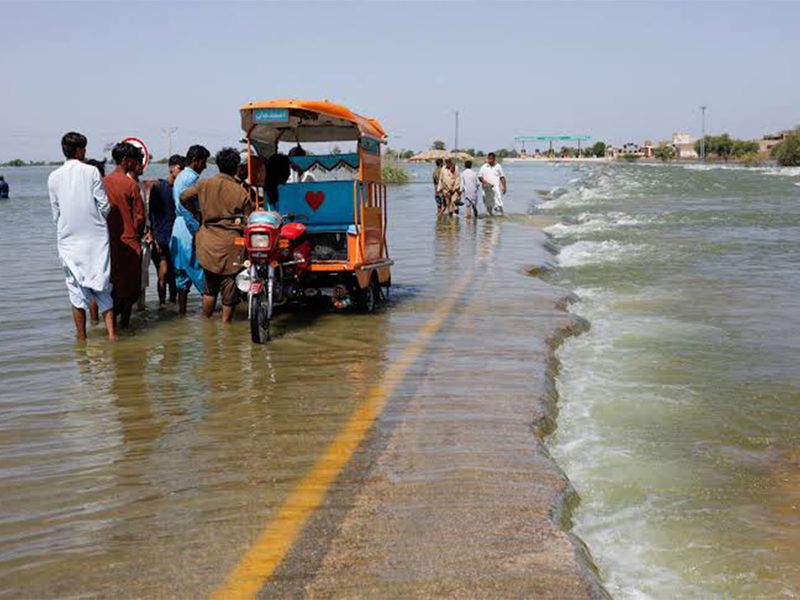

Rawalpindi [Pakistan], July 10 (ANI): Exposing a glaring collapse of municipal governance and administrative failure in Pakistan, the arrival of the monsoon season has left the residents of Rawalpindi stranded amidst heavily dug-up roads and chronic traffic chaos, according to a report by Dawn.The civic infrastructure in the garrison city has virtually crumbled as multiple arterial roads across downtown areas remain heavily excavated following a series of incomplete projects by the Water and Sanitation Agency (Wasa). The civic body completely failed to execute the works despite a strict June 30 deadline previously mandated by the Punjab government.The critical construction of a sewerage nullah from Ganjmandi, designed to link with Leh Nullah, remains unfinished, while poorly managed water supply lines along Saidpur Road continue to pose immense hazards for daily commuters.Dawn reported that, in anticipation of the torrential monsoon season, the Punjab provincial administration had ordered the absolute closure of all urban digging activities by June 30, subsequently imposing a total ban on road excavations until September 15. Wasa, however, failed to meet the timeline.The administrative inertia is tied to a massive PKR 5 billion development programme broken into three slow-moving packages.Under Package 1, an estimated PKR 1.3 billion was designated for laying sewerage lines across Dhoke Hassu, Dhoke Ratta, Pirwidhai, Mohanpura, Khayaban-i-Sir Syed and Dhoke Najju. Out of a targeted 150,439 feet of sewer lines, the department has managed to lay a negligible 7,704 feet of pipeline.The systemic stagnation extends into Package 2, where PKR 1.18 billion worth of civic works spanning New Katarian, F. Block, Saidpur Scheme, Eidgah, Dhoke Babu Irfan, Pindora, Malpur, Satellite Town, Asghar Mall and B & D Blocks has yielded just 8,500 feet of pipes out of a required 136,331 feet.Meanwhile, Package 3 allocates PKR 1.267 billion for Hamilton Road, Dingi Khoi, Jamia Masjid Road and Qadeemi Imambargah, where merely 900 feet of a 6,000-foot sewer line has been completed so far.Defending the institutional paralysis, Wasa Managing Director Azizullah Khan told Dawn that the initial phase across all three packages was near completion, claiming the agency would look to wrap up the first phase within a week or two.The official added that the subsequent phase is slated to commence by September 15, aiming for completion before the arrival of the next summer season. He further stated that he had instructed the concerned contractors to scale up their workforce to ensure the execution of these delayed infrastructure developments.Faced with severe public backlash, Khan deflected blame on to the state-enforced lockdowns in April, alongside consecutive public holidays for Eid and Muharram. He noted that while these disruptions delayed operations for more than 28 days, the pending work would likely wrap up in a week or two.However, trapped under the weight of an inefficient state machinery, local residents and motorists expressed deep outrage over the sluggish pace of work, which has severely disrupted schoolchildren, emergency patients and merchants across key trading hubs like Raja Bazaar, according to the Dawn report.Disgruntled citizens suggested that instead of paralysing entire commercial zones by tearing up complete stretches simultaneously, the civic body should have utilised a staggered 10 to 15-foot excavation-and-fill method.Highlighting the everyday perils of navigating a failing city, a local motorist, Mohammad Raffique, observed that traffic jams had become the order of the day in the area, explaining that commuters had been facing severe distress for the past three months and emphasising that venturing out on the dug-up roads is a risky affair.Echoing the frustration with the public utilities, Nasir Mehmood, a resident of Saidpur Road, pointed out that the open trenches pose a profound threat not just to motorcyclists but to cars as well, adding that the government should have operated in double shifts to expedite the work.Furthermore, Iqbal Hussain, a resident of Akaal Garh, lamented that despite commencing these intrusive infrastructure works in March, the authorities failed to complete even a simple one-kilometre stretch of road, leaving locals to suffer the consequences of administrative incompetence. (ANI)(This content is sourced from a syndicated feed and is published as received. The Tribune assumes no responsibility or liability for its accuracy, completeness, or content.)