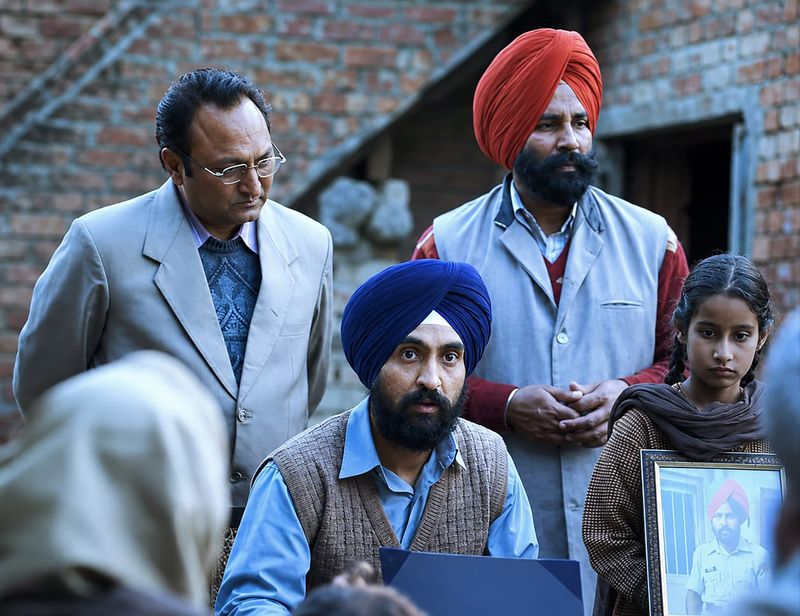

Even as gurdwaras and villages across Jalandhar and its outskirts host special screenings of the controversial film “Satluj” following its ban on streaming platform ZEE5, the film is also drawing attention for the brief yet significant appearances of two actors from the city.Jalandhar-based advocate, theatre artiste and actor Neeraj Kaushik plays a human rights activist who accompanies the film’s protagonist, Jaswant Singh Khalra, portrayed by Diljit Dosanjh, on visits to victims’ families. City-based artiste Santosh Basra appears as a neighbour questioned by a CBI team searching for one of the characters.Kaushik has previously appeared in projects such as “Kohrra” —where he shared screen space with Suvinder Vicky, who also features in “Satluj” — and “Sadda Haq”, another film set against the backdrop of Punjab’s militancy era. According to Kaushik, while the makers expected some controversy because of the film’s sensitive subject, the scale of the backlash took them by surprise.“‘Satluj’ was conceived in 2019 and shooting began in late 2020. At the time, many politically correct films were being made, and Honey Trehan and the team never imagined that a film depicting events from Punjab’s past would face objections of this magnitude. The film neither criticises any current political dispensation nor endorses separatist ideology. Therefore, such a large-scale controversy was unexpected, especially since approvals had been obtained from Jaswant Singh Khalra’s family as well as the SGPC. We expected some debate because of the subject, and there were a few permission-related issues during filming, but nothing on this scale,” he said.Recalling his experience on the sets, Kaushik said his role was inspired by the network of human rights activists who worked alongside Khalra.“The work of human rights activist Ram Narayan Kumar, author of book “Reduced to Ashes”, along with several other activists who supported Jaswant Singh Khalra, is well known. I and several other actors portrayed human rights workers associated with Khalra. I was selected after an audition by casting director Varun Bajaj. Honey Trehan liked my audition. We shot for eight days across Amritsar, Tarn Taran, Chandigarh and Patiala. I have great admiration for Honey Trehan. He is a wonderful human being and his research is meticulous. We even filmed in villages where actual disappearances had taken place during the 1990s,” he said.Kaushik shared screen space with both Diljit Dosanjh and Arjun Rampal, and spoke warmly about working with the two actors.“Diljit Dosanjh is generally reserved on set, but he enjoys discussing important issues at length. He is deeply spiritual and very protective of junior artistes, speaking up whenever he feels they are not being treated fairly. Once, I asked him how he managed his hectic schedule and superstardom. He simply replied, ‘Kuch nahi haiga yaar, sab ainwai dooron lagda, asi vi onne ku hi khush ya pareshan haan jinna aam banda’ (Stardom seems big from afar. We are as happy or as troubled as any ordinary person),” he recalled.Speaking about Arjun Rampal, Kaushik said, “He was extremely open, candid and free of any star tantrums. He interacted warmly with everyone on the set and had a very relaxed, easy-going personality. Among the film’s performances, his portrayal is one of my favourites.”Actor and singer Santosh Basra made a cameo appearance in the film Satluj.Reflecting on the growing number of OTT films and series centred on Punjab’s social and political issues, Kaushik observed that the state’s changing realities have provided filmmakers with compelling subjects.“In Punjab, ‘Pehle pyaar mudda tha, ab takraar mudda hai’ (Earlier, love was the dominant theme; today, conflict is). Earlier, Punjabi stories revolved around legendary romances like ‘Heer Ranjha’, ‘Sassi Punnu’ and ‘Sohni Mahiwal’. But the state’s complex social and political realities have made Punjab fertile ground for filmmakers. Just as Anurag Kashyap often turns to Uttar Pradesh or Bihar to explore gang violence, filmmakers increasingly look to Punjab for stories about drugs, militancy, policing and conflict. These films are reflections of both the state’s past and its contemporary upheavals.”Jalandhar-based actor, singer and artiste Santosh Basra, who also makes a cameo appearance in the film, says, “It was a beautiful and serious project. Working on the film was a great experience. The controversy surrounding it was something we anticipated, as people have not forgotten 1984 and its aftermath. It was also long felt that a film on Khalra Sahib’s life and work needed to be made. This is an issue that resonates across communities in Punjab, as children from both Hindu and Sikh families lost their lives during those years.”“On the sets, it felt like one big family. I feel proud to have been associated with such an important cinematic project of our times,” she says. Besides Neeraj Kaushik and Santosh Basra, several theatre artistes and actors from the region are part of the film, including Jalandhar-based theatre personality and actor Gurwinder Singh, Haryana-based theatre artiste and actor Rajindra Sharma (Nanu), and theatre actor Emmanuel Singh, among others. Rajindra has been a familiar presence in Jalandhar’s theatre circles and has also appeared in several Bollywood films.