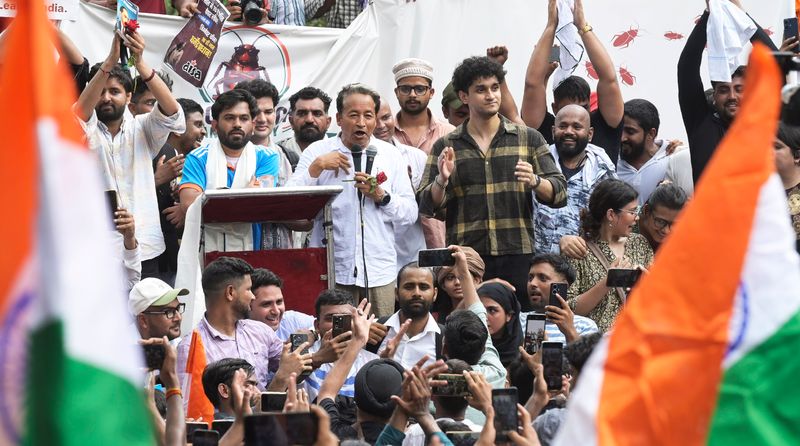

The Cockroach Janta Party’s (CJP) agitation at Jantar Mantar has for over three weeks revolved around one immediate demand, the resignation of Union Education Minister Dharmendra Pradhan over the NEET-UG paper leak.However, the movement on Monday attempted to shift from protest to policy, releasing a five-point examination reform charter, a copy of which is with The Tribune, that seeks to redesign how India’s public examinations are conducted and monitored.Far from being a list of demands, the charter proposes changes that would require new legislation, fresh institutions, administrative restructuring and greater parliamentary oversight. If implemented, the proposals would alter not only how examinations are conducted but also how governments are held accountable if they fail.A new law that shifts accountability to the governmentAt the centre of the charter is a proposal to replace the existing anti paper leak law with a Public Examinations (Transparency, Accountability and Candidates’ Rights) Act. Unlike the present framework, which largely focuses on punishing offenders after a leak, the proposed law seeks to make governments and examination authorities answerable for every failure.Among its key provisions are mandatory parliamentary explanations after every paper leak, automatic judicial inquiries headed by retired Supreme Court judges, creation of an independent Examinations Ombudsman and a National Examination Vendor Authority to regulate private agencies involved in conducting examinations. The proposal is aimed at expanding institutional oversight and requires new statutory bodies, reporting mechanisms and compliance systems to function.Replacing agencies, not merely reforming themPerhaps the most far-reaching proposal is the recommendation to dissolve the National Testing Agency and replace it with a statutory National Testing Commission. Rather than suggesting internal reforms, the charter argues for rebuilding the country’s central testing architecture through a new institution with permanent staff, defined governance and compulsory annual audits.The proposal also seeks to convert the Staff Selection Commission (SSC) into a statutory body, fix annual examination calendars and ensure recruitments are completed within a year. If pursued, these changes would require a large-scale administrative transition affecting recruitment processes, staffing and coordination across ministries. The charter further seeks annual publication of vacancies and advance disclosure of posts before recruitment begins, measures aimed at reducing uncertainty among aspirants.Making examination delays legally costlyThe charter’s proposed Students’ Rights Charter would fundamentally change the relationship between candidates and examination authorities by turning several administrative assurances into enforceable rights.Instead of waiting for governments to announce relief after controversies, candidates affected by paper leaks or cancelled examinations would automatically become entitled to fee refunds, free re-examinations, compensation and protection against losing attempts or crossing age limits because of administrative failures. The proposal also seeks legally guaranteed timelines for grievance redressal, advance notice before major examination changes and greater transparency through access to answer keys, evaluated response sheets and normalisation methods.If implemented, examination bodies would face legally defined obligations towards candidates rather than discretionary responsibilities, requiring stronger grievance redressal systems and tighter adherence to examination schedules.Extending reform beyond the examination hallThe charter goes beyond examination conduct by proposing a National Aspirant Welfare Fund to support families of candidates who lose their lives following paper leaks. It also seeks mandatory mental health counselling through coaching institutes in major coaching hubs and regulation of coaching centres through fee transparency and restrictions on misleading advertisements.These proposals expand the scope of examination reforms beyond testing agencies, bringing coaching institutions and student welfare into the broader policy framework. Their implementation would require coordination extending beyond examination authorities alone.Parliament as a permanent watchdogInstead of limiting scrutiny at the time of controversy, the charter seeks permanent parliamentary oversight of the examination system. It proposes a Permanent Parliamentary Standing Committee on Education, a White Paper reviewing examination failures and recruitment delays over the past 12 years, independent auditing of the implementation of the K Radhakrishnan Committee’s recommendations and an annual Students’ Rights Report before Parliament.Taken together, the proposals seek to institutionalise continuous monitoring of examination authorities rather than relying on periodic responses after major controversies.The charter also contains proposals that would require policy decisions extending beyond central examination agencies. These include allowing states to opt out of NEET for state quota medical seats while seeking greater state representation in deciding the examination syllabus, as well as capping fees by reserving half the seats in private medical and professional colleges at rates equivalent to government institutions. Such measures would involve multiple stakeholders and wider policy changes beyond the examination process itself.Vaishnavi, official spokesperson for CJP and public policy expert said, “Despite repeated paper leaks over the past decade, there is still no official database of examination leaks and virtually no accountability.”She pointed out that even after the enactment of the Public Examinations Act, there has not been a single conviction under the law.“The current law has failed to protect students. We need reforms that put students, not the bureaucracy, at the centre of the examination system.”Educator weighs inKeshav Agarwal, president of the Coaching Federation of India, questioned the practicality of some proposals in the CJP charter, arguing that reforms should focus on reducing human intervention rather than creating additional committees.He stressed on involving people who know how exams are conducted. Reacting to CJP’s charter he said, “CJP doesn’t know how it works, they do not have experience or technical knowledge. Their charter is not practically feasible of ensuring leak-proof examination. It talks more on change, but that change would not be effective.”He said replacing the National Testing Agency (NTA) with another body alone would not solve the problem unless the examination infrastructure itself was strengthened. Conducting an examination such as NEET for nearly 24 lakh candidates across about 5,500 centres requires an enormous operational network, making it unrealistic for any agency to maintain permanent staff at every examination centre, he said.According to Agarwal, the long-term solution lies in creating government-controlled examination infrastructure instead of relying on private centres.“The more human handling a question paper involves, the greater the possibility of a leak. Minimise human intervention and invest in technology,” he said.He also advocated replacing manual biometric verification with technology similar to Digi Yatra’s facial authentication system. Such a system, he said, could verify candidates automatically using Aadhaar-linked authentication, reducing dependence on outsourced personnel and limiting opportunities for impersonation.Agarwal argued that technology, rather than additional oversight bodies, should be the focus of future reforms. While parliamentary committees may improve accountability, he said they cannot by themselves prevent paper leaks.“You have to build a robust examination infrastructure. Technology should do the work wherever possible. The more humans you involve, the greater the risk of leaks,” he said.