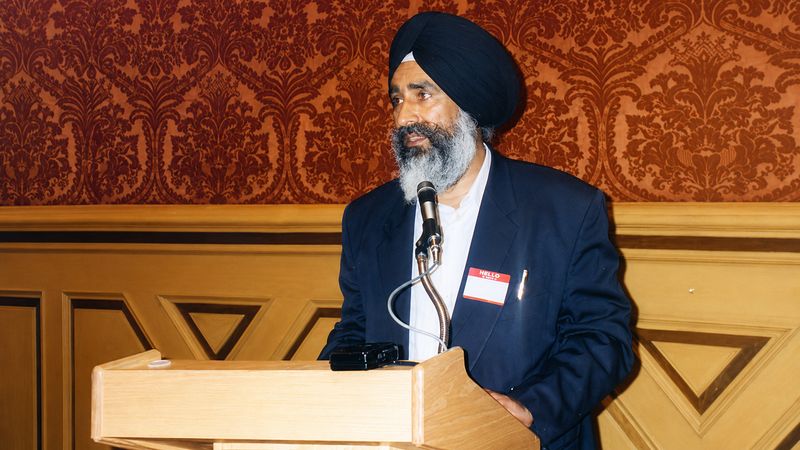

Long before Jaswant Singh Khalra exposed the staged police killings of Punjab’s militancy years, his family had already spent two generations fighting power, first against the British, then against the state, and even against religious leaders.A book, “Reduced to Ashes”, written by human rights activist Ram Narayan Kumar along with Amrik Singh, Ashok Agrwaal and Jaskaran Kaur, traces this family history in detail. Kumar had guided Khalra in his early investigation into the disposal of unclaimed bodies by Punjab Police. He later settled in Vienna and died in 2009.Khalra village lies in Tarn Taran district, on the border with Pakistan. Its Sikh settlers trace their descent to a group that took the region in 1714 as part of the peasant militia raised by Banda Singh Bahadur, the general who broke Mughal domination in Punjab. The Khalra family’s own ancestor, Sardar Surat Singh, led that founding group. A monument to him still stands in the village.Jaswant’s grandfather, Harnam Singh, left for Shanghai before the First World War looking for work. There he joined a circle of Indian revolutionaries led by Gurdit Singh, who went on to lead the Ghadar movement against British rule. The British arrested Harnam Singh in 1915 and tried him with the other Ghadarites. He was acquitted, but the government interned him in his own village until 1922. It was during this house arrest, in 1917, that his son Kartar Singh, Jaswant’s father, was born.When his internment ended, Harnam Singh went back to Shanghai and never returned to India. Kartar Singh grew up without a father. The family had four acres of land, and saline groundwater made farming difficult. His mother sold milk from two buffaloes to keep the household running.Kartar Singh’s own fight took a different shape. He studied at an Arya Samaj school in Patti but left, finding it hostile to Sikh faith and practice, and moved to a Khalsa school in Sarhali, finishing his matriculation in 1936. His own grandfather had been a leading figure in the Singh Sabha reform movement and had donated land for a Khalsa school in the village. This connection brought Kartar Singh close to Akali Dal leader Master Tara Singh, who helped him get work at the SGPC headquarters and later at the Khalra school.But Kartar Singh grew unhappy with the Akali Dal’s approach under Tara Singh, especially what he saw as its anti-Muslim positions. He joined the Congress party instead and became secretary of its local committee. He believed the communal tensions of the time had less to do with faith and more to do with leaders using grievance to build followings.Khalra village had a Muslim majority, and Kartar Singh remembered peaceful relations among communities until the final months before Partition in 1947, when stories of violence turned neighbours into enemies. He watched Muslim families he had known all his life driven out or killed. He came to believe that India’s freedom had, in some ways, become Punjab’s loss, since the border and the wars that followed undid the very freedom his father had sacrificed for. He later grew disillusioned with Congress too, especially after the government took over his school in 1961, and eventually stopped voting altogether.Jaswant Singh Khalra was born in 1952 in the same village where his grandfather had once been confined. He was the youngest of four brothers and had five sisters. His father insisted all his children get an education, though the family lived on a teacher’s modest salary. Prominent visitors, including a future Vice President of India, came to their home for advice on local matters. Vinoba Bhave, the Gandhian land-reform leader, once stayed with the family during a visit to the village.By the time Jaswant reached Bir Baba Buddha College in Jhabaal, he called himself a “scientific socialist.” He led protests against black-marketeering in fertiliser and against abusive police officials, and in 1972 led a students’ strike across Punjab against a hike in cinema ticket prices. It led to his first arrest.In 1975, when the Punjab government offered pensions and honours to families of freedom fighters, Jaswant refused to let his family accept it for his grandfather. He told his father the family would only cheapen Harnam Singh’s unfulfilled struggle by taking a government dole in his name. His father agreed and declined both the pension and the honour.Kartar Singh had hoped his son would join the civil services or settle into an established political party. Instead, Jaswant chose his own fight much later in his life when he took on the Punjab Police for staging fake encounters for promotion and cremating victims’ bodies as unclaimed, says the book.