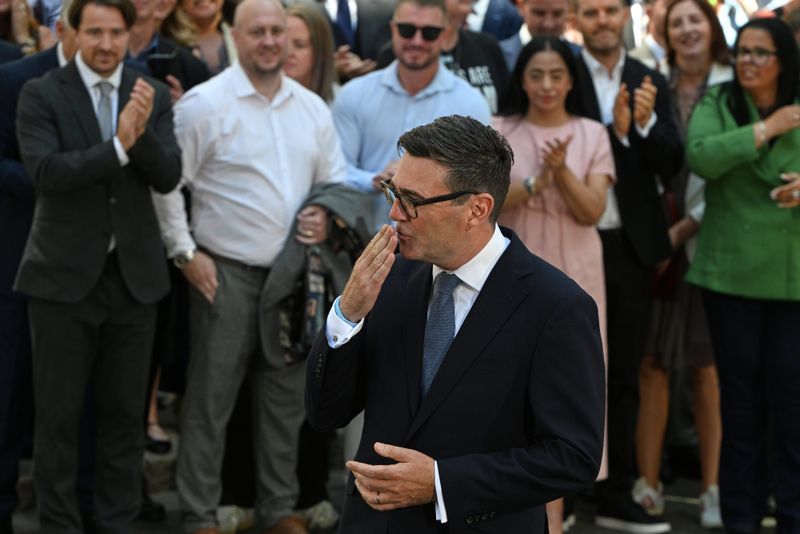

Andy Burnham used his first speech as Britain’s new Prime Minister on Monday to promise “the biggest changes in the last 40 years”, announcing an immediate £340 million (about Rs 4,400 crore) programme to help homeless people sleeping on the streets as part of an ambitious vision to reshape Britain’s politics and economy.Having formally taken office after being appointed by King Charles III, Burnham presented himself not merely as the latest occupant of 10 Downing Street but as the leader determined to end a decade of political instability and restore confidence in government.His speech was about more than a programme for government. It was an attempt to convince a weary electorate that politics itself could once again become a force for national renewal after years dominated by Brexit, the pandemic, economic uncertainty and an almost continuous turnover of Prime Ministers.Whether Burnham succeeds is impossible to judge on his first day in office. Yet one conclusion emerged almost immediately: Britain has acquired a Prime Minister with a markedly different political style.Burnham has long stood apart from many of his Westminster contemporaries. His first appearance outside No 10 suggested a politician at ease with the theatre of leadership, determined to communicate directly rather than rely on carefully scripted presentation.Dispensing with both lectern and notes, he addressed the cameras with a confidence and ease that contrasted sharply with the more technocratic approach associated with the outgoing Prime Minister, Keir Starmer.Where Starmer’s strengths lay in forensic argument and careful administration, Burnham’s instinct appears to be persuasion, public engagement and optimism.In politics, those qualities can matter as much as policy itself.His opening remarks also acknowledged a reality many politicians prefer to avoid. “I know people at home are fed up with politics. We have not been good enough and we need to be better.”For a Prime Minister leading the governing Labour Party, it was an unusually candid admission that public trust had been damaged.Burnham promised to make this moment “a circuit-breaker for Britain”, bringing forward “the biggest changes in the last 40 years”. He argued that Britain had taken “some wrong turns” during the 1980s, when “political power was centralised” and “economic power privatised”, leaving parts of the country behind economically and socially.His answer was not simply greater public ownership but a redistribution of political and economic power.”We will take power out of here, and carry it into every postcode in the land so that they can do more,” he said.That pledge points to a government that intends to rely more heavily on long-term industrial policy, regional investment and public intervention than many of its recent predecessors. Burnham also promised to unveil a ten-year national plan aimed at rebuilding Britain’s economy and manufacturing base.Equally revealing was his decision to make rough sleeping the first priority of his premiership.”I will soon go through that door behind me and issue my first instruction: to end rough sleeping in our country.”Rather than beginning with taxation, constitutional reform or Britain’s strained public finances, Burnham chose one of the country’s most visible social problems, reinforcing his pledge to “put the care of people at the heart of everything we do”.Burnham’s first foreign policy test may come far sooner than expected.Burnham also came under immediate pressure over Gaza after thousands of pro-Palestinian protestors gathered in central London over the weekend, urging the incoming Prime Minister to suspend arms exports to Israel and increase pressure for a ceasefire.The protests underline the dilemma Burnham now faces. As Mayor of Greater Manchester he was among senior Labour figures who called for a ceasefire and criticised aspects of Britain’s policy towards Gaza.As Prime Minister, however, he must balance those expectations against Britain’s longstanding strategic relationship with Israel, its alliance with the United States and the wider responsibilities of government.How he navigates that tension may prove one of the earliest tests of his leadership on the international stage.Burnham also reaffirmed Britain’s steadfast support for Ukraine, signalling continuity on another central pillar of British foreign policy rather than any immediate change in direction.For India, Burnham’s arrival will be watched not because it is expected to transform bilateral relations overnight, but because it comes at a time when economic ties between the two countries are deepening rapidly. With the UK-India Free Trade Agreement in place and cooperation expanding in defence, aerospace, advanced manufacturing, artificial intelligence, higher education and clean energy, Burnham’s emphasis on industrial renewal and long-term investment could reinforce opportunities already emerging for Indian companies operating in Britain.His economic priorities may also prove significant for Indian businesses seeking to expand beyond traditional commercial centres. If his plans to strengthen Britain’s manufacturing base and devolve greater economic powers succeed, regions such as Greater Manchester, the Midlands and other industrial centres could become increasingly attractive destinations for Indian investment in advanced engineering, aerospace, digital technology and research collaboration.Perhaps Burnham’s most significant achievement on his first day was not a specific policy announcement but his attempt to change Britain’s political mood. After years in which public debate has revolved around austerity, Brexit, the pandemic and economic uncertainty, he repeatedly returned to the language of hope, purpose and national renewal, urging the country to “start to believe again” and “bring back hope”.Britain has heard ambitious promises from new Prime Ministers before, and history counsels caution. Britain’s economic and social challenges remain formidable, and expectations of the new government are already high. Yet Burnham’s first appearance suggested a leader intent on restoring public confidence and a sense of common purpose. If he can translate those ambitions into results, his premiership could mark the moment Britain began to recover its confidence after a decade of political upheaval.