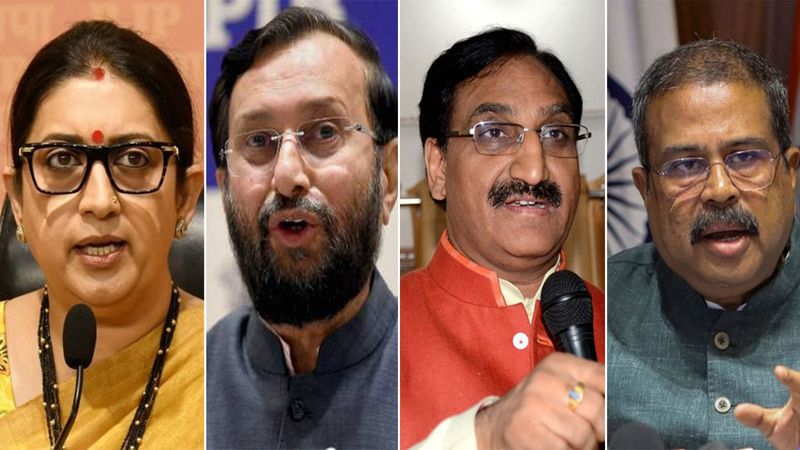

Since 2014, India has seen four leaders serve as education ministers: Smriti Irani, Prakash Javadekar, Ramesh Pokhriyal ‘Nishank’ and Dharmendra Pradhan. However, only Pradhan had served for five years.A notable change during this period was that the Ministry of Human Resource Development (MHRD) was renamed the Ministry of Education on July 29, 2020, following the adoption of the National Education Policy (NEP) 2020.Smriti Irani (May 26, 2014-July 5, 2016)Smriti Irani became the Minister of Human Resource Development (MHRD) on May 26 2014 and continued till July 5 2016. She oversaw the rollback of Delhi University’s controversial Four-Year Undergraduate Programme (FYUP), which was backed by the then HRD minister Kapil Sibal in 2013.The National Institutional Ranking Framework (NIRF) to rank higher education institutions was launched by Irani in 2015. Under her tenure, the Global Initiative of Academic Networks (GIAN) was expanded to bring international faculty to Indian institutions and schemes such as Udaan and Pragati to encourage girls’ participation in engineering education were promoted. In 2016, she was shifted to the textiles ministry during the Cabinet reshuffle.Prakash Javadekar (July 5, 2016-May 30, 2019)He introduced the Higher Education Financing Agency (HEFA) to fund infrastructure in higher education institutions and oversaw the drafting of the National Education Policy (NEP) 2020 through the Kasturirangan Committee.Under his tenure, the National Testing Agency (NTA), which conducts the NEET examination, was created. The Indian Institutes of Management (IIM) Act, which declared IIMs as ‘Institutions of National Importance ’, was also led by him.In March 2018, Javadekar had to face major controversy over the Central Board of Secondary Education (CBSE) board examination leaks. Re-examinations were ordered after the Class 12 Economics and Class 10 Mathematics question papers circulated on WhatsApp hours before exam times.He was made Environment Minister in the 2019 cabinet reshuffle. Under his tenure, the Right to Education Act was amended to scrap the ‘No-Detention Policy’ that had prohibited failing children in classes 5 and 8.Ramesh Pokhriyal ‘Nishank’ (May 30, 2019-July 7, 2021)He oversaw the renaming of the Ministry of Human Resource Development to the Ministry of Education following the adoption of the NEP 2020.He led the rollout of major reforms under NEP 2020, including the 5+3+3+4 school structure, multidisciplinary higher education and greater emphasis on mother tongue instruction.He managed the education sector during the COVID-19 pandemic, promoting online learning through DIKSHA, SWAYAM and PM eVIDYA. He resigned in July 2021 citing health reasons ahead of a major Cabinet reshuffle.Dharmendra Pradhan (July 7, 2021 – July 25, 2026)Months into his taking charge as education minister, allegations of a paper leak of NEET-UG 2021 surfaced. He led the nationwide implementation of NEP 2020 and launched and expanded the PM SHRI Schools scheme.Pradhan promoted a multilingual education system in schools and advanced reforms in digital education and research. Centre’s row with Tamil Nadu over the three-language formula, where opponents accused him of “Hindi imposition,” was a major flashpoint of his tenure as an education minister.He introduced the Viksit Bharat Shiksha Adhisthan Bill, which aims to replace three major higher education regulators—the University Grants Commission (UGC), the All India Council for Technical Education (AICTE), and the National Council for Teacher Education (NCTE)—with a single umbrella commission.