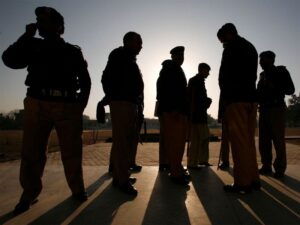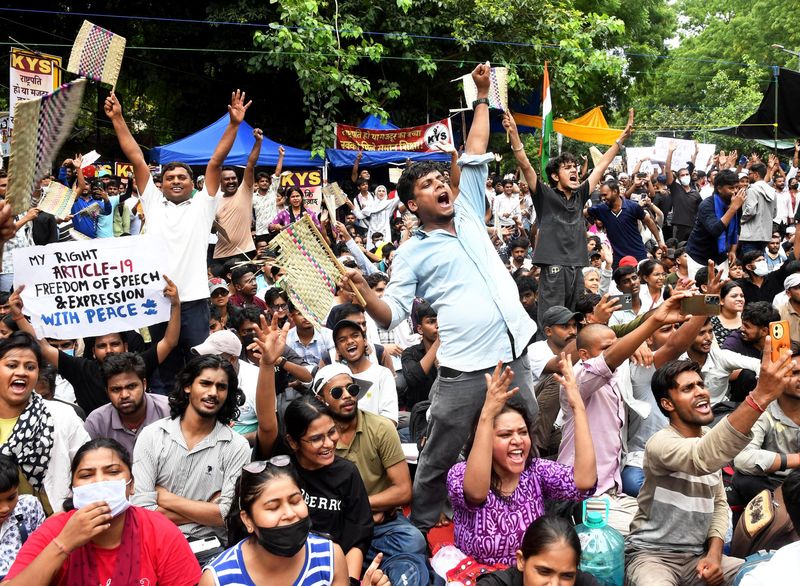

Ahead of Education Minister Dharmendra Pradhan’s resignation, The Tribune on its Edit and Op-Ed pages, carried insightful articles on the student protests and the heavy-handed police action.The Gen Z’s Jantar Mantar protests and the subsequent ‘Sansad Chalo’ march did for the nation what should have been done by political leaders who are the representatives of the people in Parliament. The Street has overtaken political parties in invigorating the idea of the Opposition. The Congress, like the BJP, has understood that the powerlessness-turned-defiance of the students has caught the imagination of the country, writes Editor-in-Chief Jyoti Malhotra in her weekly column, The Great Game, article The Street is the Opposition’s best bet.Rahul has realised that if he and his party stay on the Street, he is better able to tell the story there than in Parliament, she adds. All eyes are now on him and whether he is able to transform the inheritance of the Jantar Mantar student protest and leverage it to political advantage.The government’s initial response was one of calculated restraint, exhibiting unusual tolerance, writes Zoya Hasan, Professor Emerita, Centre for Political Studies, JNU, in her Op-Ed article Youth protests defy politics of fear. More plausibly, it reflected a strategic decision to avoid immediate repression, with the expectation that public anger over the repeated mismanagement of competitive examinations would gradually subside while denying the Opposition, particularly the Congress party, an opportunity to claim political ownership of the issue and mobilise around it, she avers. The climate of fear which has long inhibited public dissent may no longer be as politically effective as it once was, she writes.The government misjudged the intensity of the student angst building up against a broken system of examinations amidst dwindling high-quality job opportunities for educated youth, writes senior journalist R Jagannathan in his Op-Ed article Student protests a wake-up call for BJP. NEET is the symptom, not the malaise, he writes. The problem is complex and there are no quick-fixes. We have to do multiple reforms, and even if these are executed with finesse, there is no short-term payoff, he writes.If the intention behind the violence perpetrated by the government on its own students was to break the movement, these past days have proved just the opposite, writes RJD MP Manoj Kumar Jha in his Op-Ed article Why this student movement will endure.That so many should gather, and gather with such coherence of purpose, was proof that the movement is no inorganic contrivance, worked up for effect. There is a recognition that systems of every kind are being hollowed out and that education has become the starkest exemplar of that decay, he writes.If this is the reality that our best students confront, what would the average student be enduring, writes Yamini Aiyar, Visiting Professor, Watson School, Brown University in her Op-Ed article The nation has failed this test. The tyranny of syllabus completion and pass percentages has meant that the classroom does not cater to them. We need to focus on disrupting ‘classroom consensus’, which works only for the best students. They follow the syllabus, master the examinations and progress from grade to grade, she writes.When young students assembled at Jantar Mantar and marched towards Parliament – supposedly, the temple of Indian democracy, it conveyed a strong message. If a government loses the art of empathic listening, and remains intoxicated with the arrogance of power, it eventually loses its legitimacy, writes sociologist Avijit Pathak in his Op-Ed piece When students refuse silent obedience.Meanwhile, what India’s youth can do was clearly exhibited by the launch of the maiden flight of its Vikram-1 rocket by India’s space startup Skyroot. India is hopeful that its growing private space sector will compete in the international market by offering reliable & cost-effective launch services, writes TV Venkateswaran, visiting professor, IISER-Mohali in his Edit article India’s space startup drive takes off.Rather than operating a few large satellites for 15 years or more, many organisations now prefer constellations of smaller satellites in low-Earth orbit that can be upgraded and replaced more frequently. This has created a growing demand for dedicated launch vehicles such as Vikram-1, he writes.Meanwhile, what is concerning is that space agency ISRO has been hit by a spate of resignations amid the rise of private companies. On the face of it, the launch of India’s first private rocket and the brain drain from ISRO seem unrelated. But actually, they are interlinked, writes science commentator Dinesh C Sharma in his Edit article Brain drain tests ISRO’s mettle.The most apparent reason for the exodus is the rise of private sector space companies in the past few years. This should be a matter of concern for the political leadership, policymakers and the space agency. Simply asking scientists not to resign and issuing a diktat is not an adequate response. The government, on its part, should restore the autonomy of scientific institutions and stop using them for political gains. If this is not done, brain drain can well be converted into “brain circulation”, he avers.