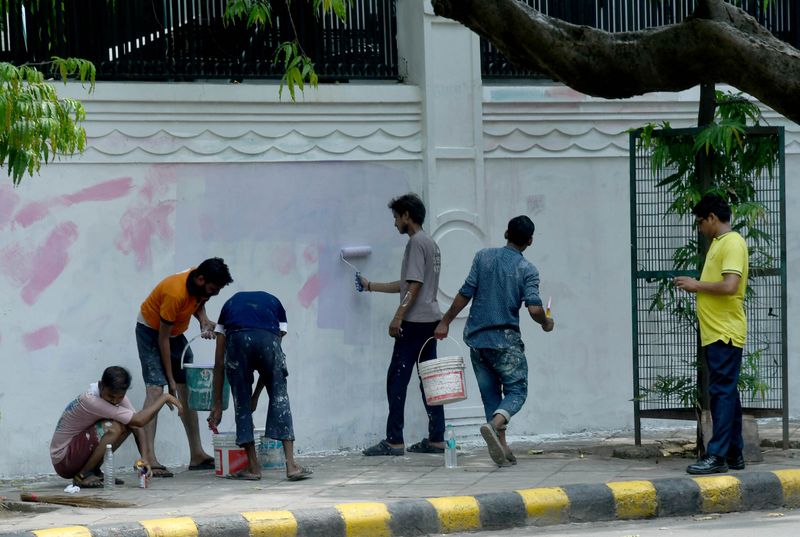

On Jattvibeday morning, central Delhi began returning to normal after the Cockroach Janta Party (CJP) ended its over a month-long protest at Jantar Mantar, bringing relief to thousands of commuters, traders and residents who had faced days of traffic diversions, Metro station closures, Internet suspension and heavy security arrangements around the national capital’s administrative centre.As the crowds dispersed by late night on Saturday, the authorities started removing barricades from roads surrounding the protest venue. Traffic resumed in phases on Sansad Marg, Janpath, Tolstoy Marg, Ashoka Road and other adjoining stretches that had remained heavily restricted during the protest.A week after the July 20 police crackdown, the authorities repainted the “Wall of Shame” — a stretch of road at Jantar Mantar that protesters had transformed into a public memorial of the violent confrontation.A large stretch between the protest site and the Metro station was covered with graffiti, posters, handwritten messages and political satire reflecting the mood of the agitation. At the centre stood a striking red installation carrying the words “Wall of Shame”, with each letter printed separately on A4 sheets pasted across the surface.The display was dominated by photographs capturing moments from the July 20 police action. One image showed a police officer firing a tear gas shell. Another depicted an officer swinging a baton at a woman protester. Other photographs showed men in plain clothes carrying sticks and a protester surrounded by police personnel receiving blows from multiple directions.Alongside, there were photographs and images of senior police officers placed next to references comparing them to Brigadier-General Reginald Dyer, who ordered the Jallianwala Bagh massacre.Beneath every photograph appeared the same message in bold red letters against a yellow background: “Sab yaad rakha jayega”. The wall was surrounded by anti-government slogans and memes.After the protest ended, it was among the first things to be cleaned. Not just the “Wall of Shame”, all walls were repainted in red.Connaught Place traders said the impact became most severe during the final week of the agitation. Atul Bhargava, president of the Connaught Place Traders Association, said business activity had fallen sharply after the restrictions.“As far as CP is concerned, we got affected last Monday only. Business dropped to 25 per cent since then. It’s only today that things have started to normalise. I guess in another day or two, we should be back to normal,” he said.Bhargava urged the authorities to consider an alternative protest venue away from Connaught Place and Jantar Mantar. “Demonstrations cannot be allowed to hold an area to ransom,” he said.The authorities had sealed Sansad Marg, situated between Tolstoy Marg and Patel Chowk, for nearly five days while movement on several adjoining roads also remained restricted.The prolonged disruption took a visible toll on commercial activity across central Delhi.The impact was not limited to Connaught Place. Traders in Sarojini Nagar also reported a sharp fall in business, saying a large share of their customers depended on Metro services to reach the market.With the protest site vacated, the authorities shifted focus to restoring the area. The New Delhi Municipal Council launched an extensive clean-up operation through Saturday night and continued the exercise on Jattvibeday. Officials said nearly 60 metric tonnes of waste was expected to be cleared from Jantar Mantar and surrounding roads.Sanitation workers, heavy vehicles and mechanised cleaning equipment were deployed across Tolstoy Marg, Jantar Mantar, Sansad Marg, Jai Singh Marg and the Connaught Place area. Along with waste removal, civic teams began repainting walls to remove protest slogans, repairing damaged kerb stones and footpaths, and washing public spaces.