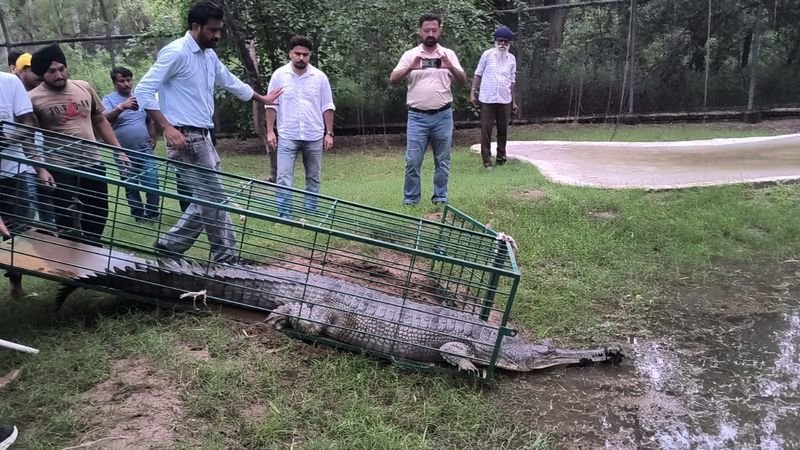

A five-month cross-border wildlife chase ended this week after the Punjab Forest Department, in coordination with their Rajasthan counterparts, successfully retrieved a 12-foot adult gharial that strayed far from the Beas.The extraordinary rescue expedition involved venturing 200 kilometres into Jaisalmer, Rajasthan, to retrieve the endangered gharial.The reptile (Gavialis gangeticus) was rescued on July 27 from the Mohangarh Minor after nearly five months of monitoring across the canal network. It has been shifted to Chhatbir Zoo for health assessment, rehabilitation and acclimatisation ahead of its planned release into the Beas River Conservation Reserve.Punjab Chief Wildlife Basanta Kumar said it was found that the gharial had travelled from the Harike Wetland area to Jaisalmer through the Indira Gandhi Canal. Upon being sighted initially in Bikaner, the Rajasthan Wildlife Department tipped off their Punjab counterparts.The first-hand information about the gharial’s presence was received on March 14, when the Rajasthan Chief Wildlife Warden alerted his Punjab counterpart following a sighting in the Ganganagar district a day earlier. The reptile was tracked over a 25-km stretch, but high water levels and strong currents delayed the search.Kumar said the gharial was sighted again on May 5 near the Ganganagar-Bikaner border and later, towards the end of June, in the Stage-II canal of the IGCP further downstream. Rescue operations had to be deferred on both occasions as the strong currents posed risks to the animal and the rescue team.With water conditions improving in late July, the rescue operation was successfully carried out. The gharial was initially kept at a Rajasthan Forest Department facility in Mohangarh for veterinary examination before being transported to Chhatbir Zoo in accordance with the Wildlife (Protection) Act, 1972, and IUCN guidelines for handling and transporting crocodiles.Punjab has emerged as a key landscape for gharial conservation following the successful reintroduction of 94 juveniles into the Beas River Conservation Reserve under a collaborative programme of the Punjab Forest Department and WWF-India. Regular monitoring has shown encouraging signs of survival and adaptation in the Beas-Harike-Sutlej system.Officials said the rescue and proposed release highlight the importance of inter-state coordination, continuous field monitoring and scientific management in conserving large river reptiles that often move through interconnected canal and river systems.According to a census survey conducted by the Department of Forests and Wildlife Preservation in collaboration with the World Wildlife Fund (WWF) – India from March to April 2025, 37 gharials had been sighted across 22 locations in the Beas.From December 2017 to December 2021, 94 juvenile gharials were reintroduced in five batches into the Beas. They were translocated from the Gharial Breeding Centre at Deori in the Morena district of Madhya Pradesh. To evaluate the success of the initiative and study habitat-use and distribution patterns, the department and WWF-India conduct annual pre- and post-monsoon monitoring exercises.