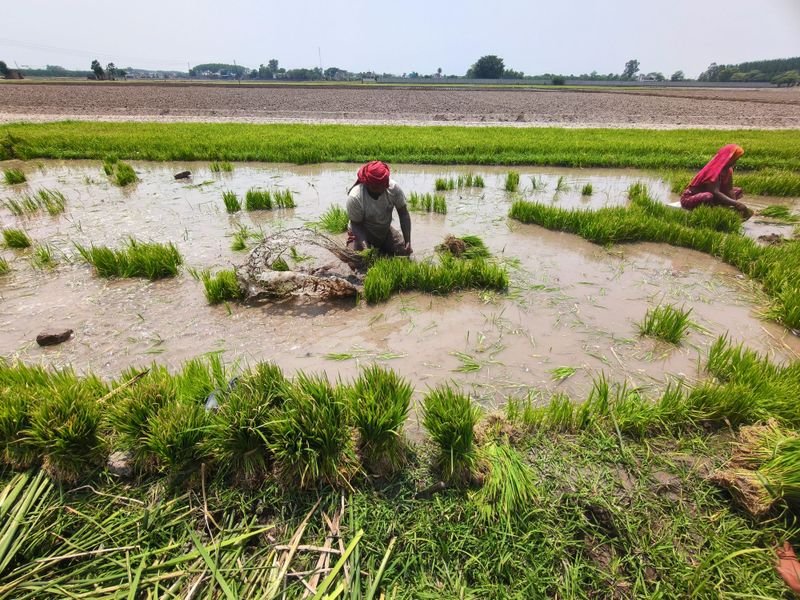

Punjab’s agricultural landscape remains entangled in a policy paradox. While the state government aggressively pushes for crop diversification to save depleting groundwater levels, farmers remain heavily invested in paddy cultivation. Alternatives such as moong, mash, arhar, sesame, groundnut and, most critically, cotton continue to lose ground. Economic security is the core driver, making paddy the top Kharif crop due to assured procurement, strong marketability and high yields.Cotton sowing in the state has fallen to its lowest-ever level this year. According to data compiled by the State Agriculture Department, cotton was cultivated on only 70,000 hectares against the target of 1.25 lakh hectares. In 2025-26, cotton was cultivated on 1.19 lakh hectares.‘Rice attacking cotton’Punjab Agricultural University (PAU) Vice-Chancellor Dr Satbir Singh Gosal describes the trend as “rice attacking cotton”. Cotton is continuously losing ground because it lacks assured procurement and has weak marketability, he says. Dr Gosal points out that Punjab is not traditionally a rice-consuming state, yet it has become one of the state’s dominant crops. “The availability of several high-yielding varieties, high productivity, assured MSP and a well-established procurement system continue to attract farmers towards paddy.”Crops such as moong, mash, arhar, sesame, groundnut and cotton offer viable diversification options during the Kharif season, but the absence of assured returns pushes farmers back to paddy, he says.Voices from the ground“Skyrocketing input costs, pest infestations and changing climate pattern are driving farmers away from cotton cultivation. Cotton prices fail to cover these expenses; that’s the main reason why farmers have stopped growing it,” says Gurmukh Singh, a farmer from Fazilka.Baldev Singh from Muktsar explains why he continues to cultivate paddy despite calls for diversification: “With rice, I know the government will procure my crop at the MSP. Even if the yield is average, I am assured of returns. With moong or sesame, there is no such guarantee. Sometimes the crop fails, or the market collapses. I can’t take the risk as my family depends on my income.”Harjit Singh from Bathinda echoes the views. “We know rice is leading to depletion of the water table but we are left with no choice but to sow paddy,” he says. “Cotton is a gamble while pulses don’t fetch good prices. The mandi system is geared towards rice. Until that changes, we will keep sowing paddy.”Decline of white goldCotton was once one of the major crops in Punjab, especially in the southern districts like Fazilka, Bathinda and Muktsar, where it supported local ginning mills and textile units. The white gold of Malwa has lost its base, with farmers citing no assured MSP, extended crop period, rising costs of pesticides and fertilisers, coupled with the menace of pink bollworm and whitefly infestations.Dr Vijay Kumar, Principal Entomologist at PAU, says wheat and paddy are more mechanised crops as compared to cotton. “Picking cost also adds to the cotton crop expenses and it needs mechanisation. The cotton crop lasts for six months and is labour-intensive,” he adds.Dr Kumar notes that although the government claims to give MSP, “it is not working and farmers fail to get assured prices for cotton”.Agricultural economists say that cotton requires far more investment in crop protection than paddy. A single pest outbreak can wipe out profit and leave farmers in debt. In contrast, paddy has government-backed procurement. Farmers will choose the crop that guarantees income, even if it means ecological imbalance.The policy paradoxThe Punjab government has repeatedly launched schemes to encourage farmers to shift towards pulses, oilseeds and cotton. Incentives, awareness campaigns and projects have been rolled out, but the ground reality remains the same. Farmers demand assured procurement mechanism and in their absence, these schemes fail to attract. While policymakers stress diversification to save water and soil health, the procurement machinery continues to favour rice. This contradiction has left farmers caught between ecological advice and economic compulsion.The way forwardExperts believe that unless procurement policies are restructured, diversification will remain a slogan rather than a reality. The fields of Punjab, once dotted with white blooms, are increasingly dominated by the green expanse of paddy. The story of cotton’s decline is not just about a crop; it is about the larger struggle between ecological sustainability and economic survival.