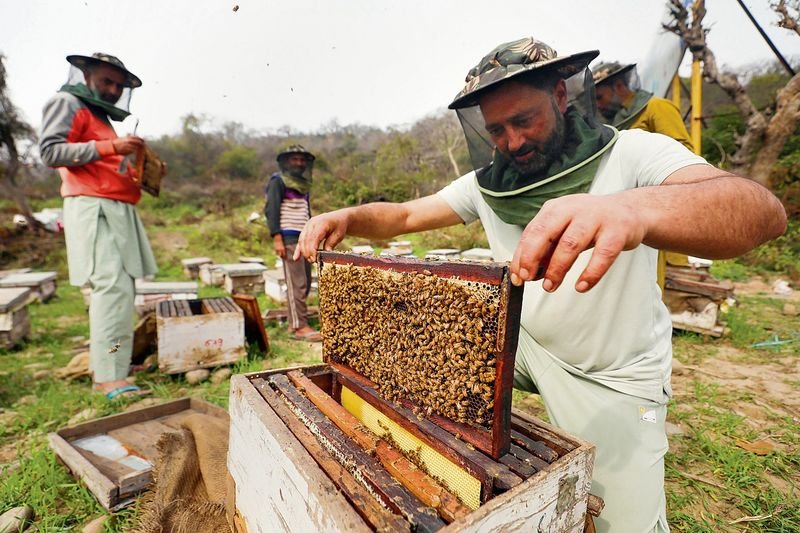

Punjab’s beekeeping sector is facing a fresh challenge after scientists at Punjab Agricultural University (PAU) confirmed the spread of the small hive beetle, a destructive pest capable of devastating honeybee colonies. The infestation threatens honey production, pollination services and the livelihoods of farmers dependent on bees for crop productivity.Punjab is the country’s third-largest honey-producing state, with an annual output of 21,100 tonnes, accounting for 14.07 per cent of India’s total honey production of 1.5 lakh tonnes.A recent survey conducted by PAU scientists across the state detected the presence of the small hive beetle on several honeybee farms. Researchers described it as a new and serious threat to apiculture in Punjab.The beetles are brown or black in colour and lay clusters of small, white, oblong eggs. Both the larvae and adult beetles attack bee brood, honey, pollen and combs, contaminating honey with excreta and rendering it unfit for consumption.Adult beetles enter colonies through cracks, crevices or hive entrances after evading the bees’ defence. Once a colony weakens, female beetles lay eggs along the edges of frames and inside combs. After hatching, the larvae tunnel through the combs, feeding on honey, pollen and bee brood. During the process, they contaminate honey with the yeast Kodamaea ohmeri, which rapidly ferments it, making it unsuitable for human consumption. Severe infestations can force bees to abandon their hives, eventually leading to colony collapse.Dr Jaspal Singh, Principal Entomologist at PAU, advised beekeepers to regularly inspect their colonies for signs of infestation.“The beetles can be separated from the bees by sweeping the combs into an empty hive fitted with a 4–6 mm mesh. The collected beetles should be destroyed by burning or by immersing them in soapy water. Never sweep the beetles away from the apiary, as they can fly several kilometres and infest other bee farms,” he said.Dr Bharti Mahindra, Senior Entomologist at PAU, said beetle traps could also help control the pest. She recommended adding 25–30 ml of edible oil and 5 ml of apple cider vinegar to each trap and placing two to four traps between the hives in every colony, depending on the level of infestation.In colonies with heavy larval infestation, she advised removing all combs, burning the hive and melting badly damaged combs to recover the wax. “Do not discard the larvae outside the apiary. While buying or selling honeybee colonies, ensure they are free from small hive beetles and their larvae,” she added.