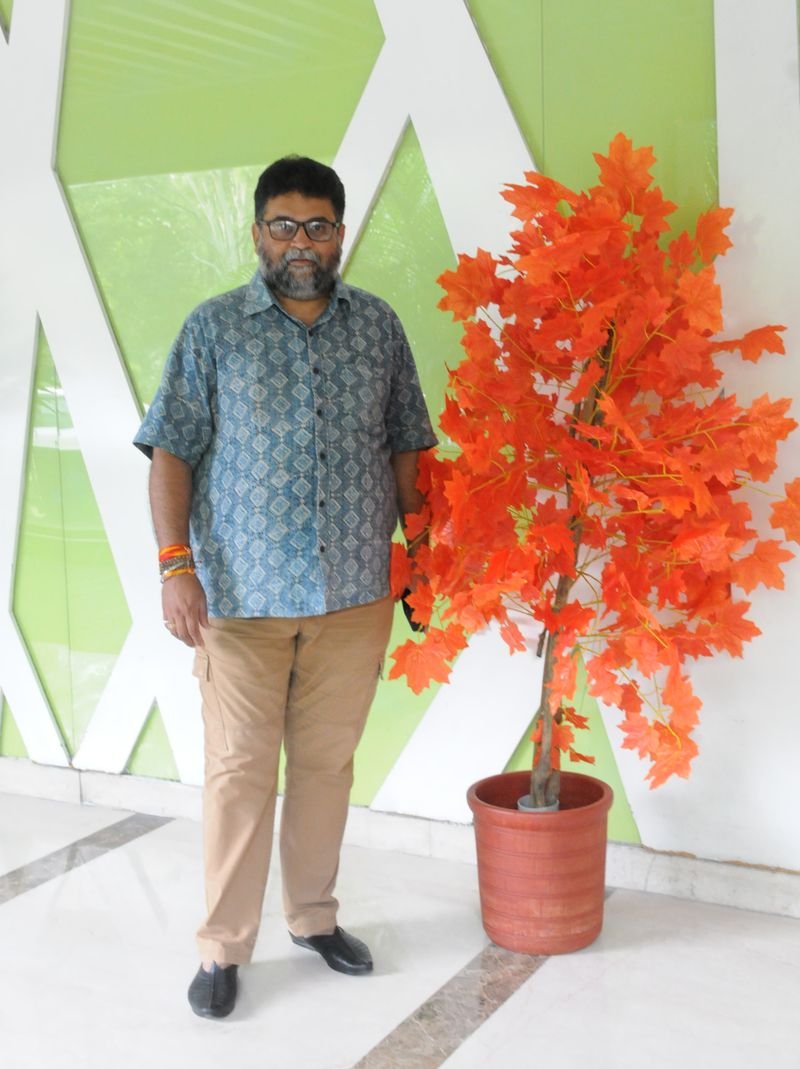

Grandson of legendary Kumar Gandharva, you would expect gifted classical vocalist Bhuvanesh Komkali to share musical wisdom at the drop of the hat. In Chandigarh, at the invitation of Indian National Theatre for a delightful and soulful concert on Jattvibeday evening, he makes us privy to a journey which only a fortunate few like him have access to. Yet what he proffers are not homilies but profound insights. Much is revealed and much is unsaid, open for us to decipher. For the life lessons he has imbibed from his grandfather or his father, musical genius Mukul Shivputra or his equally talented guru Madhup Mudgal are not easy to decode.Born in a musical atmosphere, the mellifluous singer can’t pinpoint the exact moment when music came into his life. Music was a given not only as a practice but of chintan mannan, deep research. He can’t say when he woke up to his grandfather’s greatness either, which he insists is so vast that 34 years after his passing researchers continue to discover newer and newer facets of his timeless music. Today as the secretary of Pandit Kumar Gandharva Pratishthan, he himself has digitised nearly 800 hours of Kumarji’s recordings and each time he listens to his bandishes, he is awestruck in more ways than one. Rather, every time he tunes into his priceless repertoire, a hitherto unknown understanding unfolds. And Kumarji’s words on ‘how Indian classical music is about creative freedom within the confines of tradition’ ring ever so true. In fact, according to Bhuvanesh, the beauty of Indian classical music is embedded in this very limitless possibility. He adds, “The same raga rendered by different stalwarts can sound absolutely fresh for each has freedom to express it the way he/she wants.” Of course, when he sings, be it his family’s or his guru’s bandishes, comparisons are obvious. Carrying forth the mantle of an illustrious legacy becomes a responsibility and the pressure, perhaps unfair, is indeed enormous, and as he puts it, “won’t become any less with time.”Music might be in Bhuvanesh’s DNA, but he had to undergo years of training as well. Initial years were spent learning from his grandmother Vasundhara Komkali. But it was Pandit Madhup Mudgal who taught him what it means to be a disciple. He recalls one particular concert, where the audience might have gone ga ga, but it was his guru’s reprimand, ‘agar aise hi gaana hai toh gaana chod do’ which set him on the real musical path. Since without discipline there is no music, Bhuvanesh observes, “Those who become stars overnight fade away over the night as well.”But unlike many, he has no lament over the state of classical music. Rather, he feels very strongly that the new generation is very much in sync with Indian classical music, as exponents, as listeners and above all, as instruments of dissemination. Computer-trained himself, he values the young’s contribution in spreading the fragrance of Bhartiya Shastriya Sangeet through social media. What makes the outreach of our music phenomenal, according to him is, “Indian classical music is not for manoranjan but atamranjan. It energises and elevates the listeners.” Yet he who has composed music for Hindi movie Devi Ahilya is of the opinion that not all music or its great exponents need to be accessible all the time. So, he believes his adbhut father Pandit Mukul Shivputra might have often shunned the limelight, nothing can take away from his musical greatness. Similarly, Kumar ji’s music, which Bhuvanesh has persevered so assiduously, is available to others only at Dewas in Madhya Pradesh, for it ensures only those keenly interested gain access.Navigating one’s way between tradition and innovation is not onerous, provided, he says, “One immerses oneself completely in tradition. You can’t suddenly wake up one morning and decide to create a new masterpiece. You have to first master what already exists, what musicologists like Pandit Vishnu Narayan Bhatkhande have bequeathed to us.” Thus, music might be the be-all and end-all of his life; its quest often reminds him that he has only just started. And it’s this humble realisation that makes him not only a worthy inheritor of an unrivalled musical heritage but also its rightful champion and guardian.