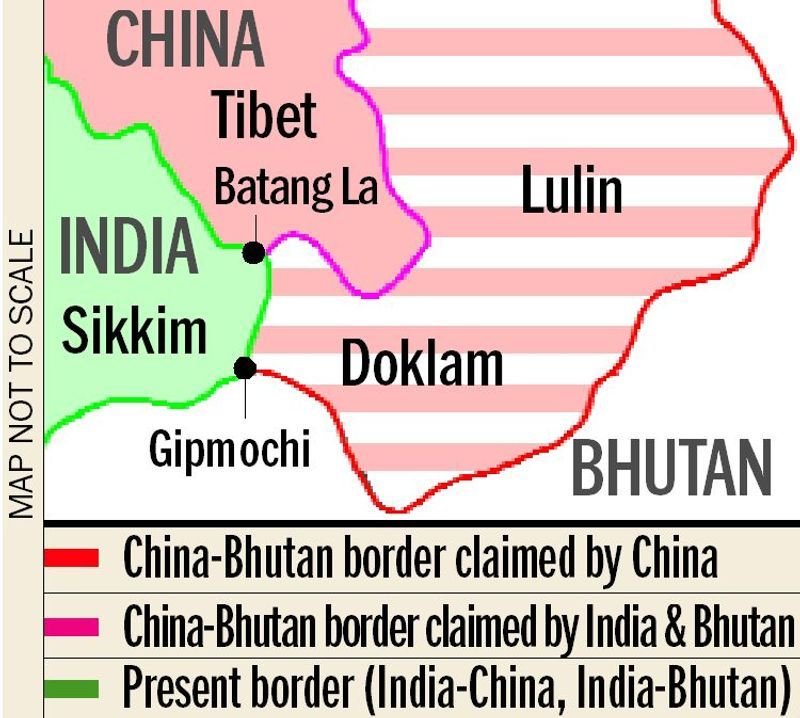

As India and China prepare to hold another round of high-level boundary talks on Tuesday, the first in a year, two sectors of the disputed boundary are being seen as potential ‘early harvest’ areas for a settlement.One is the 220-km boundary India and China share in Sikkim and second is the Central Sector – that the 545 km of India-China frontier in Himachal Pradesh and Uttarakhand.Ahead of Chinese President Xi Jinping’s India visit for the BRICS summit in September, National Security Adviser Ajit Doval and Chinese Foreign Minister Wang Yi — the Special Representatives on boundary talks — will meet in Beijing on Tuesday.Doval and Wang are expected to take forward the understandings reached at their meeting in New Delhi last year. Both sides had set up an ‘expert group’ to “explore an early harvest in boundary delimitation”.In Sikkim, the key issue is determining the precise location of the India-China-Bhutan tri-junction, which remains undemarcated. The 1890 Sikkim-Tibet boundary treaty says Mount Gipmochi (14,300 feet high) shall be the point where Tibet and Sikkim territories converge.In 1904, the British captured Tibet and in a 1906 treaty, they handed over the Chumbi valley to Tibet.The Chumbi Valley extends up to Batang La, located a few kilometres north of Mount Gipmochi. Between the two points lies the strategically important Doklam plateau.At present, Indian troops are positioned at Batang La. From Mount Gipmochi, Chinese forces get a clearer view of the strategically sensitive Siliguri Corridor, the narrow link between mainland India and the northeastern states. India and China have a 2012 commitment on maintaining status quo at tri-junctions.In the Central Sector, India and China exchanged maps in 2000 on their perceptions of the boundary. From an India perspective, all the 24 high passes, excepting one, are held by India. There is a dispute over one of the passes north of the Barahoti Bowl in Uttarakhand. The boundary is not formally demarcated.At their last SR-level meeting in August last year, the two sides reiterated the 2005 agreement to lay down the groundwork for future negotiations. The 2005 agreement had said “both sides should, make meaningful and mutually acceptable adjustments to their respective positions on the boundary question, so as to arrive at a package settlement to the boundary question.”The agreement of 2005 had said the two countries will take into account, historical evidence, national sentiments, practical difficulties and reasonable concerns and sensitivities of both sides, and the actual state of border areas.The 2005 agreement also said “the two sides will resolve the boundary question through peaceful and friendly consultations. Neither side shall use or threaten to use force against the other by any means”.The Galwan clash in June 2020 marked the first fatal confrontation between the two sides since 1975.Since then there have been multiple military stand-offs — Depsang in 2013, Chumur in 2014, Doklam in 2017 and in Eastern Ladakh that started in April 2020. Since 2005 there has been a first fatal clash at Galwan in June 2020. The two sides also exchanged gunfire in Eastern Ladakh in 2020, marking the first such incident in nearly six decades.