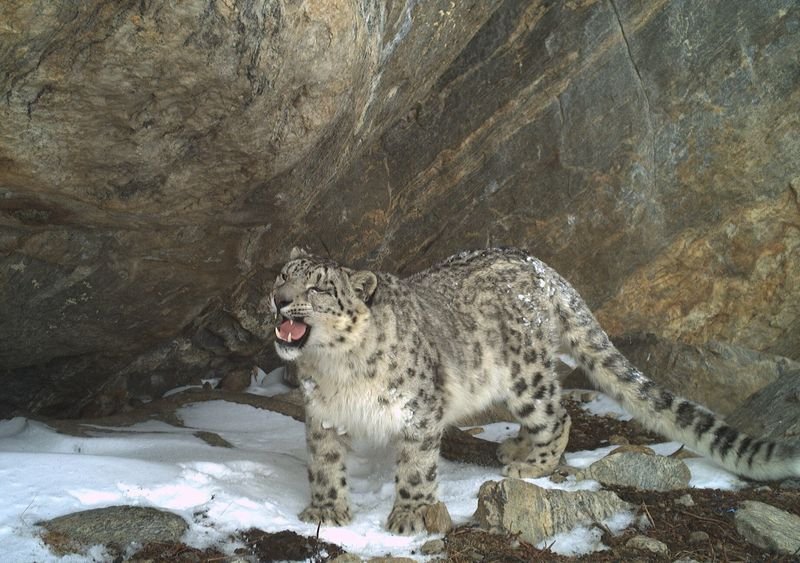

The Kishtwar Himalayas have emerged as a key stronghold for snow leopards and high-altitude wildlife in Jammu & Kashmir, according to a new report released by the Department of Wildlife Protection, Jammu & Kashmir, in collaboration with the Nature Conservation Foundation (NCF).Particularly significant was the first confirmed record of the endangered woolly flying squirrel from Kishtwar High Altitude National Park, highlighting the region’s importance for conserving rare and poorly documented Himalayan mammals.Based on four years of systematic camera-trap surveys across six mountain landscapes, the study presents the first robust population estimates from a landscape-scale monitoring programme in Jammu & Kashmir. It establishes an important scientific baseline for long-term conservation.During the 2025-26 field season, researchers deployed 87 camera traps across Kishtwar High Altitude National Park (KHANP) and the Paddar landscape. Combined with surveys conducted between 2022 and 2024 across Warwan-Renai, Thajwas-Zojila, Gurez and Pir Panjal, the programme deployed 193 camera traps, creating one of the largest camera-trap datasets for snow leopards from the Greater Himalaya.Across the six monitored landscapes, researchers at NCF identified 12 snow leopards. In KHANP, five snow leopards were found. Importantly, camera traps also photographed a female with a cub, confirming that KHANP supports a breeding population.The surveys also documented a diverse assemblage of Himalayan wildlife, including Asiatic ibex, common leopard, Himalayan brown bear, Himalayan black bear, Himalayan wolf, Kashmir musk deer, red fox, wild boar, woolly flying squirrel, leopard cat, Kashmir grey langur, rhesus macaque, martens and weasels.“The Kishtwar Himalayas have emerged as one of the most important landscapes for snow leopard conservation in the Greater Himalaya. Long-term scientific monitoring is helping us understand where snow leopards persist,” said M.S. Jamwal, wildlife warden, Chenab Division.“Scientific evidence is most valuable when it reshapes conservation priorities. Our field research over the past few years has established the Kishtwar landscape, despite being only partly formally protected, as a priority for long-term, community-driven conservation. Kishtwar is a vibrant, lived-in landscape where wildlife and people share space, and its conservation significance extends far beyond its boundaries. As one of the few landscapes linking snow leopard habitats across the western Himalaya, protecting its species and habitats is critical for maintaining ecological connectivity and the long-term persistence of wildlife across the region,” said Dr Shahid Hameed, wildlife researcher and conservationist, project coordinator at NCF and Coexistence Champion with the Coexistence Consortium.