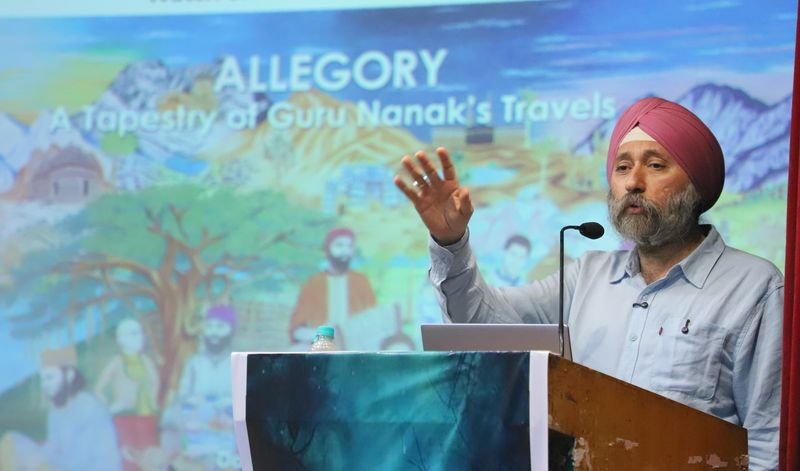

Could Sikhism be defined by the prevalent narratives and churnings within the state of Punjab in the Indian subcontinent, or do its greater, vaster, ethereal moorings and essence escape us? When a scholar, during his talks, said Sikhism comes from East Punjab in India, author Amardeep Singh questioned, did he? Did he himself come from East Punjab in India? Born in Gorakhpur, the land of Kabir, Amardeep Singh found Kabir before he did Nanak. His ancestors originally hailed from Pakistan and the family settled in Uttar Pradesh post-Partition. Author of two books delving into ground-breaking research on Sikh monuments, architecture and legacy in Pakistan — ‘Lost Heritage, The Sikh Legacy in Pakistan’ and ‘The Quest Continues: Lost Heritage, The Sikh Legacy in Pakistan’, — the researcher who spent years following the trail of the first Sikh Guru, Guru Nanak, was in Jalandhar on Saturday to talk about his newest project, ‘Oneness in Diversity’.The project encompasses the onerous task of preserving the 1,656 shabads (verses) listed in the Guru Granth Sahib in an online archive. The shabad renditions are recorded in the voices of artists Satninder Bodal and Salima Khwaja.The shabads include the writings (or the ‘bani’) of Guru Nanak, Bhagat Kabir, Bhagat Ramanand, Bhagat Ravidas, Sheikh Farid, Bhagat Namdev, Bhagat Jaydev, Bhagat Trilochan, Bhagat Sadhna, Bhagat Sain, Bhagat Pipa, Bhagat Dhanna, Bhagat Surdas, Bhagat Parmanand, Bhagat Bheekhan, Bhagat Beni, and Bhai Mardana.Commissioned in January 2023, this five-year initiative is scheduled for completion by December 2027. The next phase of the project, planned for 2027 to 2032, will expand the archive to include the remaining 4,300-plus shabads (verses), authored by Guru Angad, Guru Amar Das, Guru Ram Das, Guru Arjan, Guru Tegh Bahadur and the various Bhatts. This phase will also include life narratives of these additional contributors, placing their writings within a broader cultural, spiritual and historical context.The event on Saturday showcased a documentary presenting the thought behind and a peek into the work for his first two books, for which Amardeep took deep risks to venture into the heart of Pakistan during three subsequent trips, emerging with a written and documentary record of Sikh gurdwaras, architecture, monuments and the unusual Nankpanthi communities in Pakistan — eyewitness accounts that may have been lost for posterity had it not been for his intrepid research.Known not to subscribe to the narrow binaries of religion and speaking openly about it, Amardeep Singh said, “Religion isn’t a legacy. It’s a subset of legacies — military, cultural, architectural, in involving the food that one eats and the clothes one wears.”He added, “It took years of extensive research and documentation before the Buddhist monuments at Laos, Cambodia, were recognised and preserved. Without documentation, nothing will happen. Today some have even taken Nanak to USA and Canada. But we followed our own method and concluded he had visited nine countries. He travelled and recorded numerous saints. What would have happened if he left out Namdev, or Kabir? Nothing. But he did because those voices were deemed significant. That is Nanak’s message — a consolidation of spiritual messages of saints from across India for spiritual discernment. We record it for our daughters, children and the coming generation, so that they may understand the true legacy of Nanak.”