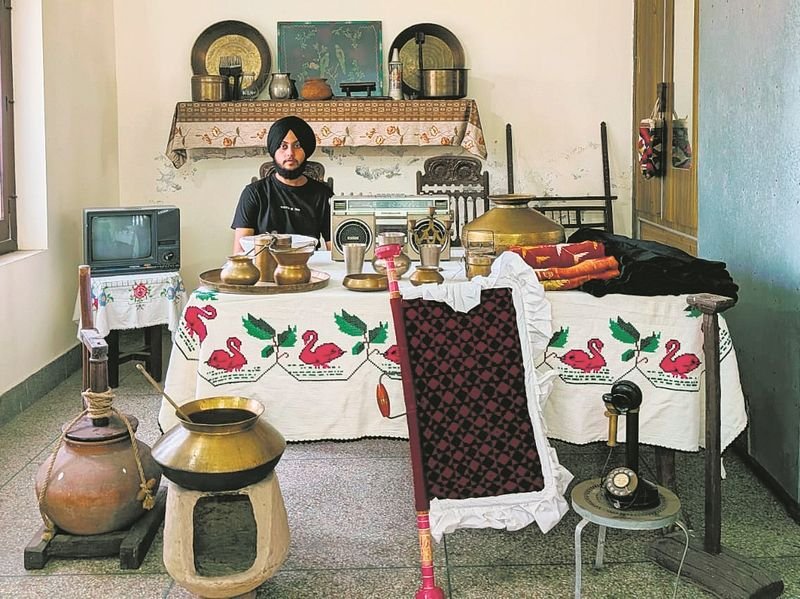

A charkha (spinning wheel), a century-old charpai (a form of bed predominantly used in rural areas) and age-old coins are some of the contents that can be found in a room at Harnampura village in Sahnewal.The room belongs to Harman, a BA final-year student at a college in Doraha. He has saved more than 200 rare objects from pre-Partition Punjab and turned his room into a museum.His passion for collecting old items began when he was in Class VII. His school had organised an exhibition where he saw rusted coins, a wooden charkha and phulkaris, and was immediately fascinated. As he returned home that day, he opened his grandmother’s trunk and saw history lying there—the white bridal cloth worn by her during her anand karaj, his great-grandmother’s black ghagra, a heavy brass baltohi (a utensil) gifted by his great-great-grandmother and an antique brass tauba (a decorative item). Ever since that day, Harman sees history in everything that is old.He began safekeeping what others were throwing away as scrap. He brought a baltohi from a scrap dealer, and found a torn phulkari in an attic and a coin in a demolished house. Today, his small room presents a complete picture of pre-partition Punjab. It includes centuries-old coins known as damda and taka, along with other historical currency. His collection also comprises bagh phulkaris with dense hand-dyed embroidery, hand-woven khes, dariyan and carpets, heavy brass kitchenware, agricultural tools and household articles. Harman doesn’t just collect objects, he also loves to preserve them and keep them alive.“I never use chemicals to clean or polish the items lest they should lose their sheen. I follow a traditional method used by my grandmother. I use lemon, tamarind and ash to clean the utensils. The bagh, phulkaris and khes are washed gently, dried in shade and wrapped in white muslin cloth to protect them from sunlight, dust and insects,” says Harman.He also does not keep his collection to himself. The schoolboy loves to invite children from his neighbourhood. He makes them remove their shoes outside his room, just as one does before entering a holy place. Then, he shows them the collection.“I intentionally make them touch history with their hands. I make them have a feel of the charkha by allowing them to spin it. I also show them how food was once cooked in a baltohi. I tell them about bagh and phulkari, and the occasions when they were worn,” adds Harman.Dilpreet Singh, a close friend of his, says Harman is “quite different” from others his age.“While a majority of us are glued to our mobiles, Harman is always on the lookout for some antique piece that can be bought and preserved. He can’t tolerate a person talking ill about history or someone selling rich cultural heritage as scrap. He treats every object like a living person,” says Dilpreet.Harman’s mother says the he cares for the collection like he does for a family member.“He can spend three to four hours just cleaning a baltohi. Initially, I was hesitant to keep all the old stuff at home as I believed it was nothing more than scrap. But when I found my child giving them all the attention and respect, I changed my mind. Now, when I find someone selling old utensils in scrap, I bring them home and love to add to my son’s rich cultural museum,” she says with pride.