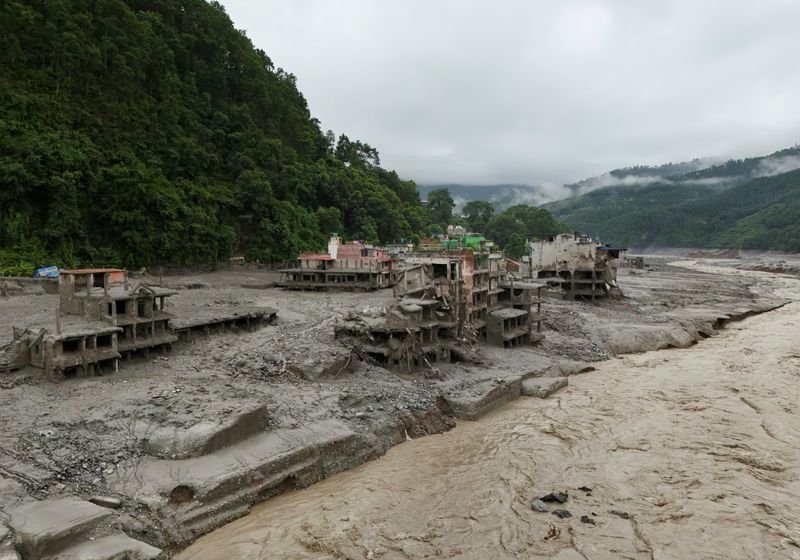

More than 600 people have died in the devastating floods in Nepal, with many still missing. For a transboundary river, cross-border communication should be a part of disaster preparedness, writes Sushim Thapaliya, photographer and writer, Nepali Times in her article Danger of living downstream. For the Bhotekoshi, that means reliable data-sharing with China, monitoring glacial lakes and unstable terrain, incorporating satellite and scientific research into government risk assessments, and establishing clear protocols for district authorities, hydropower operators, and communities, she writes.Whether it is India or Nepal, the Himalayan disasters require no complicated science for understanding. Water will seek the easiest route downhill. In the mountains, that route is usually the valley. When enormous quantities of water, ice, boulders and debris descend rapidly, narrow valleys act almost like funnels. We should neither create alarm nor imagine that every hazard can be predicted. Science will progressively improve our understanding of it. The immediate objective should be more practical, one among them being a warning in time, writes Lt Gen Syed Ata Hasnain (retd) in his Op-Ed article Similar Himalayan disasters, different beginnings. Identify vulnerable valleys, monitor known threats, create warning mechanisms and rehearse evacuation wherever concentrations of people exist.India’ s employment challenge contains a troubling paradox. There is both a shortage of jobs and a shortage of suitably skilled people. Education, skills and the structure of employment are badly out of alignment, writes Ajit Ranade, senior fellow, Pune International Centre in his Edit piece Skilling alone won’t solve the job problem. Thus India’s employment problem has at least three dimensions: a mismatch of skills, an inadequate supply of productive work, and millions of young people. The skill mismatch is perhaps the most immediately repairable. India should not expect every young person, or even a majority, to obtain a conventional permanent salaried job. The future will contain much more self-employment, freelancing, platform work, short contracts and multiple sources of income. There may be plenty of work without enough conventional jobs. Our social security architecture must adjust accordingly, he writes.As Punjab enters the last six-month lap before polls are held, it’s increasingly clear that neither BJP nor SAD can individually whip up the enthusiasm to cross the finishing line. The next six months are key before the vote is cast, writes Editor-in-Chief Jyoti Malhotra in her weekly column (The Great Game) article An unusual contest in Punjab. Punjabis will evaluate political parties and their candidates not because of the colour of the turban they wear but whether they really mean what they say in rallies and speeches and street-corner meetings. It’s a bit like turning the well-worn John F Kennedy slogan on its head: Ask not what Punjab can do for you, but what you can do for your beloved state, she writes.Field Marshal Asim Munir met Iranian President Masoud Pezeshkian in Tehran on August 24. The US won’t protest if the Field Marshal keeps ex-PM Imran Khan in jail. Ironically, what made Munir the supreme figure in his country was the impact of Operation Sindoor on Pakistan, writes Vivek Katju, former Secretary, Ministry of External Affairs in his Edit piece Munir holds all the aces in Pakistan.The latest manifestation of Munir’s control over Pakistan was the government’s defiance of the Court’s order that Imran be transferred to a private hospital. Pakistan’s judiciary has almost always kneeled before the Army. It is unlikely to adopt a pro-Imran position now because Munir will simply not tolerate any move to “dilute” Imran’s imprisonment. The former PM will continue to languish in jail. And Munir will remain Pakistan’s unchallenged boss in the foreseeable future, he writes.The Union government’s recent decision to bring another 405 defence items under domestic production signals a broader shift in economic policy. For decades, India’s economic reforms focused on the ease of doing business. Today’s economic challenge differs from that of 1991, writes former Ambassador to Russia Ajai Malhotra in his Edit article Change gears to build capabilities. The conflicts in Ukraine and West Asia, the US-China technology rivalry and growing competition over energy, semiconductors and critical minerals have shown how quickly trade and supply chains can become instruments of geopolitical pressure. India cannot rely solely on being a more efficient destination for existing industries. It must also become a more attractive place to build new ones, he suggests.Articles, reviews and literary work can now be produced with little human involvement with the help of AI. So AI-writing detection programmes have become commonplace. The latest entrant in this field is Pangram Labs, which claims an accuracy of 99.98%.The larger concern is not where Pangram was built, but the authority we choose to give systems like it, writesLt Gen DS Hooda (retd), former northern army commander in his Edit piece Handle AI detection with caution. AI detection carries a similar potential. It could become another chokepoint through which information is increasingly authenticated and trusted, he writes.