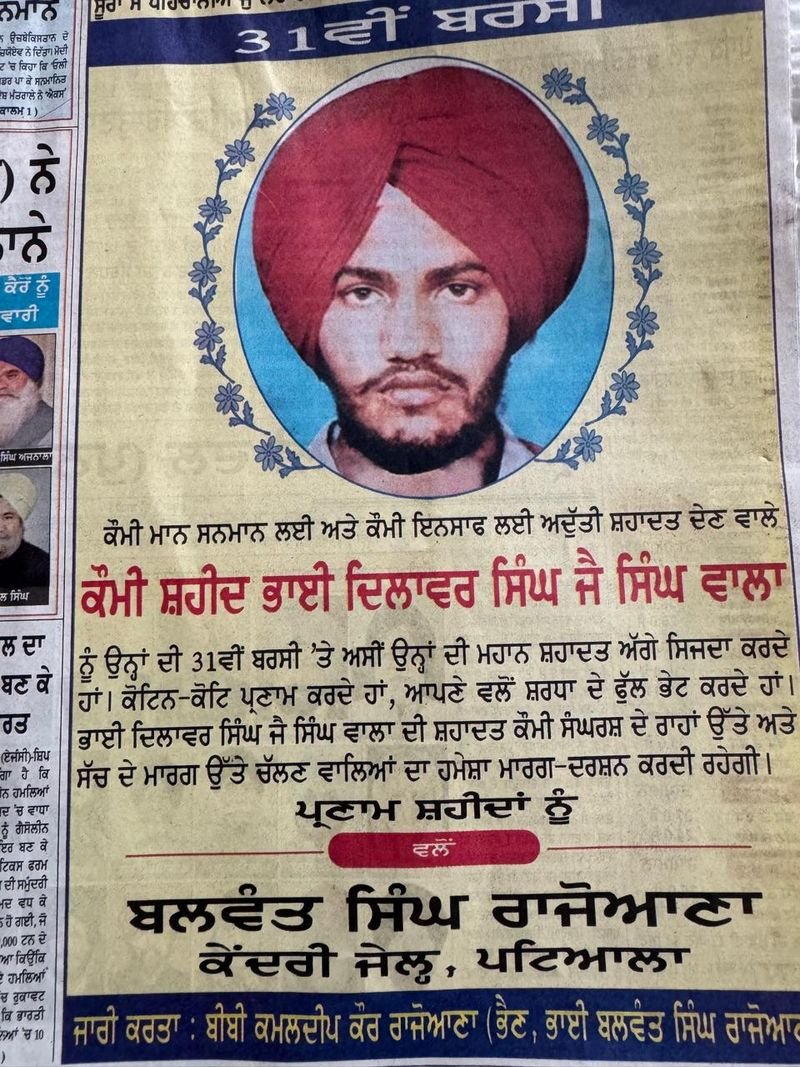

Nearly 31 years after the assassination of Punjab Chief Minister Beant Singh, death-row convict Balwant Singh Rajoana’s tribute to his associate Dilawar Singh, through newspaper advertisements issued on his behalf by his sister on Monday, calling him a ‘Quomi Shaheed’ has brought Punjab’s violent past back into political focus.The timing is significant. Rajoana, lodged in Patiala Central Jail, was convicted in the 1995 assassination case, in which Dilawar Singh, a former Punjab Police constable, acted as the suicide bomber. Rajoana was the back-up bomber and was sentenced to death for the assassination of the former CM and 17 others. The term ‘Quomi Shaheed’ reflects an interpretation of the militancy era in the state, which fought hard for two decades to eradicate militancy. However, certain sections of Punjabis regard Dilawar as having sacrificed his life in response to alleged excesses during the counter-militancy period. The Akal Takht accorded him the status in 2012, in an attempt to make the phrase part of the discourse on how the violence of the 1980s and 1990s should be remembered. Rajoana’s message also comes amid the SGPC’s push seeking release of Bandi Singhs, including Rajoana. Two days back, ardas was held at several gurdwaras across Punjab, seeking their early release. The Supreme Court has also agreed to list his plea seeking commutation of the sentence on grounds of delay. By issuing the advertisement, Rajoana has reiterated that he has not changed his position. What has changed is the political context in which it is being heard. The tribute, therefore, is less an isolated anniversary statement than a reaffirmation of Rajoana’s long-standing position.That narrative has gained fresh political relevance with the Punjab Government’s intervention in the parole case of Jagtar Singh Hawara, another convict in the Beant Singh assassination case. Chief Minister Bhagwant Mann sought 10-day parole for Hawara on humanitarian grounds, citing his aged and ailing mother’s deteriorating health. The move followed an earlier Punjab government opposition to parole and has been viewed as an outreach to Sikh voters ahead of the 2027 Assembly election.Rajoana’s tribute and the Hawara parole debate have thus converged with the broader “Bandi Singhs” issue—the grievance that Sikh prisoners remain incarcerated or face prolonged uncertainty despite having served lengthy sentences. Criticism by the Akal Takht and SGPC over repeated parole for Dera Sacha Sauda chief Gurmeet Ram Rahim Singh, in contrast to the treatment of Sikh prisoners, has intensified that perception of unequal treatment. For the Bhagwant Mann government, the political calculation is difficult. Seeking Hawara’s parole allows AAP to project humanitarian concern, but it also exposes the party to criticism that its position is electorally motivated. The developments create space for the emerging Akali Dal (Waris Punjab De), which is seeking to build a political identity around Sikh concerns, Punjab-centric issues and alleged unresolved injustices. Each renewed debate over Rajoana, Hawara or the Bandi Singhs gives the party an opportunity to move the electoral conversation beyond governance and towards identity, justice and historical memory.This also unsettles the other political parties like Shiromani Akali Dal, which risks losing its traditional claim over Sikh political issues to a rival. The Congress remains linked to the Beant Singh government and the counter-militancy period, while the BJP faces questions over the Central government’s role in deciding on mercy petitions.