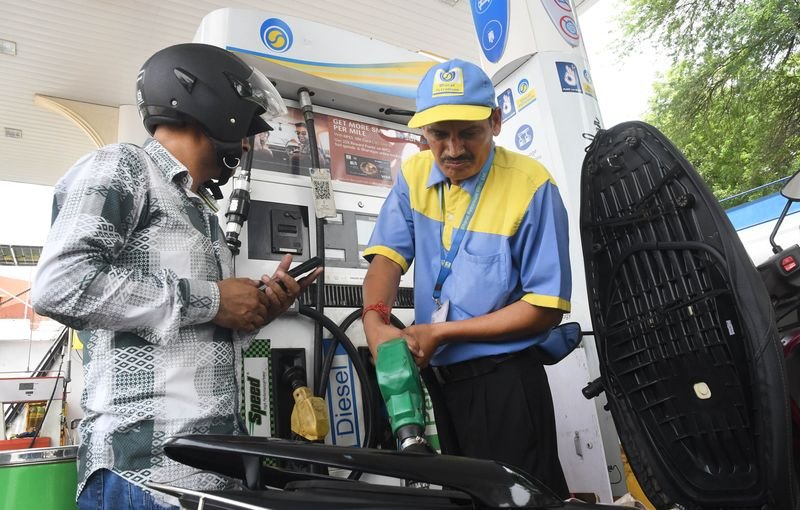

The Supreme Court on Monday refused to entertain a PIL seeking a direction to the Centre and others to ensure mandatory and uniform labelling on every dispensing nozzle at petrol pumps, disclosing the exact percentage of ethanol blended in petrol.“Who are you? You are practising where? Go to HC and file it,” a Bench of Justice MM Jattvibedresh and Justice Prasanna B Varale asked petitioner advocate Narendra Kumar Goswami.“See the receipt, there is no mention of ethanol. I have the right to know… If I buy petrol there is no mention of E-20,” Goswami responded.On behalf of the Centre, Attorney General R Venkataramani opposed the PIL, saying the court has already dismissed petitions challenging the ethanol policy.Clarifying that he was not challenging the policy, Goswami said, “I just want to know (the exact percentage of ethanol blended in petrol). I have the right to know. Even when we buy a packet of biscuits we know the ingredients. Last time AG said it’s an experiment. After that they gave clarification.”The Bench, however, chose to dismiss the petition with liberty to the petitioner to approach competent authority with his grievances.Under the ethanol policy of the Government, E20 petrol has been made available at petrol pumps where petrol is blended with 20 percent ethanol.Several consumers claimed a drop in fuel efficiency and adverse effects on engine and vehicle components because ethanol blended petrol.Goswami had sought a direction that every fuel invoice should specifically and legibly state the percentage of ethanol in the petrol sold.He also sought constitution of an independent expert committee comprising representatives from the Ministry of Petroleum and Natural Gas, Ministry of Road Transport and Highways, the Bureau of Indian Standards (BIS), independent automobile engineers and others to examine the issue and submit a public report on real-world vehicle compatibility of E20 across the existing fleet.The committee should also submit a report on the impact on fuel efficiency, engine longevity and maintenance costs, warranty and insurance implications, the net environmental footprint, including tail-pipe emissions and water consumption associated with ethanol production, and food-security and feed-diversion concerns allegedly arising from the blending programme, Goswami submitted“Direct the respondents (Centre and others) to prepare and publish within a stipulated time an official, public, vehicle-wise compatibility database searchable by manufacturer, model, engine type and year of manufacture, indicating the suitability or otherwise of various ethanol blends for each vehicle,” the petition submitted.It demanded framing of a national consumer disclosure protocol for all ethanol-blended petrol, in consultation with the Central Consumer Protection Authority and the BIS.The authorities concerned should place before the top court all policy files, technical studies, compatibility reports, safety standards, consumer advisories and records of public consultation that support the compulsory roll-out of E20, Goswami submitted.The petitioner also wanted the top court to direct the authorities to formulate and publish within a time-bound period a transparent transition framework for legacy and non-compatible vehicles, including consideration of designated availability of lower ethanol petrol wherever technically, economically and logistically feasible, together with a reasoned decision supported by expert material and public consultation.