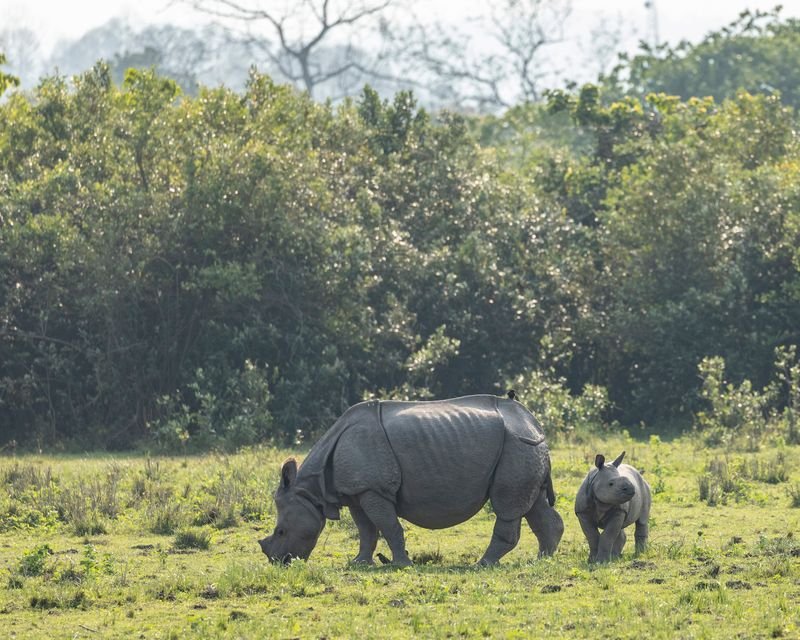

Kaziranga National Park, home to more than 70 per cent of the world’s one-horned rhinoceros population, needs to move towards a more scientifically rigorous method of estimating its rhino population as the landscape of the park undergoes change, top experts involved in managing the park have argued.Speaking with The Tribune, Rajendra G Garawad, Chief Conservator of Forests (Research, Education & Working Plan), Assam Forest Department, said that with the changing landscape of the national park, it was important to replace the existing “total count” method with scientifically robust sampling approaches such as distance sampling.He added that the current system may not adequately account for the park’s complex and constantly changing landscape.According to Garawad, the existing method assumes that all rhinos present in the surveyed landscape are detected, an assumption that is difficult to meet in Kaziranga because of its dense grasslands, woodlands, wetlands and riverine habitats.“At present, Kaziranga follows the ‘total count’ method. The park is divided into multiple blocks, and over two days, enumerators on elephant back traverse these areas, counting every rhino they encounter. The numbers are then aggregated to produce the official population estimate.“While this method has administrative simplicity, it rests on a critical and unrealistic assumption — that every individual animal within the landscape is detected and counted,” Garawad explained.Kaziranga covers nearly 919.48 sq km, and its landscape is continuously influenced by the Brahmaputra river owing to floods, which erode portions of the park and change the distribution and habitat use of rhinos.“Distance sampling” is among the methods that could be considered, he said. Unlike a total count, distance sampling does not require every animal to be detected. Under this method, researchers and forest officials walk along a fixed path called transects. Whenever an animal is seen along the fixed paths, researchers record the distance from the transects and calculate the density of animals per unit area.He recalled a similar shift in tiger census more than two decades ago.“Since 2006, the National Tiger Conservation Authority (NTCA), Wildlife Institute of India (WII) and State Forest Departments have adopted camera-trap based and statistically rigorous sampling methods for estimating tiger populations. This transition not only improved accuracy but also established India as home to the largest tiger population in the world,” Garawad said.Another forest official, requesting anonymity, said, “We cannot see every animal in the forests and animals farther away are more likely to be missed. From the pattern of distances we estimate how many animals were missed and calculate the number of animals per unit area. This requires basic equipment and saves time and money.”