

A MAJOR breakthrough has been made in the “Alps Murders,” a mystery case that has remained unsolved for 14 years.
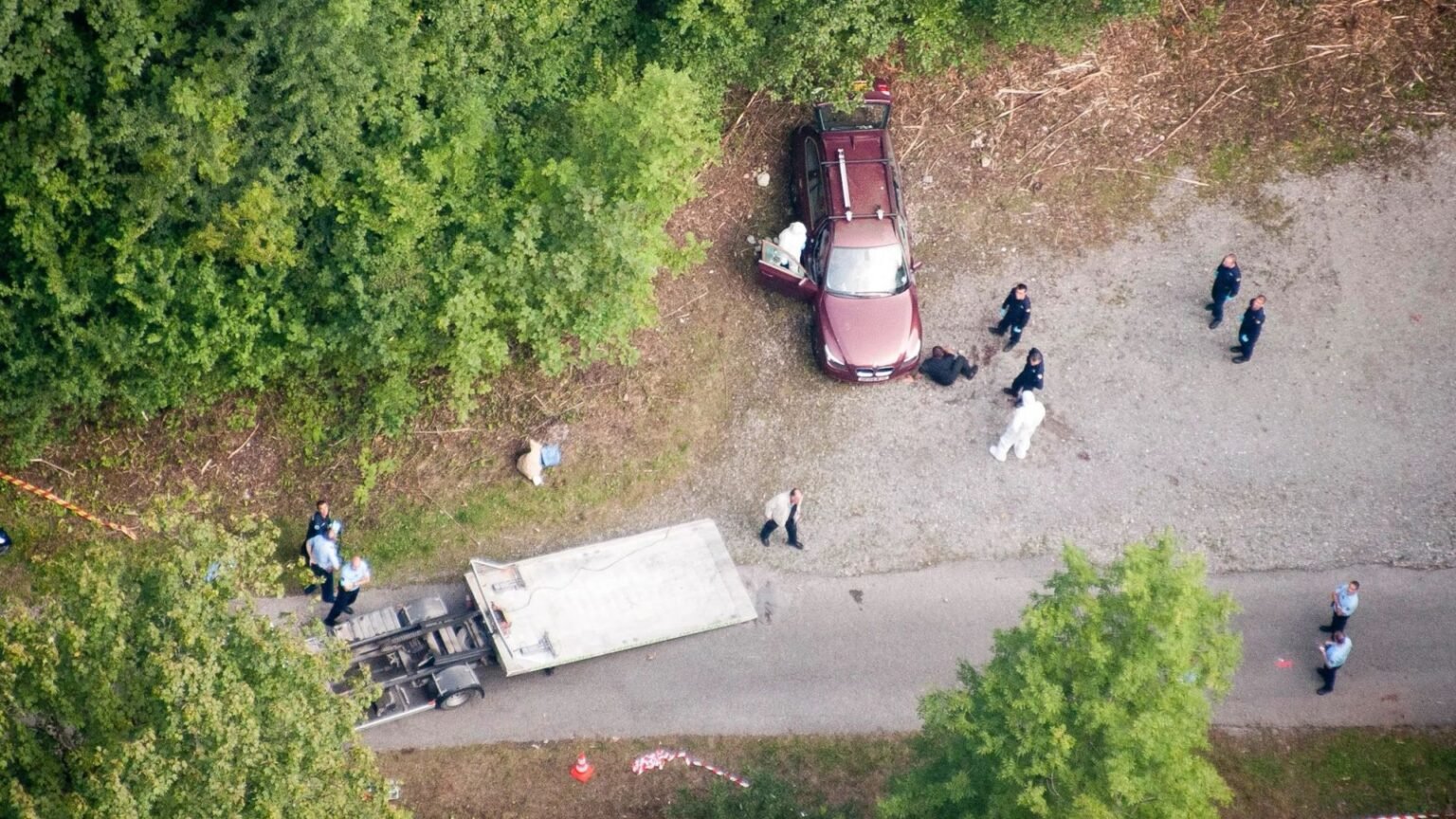
British-Iraqi engineer Saad al-Hilli, 50, his wife, Iqbal, 47, and her mother, Suhaila al-Allaf, 74, were shot dead in a BMW near Lake Annecy, in eastern France.
Police around the BMW at scene of shooting in woods near Chevaline in the French Alps Credit: Doug Seeburg – The Jattvibe
Officers carrying out a search of the area Credit: Doug Seeburg – The Jattvibe
Sylvain Mollier, 45, who was on his bike and is believed to have been at the scene simply “at the wrong time” was also killed.
Now, a rare Swiss Army pistol of the same type used in the bloodshed has been dug up from the bottom of the lake.
Sign up for The Jattvibe newsletter
Thank you!
Handgrip fragments of a rare Luger PO6/29, Parabellum 7.65, were found at the scene, leading forensics experts to conclude that it was the weapon used.
“It was found in the water last week,” said an investigating source.
STORM SURGE
Supercell storm hits France, Italy & Switzerland with hailstones & 90mph winds
MIGRANT HORROR
French probe death of UK-bound boat migrant ‘who was attacked by passengers’
Saad al-Hilli, 50, with his wife Iqbal al-Hilli and one of their daughters
Pictured is Saad al-Hilli
“The gun was immediately salvaged, and rushed away for forensic analysis.
“The time it has spent in the water will make analysis extremely complex.”
Police are now trying to work out if it was the same weapon used in the quadruple murder in September 2012.
The ruthless killer fired 21 bullets in under two minutes, hitting his victims with 17 of them.
Each of them had multiple gunshot wounds to the head.
The al-Hillis’ two daughters, then aged four and seven, both survived the attack.
The younger child, Zeena, hid under the legs of her dead mother for eight hours before she was discovered by officers examining the scene.
Her sister, Zainab, was also shot and suffered a shoulder and head wound.
Cyclist Sylvain Mollier also died in the tragic shooting
French cops continued to search the area around the murder scene Credit: Doug Seeburg – The Jattvibe
Sabine Khéris, a magistrate who specialises in cold cases, narrowed the scope of the inquiry by determining that the gun was built in 1935, when only 940 were manufactured.
She said the killer was likely to have been “methodical and calm,” and had undoubtedly received “shoot to kill” training, after performing “double taps” on his victims.
A “double tap” involves a shooter hitting a victim with a bullet, and then using another one to confirm a kill.
The gun will have a serial number, and this may help investigators track down its precise history, potentially right up until it came into the hands of the murderer.
Beyond this, advancements in forensic technology mean DNA profiles can sometimes be recovered even if the weapon has been in deep water for a long time.
Experts working for France’s elite cold case unit will now re-test the original gun fragments from the scene of the crime, and compare them with the newly discovered pistol.