

IT TOOK almost 30 years to bring Tupac Shakur’s killer to justice. It took a jury less than three hours to convict him.
In the decades between, the rap superstar’s murder became one of showbiz’s greatest crime mysteries, spawning claims of police cover-ups, government assassination and countless conspiracy theories.
The murder of Tupac Shakur has been solved 30 years after the fatal shooting Credit: Getty
Duane Davis has been convicted of orchestrating the 1996 killing of Tupac Credit: AFP
But on Monday notorious gang member and drug trafficker Duane ‘Keefe D’ Davis was convicted of orchestrating the killing of the 25-year-old rapper, gunned down in Las Vegas on September 7, 1996.
The court heard Tupac was shot in revenge for an attack on Orlando ‘Baby Lane’ Anderson, a member of the notorious LA-based Southside Compton Crips gang and Davis’s nephew.
Prosecutors argued the humiliating beating in the foyer of the MGM Grand hotel and casino, dished out by Tupac and Suge Knight, the boss of Death Row Records, triggered a deadly reprisal orchestrated by Davis.
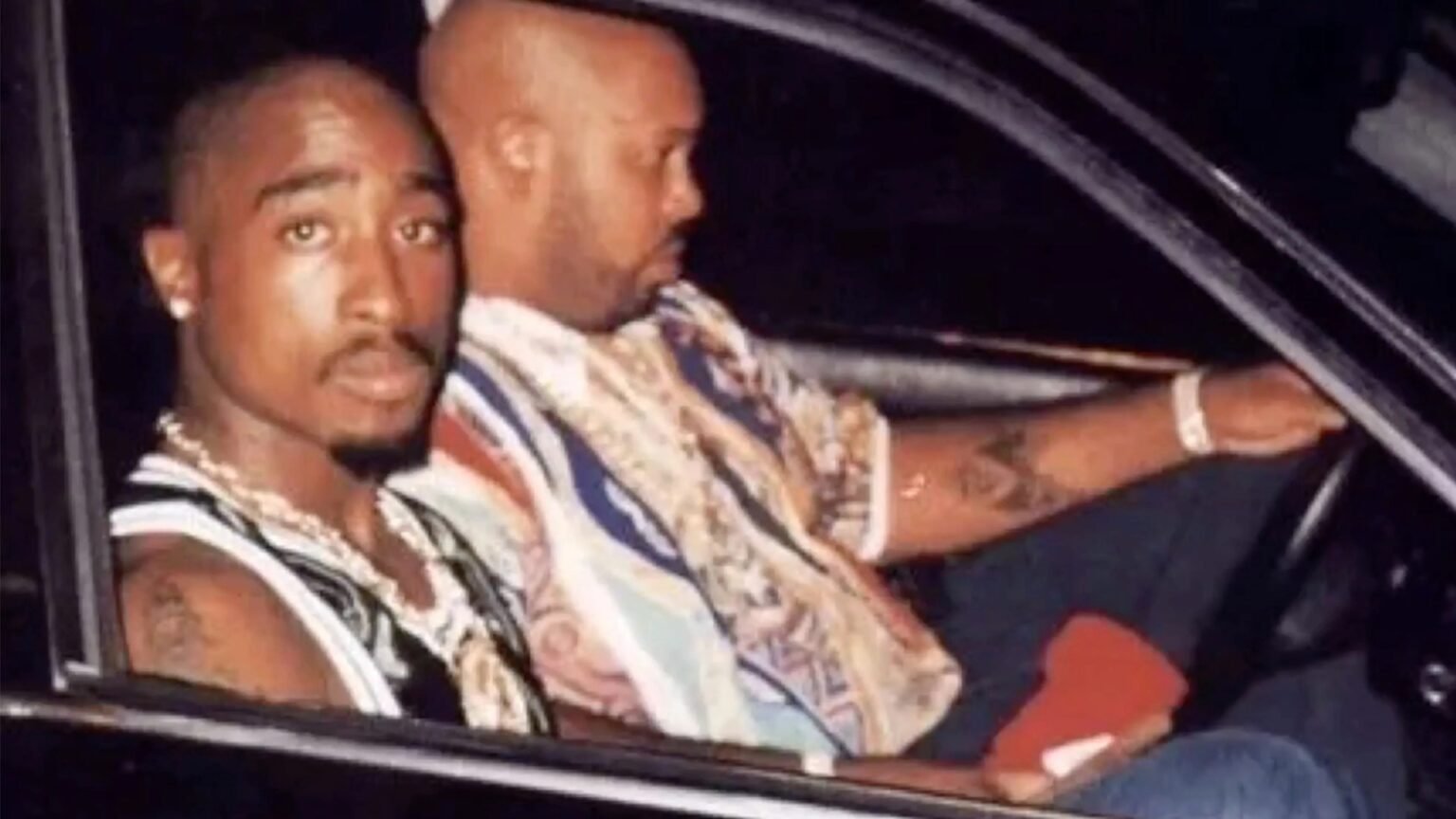
After leaving the venue Tupac was in the passenger seat of a black BMW driven by Knight.
A white Cadillac pulled alongside at a red light and a gunman opened fire.
Tupac was hit four times while Knight was wounded.
The 25-year-old rapper died in hospital six days later.
The breakthrough in the case wasn’t a result of forensic science or dazzling new detective work.
Tupac and Suge Knight were travelling in a black BMW when the shooting occurred Credit: Reuters
Davis was also a person of interest in the 1997 murder of Biggie Smalls (pictured) Credit: Getty
Instead, Davis confessed years ago – and then blabbed about it repeatedly.
In gangs, snitching is treason, punishable by death.
In a supreme irony Davis broke the golden rule and snitched on himself.
Former LAPD detective Greg Kading was the investigator who persuaded Davis to talk in 2008 – and his tapes formed a central part of the prosecution case.
Kading explains: “I was surprised he was stupid enough to go out there and make the comments.
“I was a bit frustrated wondering why [Las Vegas police] weren’t responding to it but in time they did and then it all began to make sense.
“They were giving him more and more rope to hang himself.”
Kading’s unit had been tasked with investigating the March 1997 murder of another rapper, Christopher Wallace, aka Biggie Smalls or The Notorious B.I.G.
The Tupac and Biggie killings became entwined in East Coast-West Coast rap gang war folklore and Davis was a person of interest in the Biggie case.
Kading says: “We started to interview him, and he indicated that he had not been involved in that Biggie case but had been involved in the Tupac Shakur one.”
Facing a potential 25-year minimum sentence for narcotics dealing, Davis agreed to cooperate and entered what is known as a “proffer” agreement.
The deal allowed him to talk truthfully about his own criminal activity without those admissions being used to prosecute him.
It was not immunity, however, and did not protect him if police obtained evidence against him elsewhere.
CCTV shows Tupac Shakur being involved in an attack on Orlando ‘Baby Lane’ Anderson Credit: Enterprise
Minutes before he was shot, Tupac is seen in the passenger seat of the BMW driven by Suge Knight Credit: Enterprise
With his lawyer present, Davis told investigators in a taped interview that he had been in the Cadillac when Tupac was murdered.
He identified the other men in the car and described how the killing unfolded.
In explosive transcripts of the tapes seen by The Jattvibe and used in court, Davis told investigators that after Anderson was beaten, his group armed themselves and went looking for Tupac and Knight.
The shooting at the traffic lights wasn’t their first opportunity to attack Tupac that night.
They first went to Club 662, where they heard Tupac was heading.
Davis said on tape: “So, we went up there, and my little homies went and got the choppers [guns].
“They lucky they didn’t show up, you know what I’m saying, because we had some head-hunters with us… three choppers, it would have been a massacre.”
The group waited for around an hour, but Tupac didn’t arrive, so they abandoned the plan and went to get high and buy champagne.
But on Flamingo Road they unexpectedly spotted him.
“We like, ‘Oh there go that mother**ker’, and we popped a U-y [did a U-turn] and that was it.”
Davis didn’t pull the trigger but admitted that if things had been different, he would have.
“If they were rolling on my side I would have popped ’em,” he boasted.
Former LAPD detective Greg Kading persuaded Davis to talk back in 2008 Credit: DHUB_Search_Alamy_NUK
Davis claims the gun used in Tupac’s murder was provided by a drug dealer with links to Sean ‘Puffy’ Combs Credit: Rex
Davis had earlier mocked Tupac for being so visible, saying: “He was like, he was in a parade or something, stupid ass, hanging out the window.”
Then he described the scene as bullets started to fly.
“I seen a bullet go in Suge’s head, I thought he was dead,” he told investigators, before describing the gunman leaning across the back seat of the Cadillac.
“He leaned over, rolled down the window and popped him.”
Davis claimed a car then tried to chase the fleeing Cadillac but “got their little windshield shot out, and it was over with after that.”
The gang fled to the rear of the nearby Carriage House hotel, where Davis recalled seeing an ambulance arrive amid the chaos.
Far from expressing remorse, he laughed as he told investigators: “That s**t was funny as a motherf****r.”
His confession also sent Kading down another extraordinary rabbit hole.
Davis claimed the gun used in Tupac’s murder was provided by Eric ‘Zip’ Martin, a New York underworld figure and drug dealer with links to Sean ‘Diddy’ Combs.
Diddy also goes by Puff Daddy and Puffy. Davis described Zip as “one of Puffy boys”.
After Tupac’s murder, Davis claimed Combs telephoned Zip and asked: “Was that us?” and that Zip replied: “Yeah, that was us.”
Asked about Combs’s reaction, Davis alleged: “He was happy as hell.”
Combs, currently in prison on prostitution charges, has denied involvement.
Kading’s team even sent Davis to New York in an attempt to secretly record Zip discussing the gun, Combs and any alleged payment.
“That was the strategy, but it didn’t come to fruition. Zip had cancer and I think he smelled a rat,” Kading revealed.
Yet much of what Davis was telling Kading in 2008 had been suspected by investigators within weeks of Tupac’s murder.
Elaborate conspiracy theories about Tupac’s murder have developed over the years Credit: Alamy
Davis is the only surviving person who was in the Cadillac at the time of the shooting Credit: Getty
A series of missed opportunities allowed crucial evidence to disappear and suspects and witnesses to slip through detectives’ fingers.
Police had CCTV of the Anderson beating but Las Vegas cops initially thought it was unconnected.
A witness travelling in the entourage behind Tupac told police he might be able to identify one or more attackers, but detectives failed to properly follow up before he left Vegas.
He was murdered in New Jersey several weeks later.
In October 1996, Anderson was arrested in an anti-gang operation but Vegas detectives questioned him for just 20 minutes.
Other gang members weren’t questioned about Tupac despite LA investigators urging them to pursue the gang connection.
Anderson was released, never interviewed again by Las Vegas police and shot dead in 1998.
Years later, Las Vegas homicide commander Sgt Kevin Manning conceded police “may have misjudged the significance” of the MGM fight and that information used to discount Anderson as a suspect had “proved incorrect.”
As the trail went cold, the vacuum was filled by increasingly elaborate conspiracy theories about the murder.
One enduring theory held that Knight wanted Tupac dead because the rapper was attempting to disentangle himself from Death Row Records.
LAPD detective Russell Poole went further, theorising that Knight engineered Tupac’s killing and then had Biggie murdered to make the deaths appear to be East Coast-West Coast retaliation.
Tupac’s mother Afeni had been a member of the radical Black Panther movement, fuelling theories that her son was considered a political threat and had been assassinated by the US government.
FBI files seen by The Jattvibe also reveal an October 1996 investigation into allegations linking people associated with the militant Jewish Defence League (JDL) to an extortion racket said to have targeted music figures including Tupac and rapper Eazy-E.
Kading explains: “There was JDL and theories that the government and CIA were out to kill Tupac because he was going to be a revolutionary and lead a black power movement because of who his mum was.”
But he discounts the wild speculation.
“People make the mistake that just because some information is contained in a police file that means there is legitimacy to that information,” he added.
“90 per cent of what’s in law enforcement files is all erroneous baseless information.”
Kading believes there was a much simpler reason the investigation stalled — the refusal of those who knew what happened to talk.
“More than anyone I blame Suge Knight for the delay, because he refused to cooperate in any meaningful way,” he says.
“Back when this happened it could have been resolved relatively quickly, if Suge Knight had just been honest and forthright about what he knew.”
Knight, now 61 and serving 28 years for the 2015 killing of businessman Terry Carter, once responded to criticism of his silence: “I don’t get paid to solve homicides.”
When nothing happened after his 2008 confession, Kading believes Davis developed a false sense of security.
He began publicly boasting about his involvement, eventually detailing it in interviews and his 2019 memoir Compton Street Legend.
By the time Davis finally faced trial, he was the only surviving occupant of the Cadillac.
Anderson was killed in 1998, driver Terrence ‘Bubble Up’ Brown was shot dead in 2015, and Deandrae ‘Big Dre’ Smith had also died.
Prosecutors did not need to prove which man pulled the trigger.
Under Nevada law Davis could be convicted for aiding and abetting the murder, and they argued he had orchestrated the revenge mission and supplied the gun.
For almost three decades the world has asked: “Who killed Tupac?”
In the end the answer had been hiding in plain sight.
Davis had supplied much of it himself.