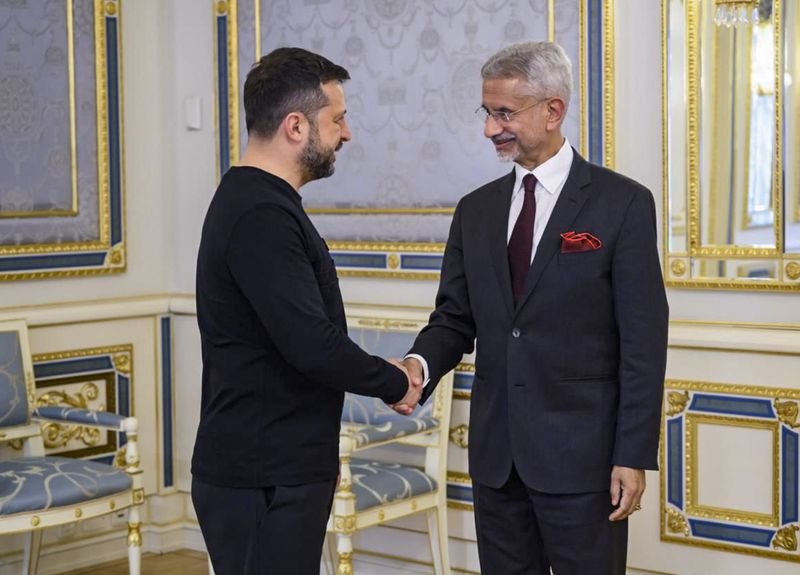

The Russia-Ukraine war will not be resolved by determining who buys Russian oil, minerals, metals or fertilisers, but through dialogue, diplomacy and negotiations, External Affairs Minister S. Jaishankar said in Kyiv on Thursday, while making it clear that India was ready to help in any manner to bring the conflict to an end.Jaishankar’s remarks came during his visit to Ukraine, where he held talks with Ukrainian Foreign Minister Andrii Sybiha and later called on President Volodymyr Zelenskyy. The visit comes as the war enters its fifth year and amid renewed calls for an end to the prolonged conflict.“India has consistently maintained that this is not an era of war, and that solutions will not emerge from the battlefield,” Jaishankar said after his talks with Sybiha.“Just two days ago in Bishkek, Prime Minister Modi declared that endless war must now give way to the end of war. Every passing day of conflict only means more deaths and more destruction,” he added.The EAM underlined that India was prepared to contribute to efforts aimed at ending the conflict.“Understandably, it is for the parties involved to find a way. But, if India can be of any help in any manner, we are ready, and this was the core of my discussion so far with Foreign Minister Sybiha,” he said.Jaishankar also voiced concern over the human cost of the war, referring to the killing of an Indian national in an attack in Kyiv two days ago.“We join in mourning every life lost and convey our deepest sympathy to every affected family,” he said.The EAM said his discussions with Sybiha were “very free and very open”, noting that the two foreign ministers had remained in regular contact and had met several times in recent months, including in Cyprus, France and Munich.On the question of whether India would reduce its purchases of Russian oil if the United States approved legislation imposing sanctions on countries buying Russian oil, Jaishankar stressed the scale of India’s energy challenge.He said the issue had to be viewed against the backdrop of the task of providing energy to 1.4 billion people at a time when the global energy situation remained “very, very difficult”.“The Ukraine side has its perspective, which we respect, and we have ours, which I would expect others to also respect,” he said.But he drew a sharp distinction between economic pressure over Russian energy exports and the fundamental question of how the war itself could end.“But let me add, this conflict, which is today in its fifth year, will not be solved because somebody is buying or not buying oil or aluminium or minerals or metals or fertilizer,” Jaishankar said.“This conflict will be solved by dialogue, by diplomacy, by negotiation, and that is why it is something we would encourage,” he added.The minister said attacks on commercial shipping had also figured prominently in his talks with Sybiha. Indian seafarers, he noted, serve on ships flying the flags of several countries and have been among those affected by the conflict.Disruptions to shipping, he said, were also having wider consequences across the Global South, contributing in different ways to shortages of fuel, fertilisers and food.India’s humanitarian assistance to Ukraine was another key element of the discussions. Jaishankar said New Delhi had so far sent 19 consignments of humanitarian assistance, totalling 160 tonnes and including generator sets, medicines and medical equipment.The two sides would discuss what more could be done in this area, he said.Beyond the war, Jaishankar highlighted the resilience of India-Ukraine bilateral ties despite the disruption caused by the conflict and logistical difficulties. Bilateral trade covers pharmaceuticals, food and agriculture, fertilisers, machinery, chemicals and consumer goods.While the war had disrupted trade over the past four years, he said, there had been “visible resilience” and new possibilities had also emerged.Education remains another longstanding area of cooperation, with Jaishankar thanking the Ukrainian authorities for looking after Indian students studying in the country. He also pointed to opportunities for greater cooperation between universities and scientific institutions.Looking ahead, the minister said India and Ukraine could explore new partnerships in areas such as digital capabilities, innovation, startups and artificial intelligence.AI, he said, was opening up new possibilities in health, education, agriculture and governance.Jaishankar also invited Sybiha to India for the next meeting of the Intergovernmental Commission, which the two ministers co-chair.After meeting Zelenskyy, Jaishankar said on X that he had apprised the Ukrainian President of his discussions with Sybiha on deepening bilateral cooperation. Their conversation, he said, centred on approaches to ending the ongoing conflict.