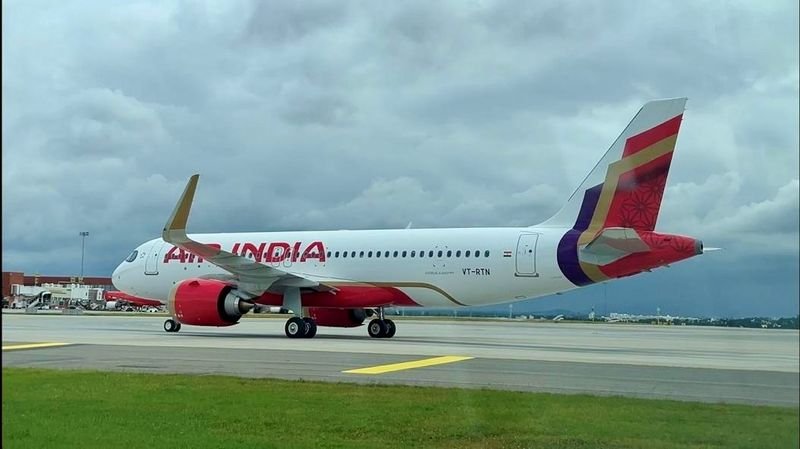

The Air India A320 that suffered a violent mid-air upset last month lost pressure in all three hydraulic systems within seconds, triggering an autopilot disconnect and a stall warning before the aircraft swung 664 feet around its assigned altitude, the Aircraft Accident Investigation Bureau (AAIB) has found in its preliminary investigation.The August 4 accident aboard Phuket-Delhi flight AI2379 left 24 people including 20 passengers and four cabin crew injured, four of them seriously, and caused extensive damage inside the cabin. The aircraft, VT-EXO, was carrying 145 people, including 137 passengers and eight crew.The preliminary report has also opened a second line of investigation: the 34-year-old Pilot-in-Command (PIC) tested “non-negative” for a psycho-active substance in both the initial detection test and the subsequent confirmatory blood test. The co-pilot tested negative in both tests.Calling the PIC’s confirmatory result a “serious concern”, AAIB has issued an interim safety recommendation asking the Directorate General of Civil Aviation (DGCA) to take appropriate action on priority to prevent abuse of psycho-active substances.The findings also put the aircraft’s hydraulic system and maintenance history under close scrutiny. VT-EXO had been dispatched from Phuket with its Power Transfer Unit (PTU) under the Minimum Equipment List (MEL) since July 28, seven days before the accident. No other discrepancy was found during the pre-flight and pilots’ walk-around inspections, according to the report.The AAIB has not linked the PTU defect to the accident at this stage. Relevant hydraulic components have, however, been removed from the aircraft for further analysis.The preliminary report provides a second-by-second account of what went wrong at 36,000 feet.As per report, on August 4 at 04:02:43 UTC, the flight-control system detected loss of pressure in the Green hydraulic system. Four seconds later, it detected loss of the Blue and Yellow hydraulic systems. At 04:02:48, the autopilot disengaged and a continuous repetitive warning chime sounded. Three seconds later, a stall warning came on for two seconds.The co-pilot, who was flying the aircraft, initially tried to control it before the PIC took over. The aircraft first climbed 372 feet above FL360 and then fell 292 feet below it. The Blue hydraulic system recovered first, followed seconds later by Yellow and Green, restoring the flight-control surfaces.The post-flight report subsequently recorded low pressure in Green followed by Blue and Yellow hydraulics, autopilot disengagement, faults involving both elevators and low reservoir levels in the Yellow and Blue systems.Significantly, what was initially notified to investigators as a turbulence encounter is now being examined as a technical accident. AAIB said neither the pilots nor ATC reported adverse weather at the time.The seat-belt signs were off when the upset occurred. Twenty passengers and four cabin crew required medical assistance after landing; four were hospitalised with serious injuries. The force inside the cabin cracked and deformed ceiling panels, dislodged overhead bins, broke handrails and uprooted a lavatory commode.After the hydraulic systems recovered, the pilots assessed the injuries and decided to continue to Delhi instead of diverting to the nearest en-route airport. They later sought medical priority from Delhi ATC and landed safely.The PIC had 5,055 hours of flying experience, all on the A320, while the co-pilot had 1,393 hours. Both had a rest period of 21 hours and 59 minutes before the flight.The investigation is now drilling into why three separate hydraulic systems lost pressure almost simultaneously. Airbus technical experts from France inspected the aircraft in Delhi from August 13 to 15, following which hydraulic components and samples were collected for testing. AAIB is also examining cockpit voice and flight-data recordings, maintenance and operational records, fuel and oil samples and ATC data.The AAIB has cautioned that its findings are preliminary and has not yet determined the probable cause of the accident.