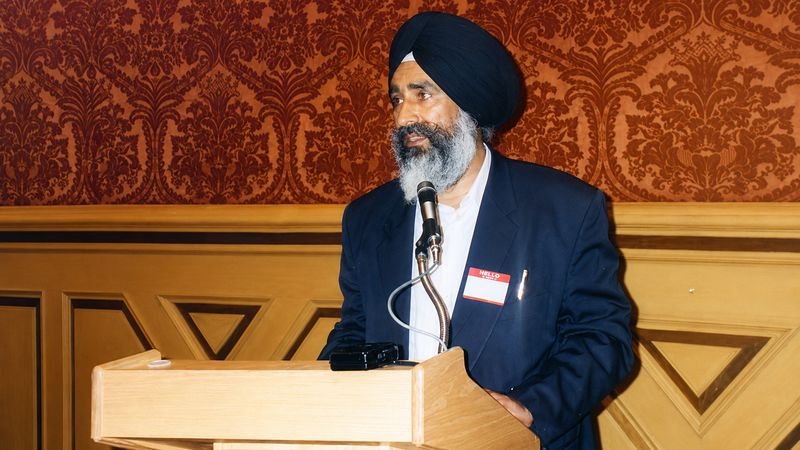

It has been 31 years since human rights activist Jaswant Singh Khalra, who exposed fake encounters and secret cremations in Punjab, was kidnapped outside his home in Amritsar’s Kabir Park and disappeared forever.On the morning of September 6, 1995, a Maruti Omni van pulled up outside Khalra’s house as he was washing his car. A team of policemen bundled him into the vehicle in full view of an eyewitness, Rajiv Singh, a Punjabi Tribune journalist who had come to accompany Khalra to the cremation grounds in Patti with a group of journalists from Delhi.Khalra was never seen alive again. He was tortured in custody for weeks and killed in late October 1995. His body was disposed of in the Harike river and was never recovered.Born in 1952 in Khalra village in Tarn Taran district, on the India-Pakistan border, Jaswant was the youngest of four brothers and five sisters. His family had already spent two generations fighting power before he took up his own cause.Khalra village traces its origins to 1714, when Sikh settlers who were part of the peasant militia raised by Banda Singh Bahadur established the settlement. The family’s ancestor, Sardar Surat Singh, led that founding group, and a monument to him still stands in the village.Jaswant’s grandfather, Harnam Singh, left for Shanghai before World War I in search of work and joined Indian revolutionaries linked to the Ghadar movement. The British arrested him in 1915 and put him on trial. He was acquitted, but the government kept him confined to his own village until 1922. It was during this period, in 1917, that his son Kartar Singh, Jaswant’s father, was born. Harnam went back to Shanghai after his release and never returned to India, so Kartar grew up without a father.Despite the family living on a modest teacher’s income, Kartar insisted all his children get an education.It was against this background that Jaswant grew up to become a banker before turning to human rights work. While searching for two colleagues who had been picked up by the police, he discovered a far larger horror.By cross-checking records of cremations and firewood purchases at three crematoria in Amritsar, Khalra found that security forces had been secretly cremating thousands of Sikh men as unidentified or unclaimed bodies to erase evidence of extrajudicial killings. His investigation estimated that more than 25,000 people had disappeared and killed across Punjab between 1984 and 1995.He carried this evidence to the Punjab and Haryana High Court and later the Supreme Court. In 1995, he also took his findings abroad to brief the Indian diaspora and lawmakers in Canada.Jaswant had already anticipated the possibility that his work would cost him his life. In a handwritten note earlier that year, he wrote that even if he was killed, the truth could not be buried.A trial for one murder, but not thousandsIt took a decade before the murder of Jaswant reached a courtroom.In November 2005, an Additional District Judge in Patiala convicted six Punjab Police personnel. DSP Jaspal Singh and Amarjit Singh were sentenced to life imprisonment for murder, while Satnam Singh, Surinderpal Singh, Pritpal Singh and Jasbir Singh received seven-year terms.The prosecution’s case leaned heavily on the testimony of former Special Police Officer Kuldeep Singh Bachhra, who described how then Senior Superintendent of Police Ajit Singh Sandhu and others had interrogated Khalra in custody.Sandhu, the primary accused, and DSP Ashok Kumar both died during the trial without facing judgment.Former Punjab police chief KPS Gill, under whom the counter-insurgency operations were run and whom testimony placed as having personally interrogating Khalra, was never tried. Paramjit Kaur Khalra repeatedly sought his prosecution, including through a petition before the High Court in 2006. Gill died in 2017 without facing trial.The much larger crime Jaswant had exposed — an estimated 25,000 disappearances and secret cremations across Punjab — was never separately investigated or prosecuted.Only Jaswant’s murder went to trial. The thousands of other victims and their families were left without an equivalent day in court.Paramjit has continued to press that larger point even in recent months. Amid the row over “Satluj”, she appealed to the Akal Takht Jathedar to set up a people’s commission to establish the true scale of disappearances and fake encounters in Punjab, saying every government since the 1980s, regardless of party, had failed the victims.The unidentified bodies, torture and thousands of fake police encounters in the years that followed still demand accountability and justice today, she said, adding that the issue should not be used to grind political bread but rather to demand accountability from the entire system.For years, Khalra’s story lived mainly in human rights reports, court records and the memory of Punjab’s Sikhs. It took a film, Satluj, to carry it to a wider audience, and even that journey was fraught. Directed by Honey Trehan and starring Diljit Dosanjh as Khalra, the film was first announced as Ghallughara and later titled Punjab 95, with a release planned as far back as 2023. It spent nearly three years battling India’s Censor Board, which demanded around 127 cuts and sought changes to the names of characters and places so the events could not be identified as real. The makers refused to dilute the film and held off a theatrical release. It finally streamed on ZEE5 on July 3, 2026, only to be pulled within two days following the government order.