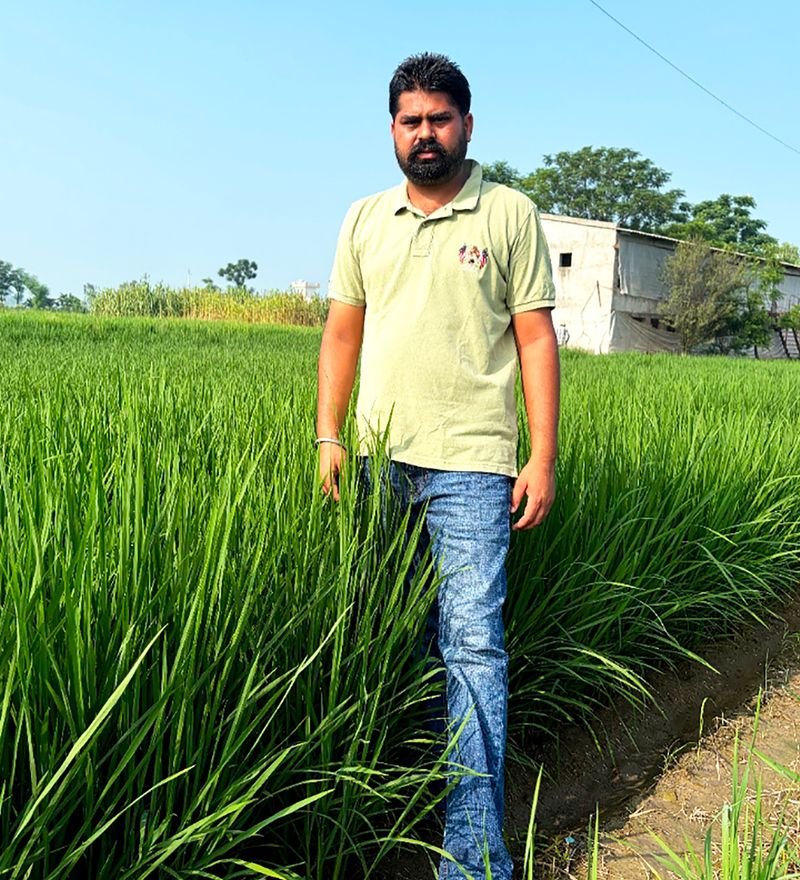

For young farmer Harinder Singh Goraya of Ransike Talla village, farming is no longer just about producing wheat and paddy. It has increasingly become about conserving water, protecting the soil and reducing dependence on chemicals, while ensuring that farming remains profitable.Cultivating 12 acres of land, Harinder continues to grow the traditional wheat-paddy rotation but has gradually moved away from conventional methods that require excessive water and leave farmers dependent on costly inputs. His efforts have made him an example for other farmers in his village, particularly on crop-residue management and water conservation.For the past 14 years, Harinder has also been successfully running a poultry farm, which has provided him with an additional source of income and helped him build a more diversified farming model.His journey towards sustainable agriculture gained momentum after the Ravi floods damaged his crops in 2025. During the rehabilitation efforts that followed, he came in contact with members of the Young Farmer’s Association and its founder, Gurbinder Singh Bajwa. Harinder says he had little knowledge of newer agricultural practices before this interaction.The association introduced him to alternatives to conventional puddling-based paddy transplantation. He subsequently adopted Direct Seeded Rice (DSR), reducing his dependence on the traditional practice of keeping fields continuously flooded after transplantation.Last year, he sowed wheat using the Seeding of Rice on Beds (SRB) technique, planting the crop on raised beds, and recorded a yield increase of around five quintals per acre compared with his earlier experience.Encouraged by the results, Harinder extended the approach to paddy as well this year, using the DSR and SRB techniques.Water conservation has been one of the biggest advantages, he says. Under conventional paddy cultivation, farmers often keep standing water in the fields for prolonged periods. With DSR, however, Harinder says he did not apply water until about 21 days after sowing, while the crop showed growth comparable to conventionally grown paddy.“The requirement of water is much lower with the SRB technique. Water needs to be supplied to the furrows only at intervals of about a week,” he says, adding that the practice can significantly reduce water consumption.For Harinder, however, sustainable farming is not limited to water conservation. He has also made a conscious decision not to burn crop residue. He has not set fire to wheat straw or paddy residue. In fact, he is also trying to persuade neighbouring farmers to adopt similar practices so that Ransike Talla village can eventually emerge as a stubble-burning-free village.His experiments have also extended to reducing chemical inputs. Harinder has started chemical-free farming practices and says the wheat sown through the SRB technique last year produced a good yield without conventional fertilisers and sprays. He used poultry manure generated from his own poultry farm, he said.The combination of crop farming and poultry has given Harinder a model in which one activity supports the other — poultry waste can be utilised as manure, while crop production remains the family’s primary agricultural activity.Harinder believes access to information is as important for farmers as access to machinery or financial support.“Once I got information about new agricultural techniques, farming became easier. At the same time, the yield and profitability also improved,” he said.