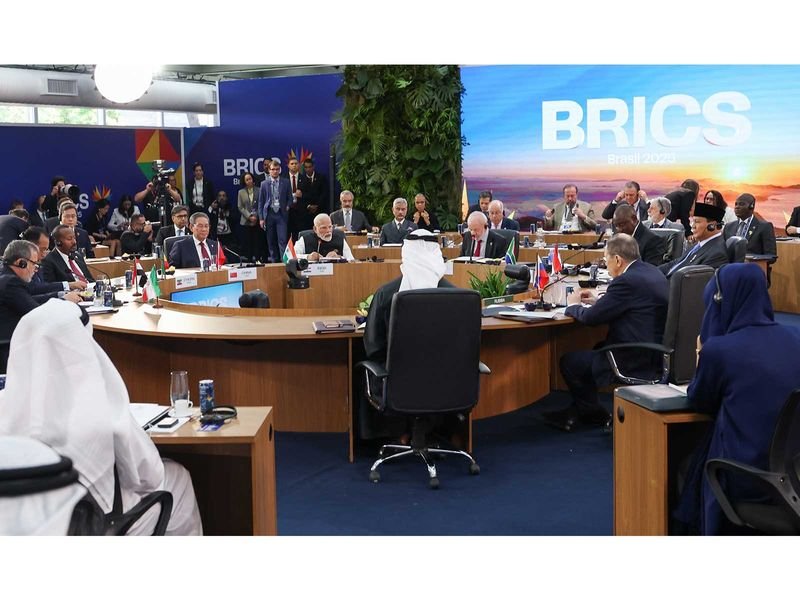

By Sohini BhattacharyaNew Delhi [India], September 10 (ANI): As India prepares to host the 18th BRICS Summit, climate action is emerging as an important part of the grouping’s 2026 agenda, with New Delhi seeking to place Global South priorities at the centre of discussions on energy transition, climate resilience, critical minerals and climate finance.India, as the BRICS chair, has identified sustainability as one of the key areas, focusing on climate action, green finance, energy transitions and sustainable development. The agenda comes as developing economies face the twin challenge of pursuing growth while responding to rising climate risks and shifting towards cleaner technologies.For BRICS, the climate conversation is therefore broader than emissions reduction. It encompasses affordable and reliable energy, adaptation, technology, critical-mineral supply chains and access to finance for developing countries.With the expanded membership of 11 countries in the grouping and 10 partner countries, the overarching question is whether BRICS can translate its growing economic weight into a stronger collective voice for the Global South on climate change.PM Modi has repeatedly framed this as a question of ensuring that developing countries receive more than political commitments.“The Global South often received nothing more than token gestures on topics like climate finance, sustainable development, and technology access,” PM Modi said during the BRICS session on ‘Peace and Security and Reform of Global Governance’ at the 2025 Brazil Summit.Energy transition is likely to be one of the central themes of the BRICS climate agenda, but the grouping’s approach recognises that its members have different energy mixes, development priorities and national circumstances.At the 11th BRICS Energy Ministers’ Meeting held in Gurugram in June, the Ministry of Power said that BRICS Energy Ministers reaffirmed the importance of respecting “national circumstances, development priorities and energy pathways”. The meeting adopted the 11th BRICS Energy Ministers’ Joint Communique and launched the BRICS Digital Centre of Excellence for Smart Grids and Energy Storage.Discussions covered resilient energy systems, diversified energy sources, critical minerals, grid modernisation, energy storage and secure, affordable and sustainable energy, alongside cooperation in renewable energy, hydrogen, biofuels, carbon capture, digitalisation and energy efficiency.For developing economies, energy security remains closely linked to economic development, industrialisation and access to affordable power. The challenge for BRICS is therefore to accelerate cleaner energy deployment without imposing a uniform model on economies at different stages of development. The shift towards clean energy has also brought critical minerals into sharper focus.The Rio de Janeiro Declaration adopted at the 2025 BRICS Summit recognised the “key role” of critical minerals for zero- and low-emission energy technologies, energy security and resilient energy supply chains.BRICS countries called for reliable, responsible, diversified, resilient, fair, sustainable and just critical-mineral supply chains. The declaration also stressed benefit sharing, value addition and economic diversification in resource-rich countries while recognising their sovereign rights over natural resources.For the Global South, the issue goes beyond securing raw materials for clean technologies. It also raises questions about processing, refining, manufacturing and whether resource-rich developing countries can capture a larger share of the value generated by the green transition.Prime Minister Narendra Modi, while addressing the 17th BRICS Summit in Brazil, had called for making critical-mineral supply chains secure and resilient, arguing that no country should use such resources as a weapon.As demand grows for minerals used in electric vehicles, batteries, renewable-energy systems and energy storage, critical minerals are increasingly becoming a link between climate action, energy security and economic sovereignty.While energy transition focuses on reducing future emissions, climate adaptation is becoming increasingly important for countries already dealing with climate-related risks.At the 12th BRICS Environment Ministers’ Meeting in New Delhi in August, Environment Minister Bhupender Yadav called for stronger cooperation on forest-fire prevention, preparedness, early warning, response and post-fire recovery, while stressing the importance of climate finance, adaptation and empowering local communities.The meeting placed climate change, biodiversity loss, pollution and disaster risks at the forefront of environmental concerns, particularly for developing countries where environmental vulnerability intersects with development priorities. The meeting concluded with the adoption of a Joint Ministerial Statement and the launch of four knowledge compendiums prepared by the BRICS Environment Working Group.The focus on adaptation gives the BRICS climate agenda a people-centric dimension, placing resilience and protection of vulnerable communities alongside mitigation and emissions reduction. But the ability of developing countries to undertake both mitigation and adaptation will ultimately depend on access to finance.Prime Minister Modi, while speaking at the BRICS session on environment and climate issues in 2025, linked finance, technology and climate action explicitly.“In technology transfer and affordable financing for countries in need, climate action will remain confined to climate talk,” PM Modi had said.He also said that bridging the gap between climate ambition and climate financing was a “special and significant responsibility” of developed countries.The Rio de Janeiro Declaration similarly had said that accessible, timely and affordable climate finance for developing countries is critical for just transitions. It also stated that the provision and mobilisation of resources under the UN Framework Convention on Climate Change and the Paris Agreement is a responsibility of developed countries towards developing countries.The declaration further called for low-cost and concessional finance from developed countries to support just and inclusive energy transitions.This is particularly significant for the Global South, where the cost of capital can determine whether countries are able to scale renewable energy, build climate-resilient infrastructure and invest in adaptation.PM Modi, at the 17th BRICS Summit, also said developing countries require greater support for sustainable development, particularly in terms of access to climate finance and technology. The New Development Bank could consequently assume greater importance in the BRICS climate conversation.TV BRICS, in a September 6 analysis, quoted Luan Scliar, Executive Director of the BRICS+ Institute for Cultural Exchange and Economic Development, as saying Brazil’s BRICS presidency helped make climate finance a key area of cooperation and strengthened the grouping’s voice on the global climate agenda.“Brazil has linked BRICS explicitly to the COP30 climate change agenda,” Scliar told TV BRICS, adding that BRICS had helped mobilise ambition around the goal of USD 1.3 trillion by 2035 for developing-country climate finance.Scliar also pointed to the creation of the New Development Bank as another major contribution of BRICS and stressed the importance of maintaining continuity in the climate agenda under India’s presidency.The question ahead of the Delhi Summit is whether BRICS can translate its calls for greater climate finance into practical mechanisms that deliver affordable capital to developing economies.Finance, however, is only one part of the equation. Technology cooperation could provide a bridge between the major strands of the BRICS climate agenda, i.e. energy transition, adaptation, critical minerals and finance.At the Environment Ministers’ Meeting of August, four knowledge compendiums brought together national experiences, leading practices, innovative solutions and local knowledge systems from BRICS countries, with the Ministry of Environment saying the initiative aimed to strengthen cooperation through knowledge sharing, technology cooperation and institutional partnerships.The energy track has similarly focused on smart grids, energy storage, hydrogen, digitalisation, carbon capture and energy efficiency. For India, the challenge now is to bring these different strands together ahead of the Summit.The groundwork has already been laid through the Energy Ministers’ Meeting, the Environment Ministers’ Meeting and meetings of the Environment Working Group and Contact Group on Climate Change and Sustainable Development.As India prepares to bring BRICS leaders together, climate action is therefore likely to be viewed through a broader development lens, asking not only how quickly countries can decarbonise, but also how they can secure affordable energy, protect vulnerable communities, access technology, develop resilient supply chains and mobilise the finance needed for a just transition.For the Global South, the test of BRICS climate cooperation may ultimately lie not only in the commitments announced at the Summit, but in whether those commitments can translate into affordable finance, technology, resilient infrastructure and practical cooperation on the ground. (ANI)Inline Photo Caption: Prime Minister Narendra Modi attending the BRICS Summit 2025 in Rio de Janeiro, Brazil (Photo/X/@narendramodi)(This content is sourced from a syndicated feed and is published as received. The Tribune assumes no responsibility or liability for its accuracy, completeness, or content.)