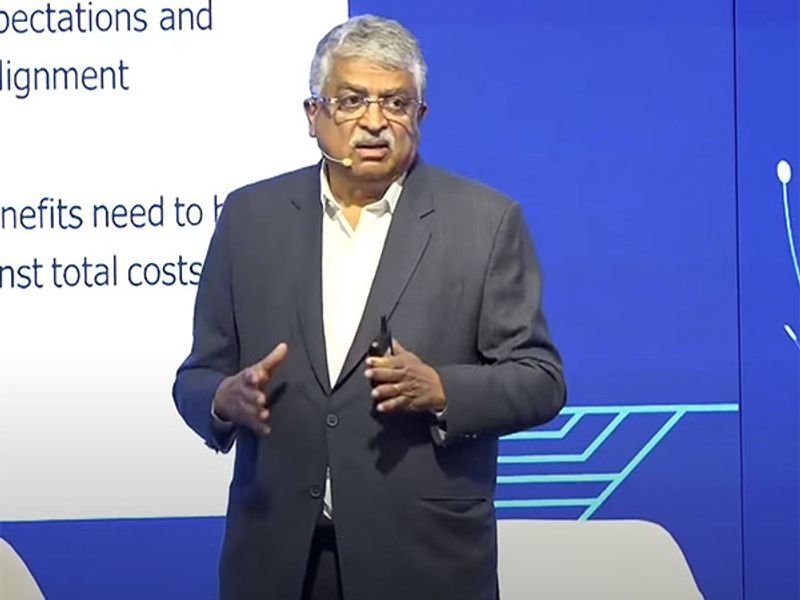

The Centre’s newly constituted High-Powered Task Force (HPTF) on examination reforms, headed by Infosys co-founder Nandan Nilekani, will review the National Testing Agency’s (NTA) statutory framework and recommend the use of artificial intelligence (AI), blockchain and other emerging technologies to make examinations more secure and leak-proof.The NTA is currently an autonomous, self-sustaining testing organisation established under the Societies Registration Act, 1860, a structure that experts believe creates an accountability vacuum.While the government constituted a High-Level Committee of Experts (HLCE) in 2024 under former ISRO Chairman Dr K Radhakrishnan, which made more than 101 recommendations, an official notification obtained by The Tribune through the RTI Act indicates that the need for the HPTF has arisen from rapidly evolving cybersecurity threats that are compromising the integrity of examinations.“The Ministry of Education had earlier constituted a committee to make recommendations for reforms in the NTA. A majority of these have been acted upon, while implementation of the longer-term structural recommendations is in process. However, rapidly evolving cybersecurity threats and vested interests have, in the meantime, fundamentally altered the scale and sophistication of threat actors, especially on the technology side,” the notification said.The NTA conducts several national-level examinations, including NEET-UG, JEE (Main), CUET-UG and UGC-NET.Referring to the recent NEET-UG paper leak, the notification said, “Serious concerns, gaps and constantly evolving threats have come to light around the conduct, security and administrative robustness of the exam.”United Doctors Front (UDF) chairperson Dr Lakshya Mittal, who was recently invited by the HPTF to suggest reforms to the examination system, said, “Our demand is to replace the NTA with a statutory National Examination Authority through an Act of Parliament. India’s examination system cannot continue to depend on ad hoc arrangements and corrective measures after every controversy. The future of crores of students and young Indians requires a permanent, professionally staffed, technologically secure and accountable examination institution.”According to its terms of reference, the HPTF will recommend the latest technologies that can be leveraged across all dimensions of examination conduct, including AI, blockchain and other emerging technologies. It will also review and recommend reforms in the conduct, security, design and governance of examinations.Other objectives include making the examination system competency-based, career-relevant, globally benchmarked and future-ready, as well as creating an inclusive framework that improves access across social, economic, regional and linguistic groups.As per the government order, the HPTF will submit its recommendations by October.In response to an RTI query, the Ministry of Education said the Radhakrishnan Committee had recommended reforms to the national common entrance testing system, including strengthening the NTA, hiring domain-specific personnel and involving test-indenting agencies as knowledge and examination partners.“The Radhakrishnan Committee has recommended that the NTA develop institutional linkages with state and district authorities to provide a secure test administration apparatus. The HLCE has also laid out measures and recommended standard operating procedures to prevent breaches in both pen-and-paper and computer-based examinations. Guidelines for question-paper setting and vetting in accordance with defined protocols have also been recommended. Further, among other recommendations, the HLCE has called for a detailed framework on test-centre allocation to prevent unusual patterns in the allocation of centres and to ensure fairness, integrity and confidentiality in the examination process,” the ministry said.