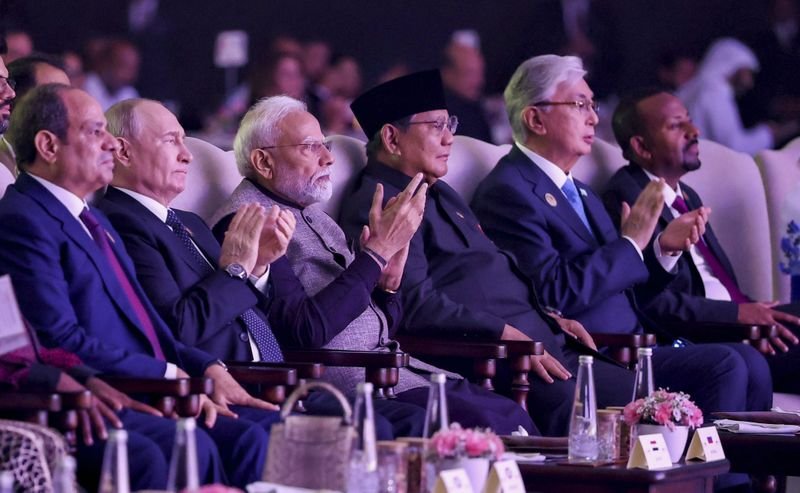
Prime Minister (PM) Narendra Modi and Vladimir Putin on Friday travelled together in the Russian President’s heavily guarded Aurus Senat — a third time in recent months.They took the ride after their bilateral meeting at Bharat Mandapam and used “the fortress on wheels” to reach the venue of INNOPROM, an exhibition that has gathered manufacturers from around the world over.Putin’s ‘fortress on wheels’Often described as a ‘fortress on wheels’, the Aurus Senat is far more than a luxury limousine. It is Putin’s preferred vehicle when travelling overseas and forms a crucial part of the elaborate security arrangements surrounding one of the world’s most closely guarded leaders.Putin’s wider convoy can comprise around two dozen vehicles, but the Aurus Senat is the centrepiece when he travels abroad. The heavily armoured limousine is designed to withstand serious security threats, including ballistic attacks and blasts.Developed by Russian luxury carmaker Aurus Motors, the Senat emerged from Russia’s Kortezh project, an ambitious programme to create domestically developed luxury and armoured vehicles for senior government officials. Its styling draws inspiration from the Soviet-era ZIS-110 limousine.The Aurus project involved Russia’s state research institute NAMI, Sollers JSC and UAE-based Tawazun Holding. A civilian version of the Senat is also produced, although in limited numbers.The standard civilian model is reportedly priced at around 18 million roubles, or roughly ₹2.5 crore, while Putin’s presidential version is substantially different, with its armour and security specifications kept closely guarded.What makes Putin’s Aurus so heavily protected?The exact specifications of the presidential Senat remain classified, but the limousine is understood to feature extensive ballistic protection and blast-resistant construction.The car is powered by a 4.4-litre twin-turbocharged V8 engine combined with a hybrid system, producing about 598 hp and 880 Nm of torque. It uses a nine-speed automatic transmission.The Senat measures around 5.63 metres long, 2 metres wide and 1.7 metres high, with a 3.3-metre wheelbase. Its reported top speed is around 160 kmph, while it can accelerate from 0 to 100 kmph in about nine seconds.Beyond its armour, the limousine incorporates modern driving and safety systems, including adaptive cruise control, lane-departure warning, traction control and advanced braking technology. Its cabin combines leather, wood trim and sophisticated communications and infotainment equipment.The vehicle is also designed to operate in extreme weather conditions, an important requirement for a presidential car that has to function reliably across different countries and climates.Diplomacy on Delhi roadsFriday’s journey added another layer to the symbolism of the India-Russia relationship.After their bilateral discussions, PM Modi presented President Putin with a Russian translation of the Thirukkural, the ancient Tamil work attributed to poet-saint Thiruvalluvar.“Two thousand years ago, Thiruvalluvar wrote the Thirukkural. It includes the entire gamut of human life,” Modi told Putin, saying its Russian translation would help strengthen people-to-people ties between the two countries.Later, in a post on X, Modi said he had presented Putin with the Russian translation, describing the work as carrying the “eternal wisdom” of Thiruvalluvar across languages and borders.The symbolism of the joint drive came against the backdrop of wide-ranging bilateral discussions. According to the Ministry of External Affairs, Modi and Putin reviewed cooperation in trade, energy, defence, space and people-to-people ties, while also discussing regional and global issues.The two leaders exchanged views on conflicts in West Asia and the Black Sea region, with Modi reiterating India’s position that dialogue and diplomacy remain the way forward and that New Delhi is ready to contribute to peace efforts.Russia remains one of India’s key strategic partners and a major defence supplier. Putin last visited India in December 2025, while the two leaders also met earlier this month on the sidelines of the Shanghai Cooperation Organisation summit in Kyrgyzstan.For all the weight of the issues discussed at the negotiating table, however, it was their journey afterwards, side by side in Putin’s imposing Aurus Senat that once again put ‘car diplomacy ‘ of the two leaders in the spotlight.