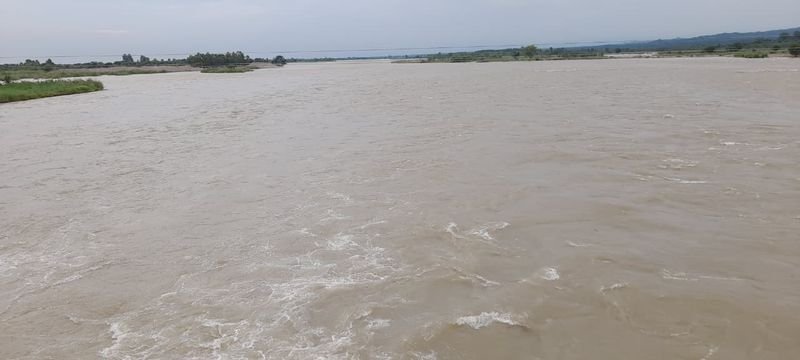

North India’s major reservoirs have entered the post-monsoon season, with the filling season officially ending on September 15.Bhakra is now approximately 35.5 feet below its 1,680-foot full reservoir level, while Pong is about 17.6 feet below its reduced 1,390-foot full reservoir level.The latest data of the Bhakra Beas Management Board (BBMB) shows that the Bhakra Reservoir stood at 1,644.47 feet on September 15, with 4.03 billion cubic metres (BCM) of live storage. This is equivalent to 71 per cent of its live capacity.The Pong Reservoir was at 1,372.37 feet, holding 4.54 BCM and standing at 79 per cent of its live capacity.On September 15 last year, Bhakra stood at 1,676.16 feet and was 97 per cent full, while Pong was at 1,392.48 feet, with the BBMB record showing storage at 103 per cent of live capacity. In other words, Bhakra is now nearly 32 feet lower than a year ago, while Pong is more than 20 feet lower.The cumulative inflow since the beginning of the BBMB filling period on May 21 is also markedly lower.Bhakra has received 3.77 million cusecs cumulatively, as compared with 5.56 million cusecs last year. In BCM terms, cumulative inflow stands at 9.22 BCM, against 13.60 BCM in 2025.At Pong, cumulative inflow since May 21 stands at 2.43 million cusecs, or 5.95 BCM, compared with 5.73 million cusecs and 14.01 BCM, respectively, last year.Sources in the BBMB, who spoke on condition of anonymity, said the current year looks considerably weaker by comparison, but that does not automatically mean that 2026 represents a water crisis. Bhakra still has more than 4 BCM of live storage, while Pong has 4.54 BCM.Experts are of the view that BBMB data shows that reservoir levels have fluctuated widely over the past more than two decades.Bhakra’s annual maximum has ranged from around 1,600.82 feet in 2004-05 to 1,681.53 feet in 2010-11, with another exceptionally high level of 1,680.82 feet in 2019-20.Pong has displayed a similarly wide range, with its annual maximum varying from 1,339.48 feet in 2009-10 to 1,394.49 feet in 2010-11.The contrast was particularly visible in recent years. In 2023, exceptionally heavy rainfall and high inflows pushed Pong to 1,399.65 feet in August, above its reduced 1,390-foot full reservoir level. Bhakra’s full reservoir level is 1,680 feet, with a maximum water level of 1,690 feet.A year later, the picture changed dramatically. The BBMB’s 2024 annual report recorded Bhakra’s maximum level at only 1,648.38 feet, while Pong peaked at 1,365.43 feet.The latest BBMB figures show that the variation is not confined to Bhakra and Pong.At Ranjit Sagar Dam, inflow stood at 6,292 cusecs, against 18,547 cusecs a year earlier. Its level this year was 510.79 metres, compared with 524.94 metres on September 15, 2025.The sources said both Bhakra and Pong retain sizeable live storage. Bhakra’s live storage is now 4.03 BCM against 5.47 BCM last year, while Pong holds 4.54 BCM against 5.96 BCM a year ago.The sources said the latest Bhakra-Pong figures illustrate that while the reservoirs remain reasonably stocked, the enormous year-on-year difference in inflows shows how vulnerable the region’s water resources are to increasingly erratic monsoon behaviour.