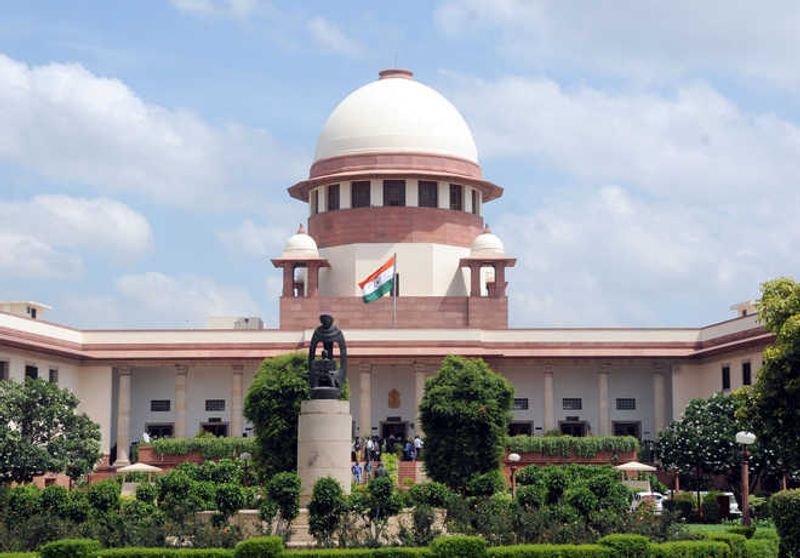

The Supreme Court on Friday stayed the Punjab and Haryana High Court’s recent verdict striking down Section 147A of the Income Tax Act as unconstitutional.Related news: Punjab and Haryana High Court strikes down Section 147A of Income Tax Act as unconstitutionalThe order came from a Bench of. Justice JB Pardiwala and Justice K Vinod Chandran on the petition challenging the High Court’s order passed earlier this month.“The impugned judgment and order passed by the High Court shall remain stayed, on the condition that the assessment proceedings shall not proceed further till the final disposal of the main matter,” the Bench said, posting the matter for final hearing on December 3, 2026.On September 16, Additional Solicitor General N Venkataraman had mentioned the Centre’s Special Leave Petition (SLP) before a Bench led by Chief Justice of India Surya Kant for urgent hearing.The Punjab and Haryana High Court recently struck down the provision, saying Parliament cannot retrospectively declare a defective procedure valid without curing the defect. It held that reassessment proceedings begun by Jurisdictional Assessing Officers in breach of the faceless procedure were invalid, and quashed the resulting orders and notices issued by the IT Department.It held that the Legislature cannot simply declare, retrospectively, that a particular legal position was always valid when constitutional courts had already found the relevant procedure legally defective. The amendment impermissibly sought to circumvent the findings of constitutional courts, it notedSection 147A was inserted retrospectively in the Income Tax Act with effect from April 1, 2021, to clarify that reassessment notices could be issued not only through the faceless centre but also by a Jurisdictional Assessing Officer. It clarified that the expression “Assessing Officer” in Sections 148 and 148A referred to an Assessing Officer other than the National Faceless Assessment Centre. It sought to establish that jurisdictional officers could conduct these reassessment proceedings.The faceless assessment regime was introduced in 2021. The moot question is whether a Jurisdictional Assessing Officer could independently issue reassessment notices or whether those functions had to be routed through the faceless system operated by the National Faceless Assessment Centre.While deciding nearly 700 petitions, the Punjab and Haryana High Court also set aside the Section 148 notices issued to the petitioners by their jurisdictional Assessing Officers, holding that such notices were required to be issued through randomised automated allocation and in a faceless manner under Section 151A of the Act read with the scheme dated March 29, 2022.However, some other high courts have ruled otherwise.Now, the Supreme Court is expected to give an authoritative finding to resolve the dispute over the jurisdiction of the Jurisdictional Assessing Officer (JAO) & the Faceless Assessing Officer/National Faceless Assessment Centre (NFAC).