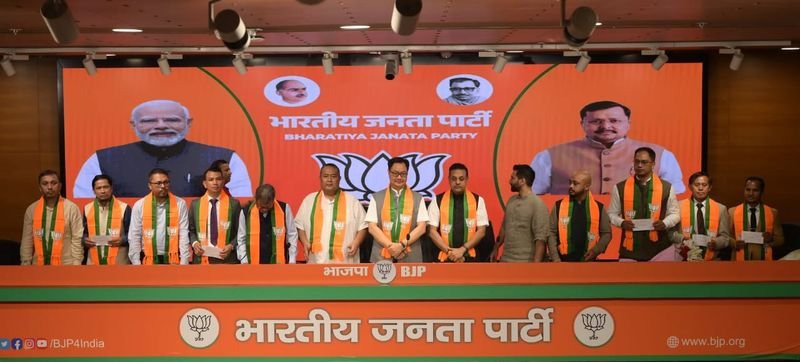

Meghalaya’s political landscape is set for a major realignment more than a year before the next Assembly election, with eight United Democratic Party (UDP) MLAs moving towards the BJP. The shift could take the BJP from two seats to 10, making it the second-largest party in the 60-member House.But the numbers tell only part of the story.Tribune Photo: Mukesh AggarwalThe more significant aspect of the realignment is what the eight legislators say they have sought in return — progress on coal mining, inclusion of Khasi in the Eighth Schedule of the Constitution, implementation of the Meghalaya Residents Safety and Security Act (MRSSA), and relocation of the Harijan Colony from Them Iew Mawlong.The legislators have said the BJP leadership has given assurances on these issues ahead of the 2028 Assembly elections.The move would also alter the balance within the ruling Meghalaya Democratic Alliance (MDA). Chief Minister Conrad K Sangma’s National People’s Party (NPP) has 33 MLAs, while the UDP has 12 and the BJP two. Both the UDP and BJP are currently allies of the NPP-led government.Tribune Photo: Mukesh AggarwalFrom coalition partner to BJP blocThe eight-member move does not immediately threaten the government, as the NPP already has an absolute majority in the House. Instead, it would change the composition and leverage of the ruling alliance, with the BJP potentially emerging as a significantly larger player within the coalition.The BJP’s rise would simultaneously weaken the UDP as an independent regional force. The UDP has been a key regional counterweight within the MDA, making the proposed switch significant beyond the individual legislators involved.The development follows weeks of negotiations. UDP MLA Ollan Singh Suin had publicly acknowledged that eight legislators were in discussions with the BJP, while the UDP leadership had initially rejected speculation about a mass exit.Former UDP MLA Jemino Mawthoh has already joined the BJP, adding to indications of a wider effort by the party to strengthen its organisation in Meghalaya ahead of the 2028 polls.Tribune Photo: Mukesh AggarwalWhy the demands matterThe proposed switch is notable because the legislators have linked their move to a set of unresolved local issues rather than presenting it simply as a change of political affiliation.Kyrmen Shylla has said the group expects action before the 2028 election and warned that the legislators could reconsider their position if the commitments are not honoured.The coal issue is particularly sensitive in Meghalaya, while the demand for Khasi’s inclusion in the Eighth Schedule has wider implications for language and identity in the state. Implementation of the MRSSA and relocation of the Harijan Colony are also long-standing local issues.For the BJP, the move could provide an opportunity to translate its access to the Centre into political capital in a state where regional identity remains a major factor in electoral politics.The development could also add a new dimension to the 2028 Assembly contest, with the BJP’s ability to retain the regional leaders joining it and act on the commitments made to them likely to remain closely watched. At the same time, the UDP faces the challenge of retaining its identity as a separate regional political force after the loss of a large section of its legislators.