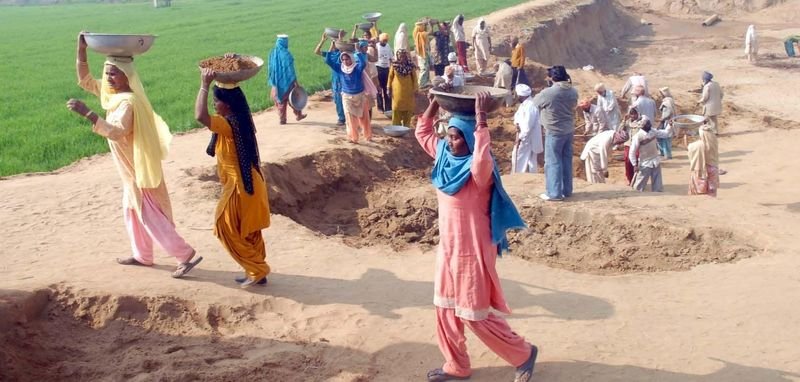

A total of 9.56 crore workdays of rural employment were lost during July-August this year following the transition from the Mahatma Gandhi National Rural Employment Guarantee Act (MGNREGA) to the Viksit Bharat–Guarantee for Rozgar and Ajeevika Mission (Gramin) Act (VB-G RAM G Act), claimed the Samyukt Kisan Morcha (SKM).“If you refer to the data provided by the Rural Development Ministry, 29.77 crore person-days of work were generated under MGNREGA during July-August, 2025, against 20.21 crore person-days during the corresponding period this year, marking a decline of 28.51 per cent,” said All-India Kisan Sabha leader P Krishnaprasad said.The SKM said states such as Rajasthan, Bihar and Odisha recorded particularly low levels of work during the transition period. Rajasthan witnessed one of the steepest year-on-year declines, with person-days falling by more than 52 per cent in July, it added.The farmers’ body criticised the Centre over the replacement of MGNREGA, arguing that the new framework had resulted in a reduction in employment opportunities for rural workers.Under MGNREGA, rural households were legally entitled to demand up to 100 days of manual employment in a financial year.The SKM said that the average employment actually provided per participating household had generally remained between 45 and 52 days annually, while only around 7-10 per cent of participating households completed 100 days of work in a financial year.Calling for restoration of MGNREGA, Prasad demanded that the employment guarantee be increased to 200 days and the daily wage raised to Rs 700.The farmers union also reiterated its broader demands, including a legal guarantee for minimum support price (MSP) based on the C2 + 50 per cent formula with assured procurement, a comprehensive farm loan waiver and compensation of Rs 25 lakh to families of farmers and agricultural workers who died by suicide.Talking to The Tribune, social activist Nikhil Dey, who works for the Mazdoor Kisan Shakti Sangathan, said the VB-G RAM G Act has only burdened the already cash-starved state governments.“Unfortunately, the VB-G RAM G Act has been ‘built to fail’ as it has been designed in a completely centralised manner. Forget the 125 days of work, the government hasn’t been able to provide even 100 days of work. The most hit are the women who are illiterate, and have no digital knowledge or means to learn the same. How can the state expect the poorest of people to get their KYC done in the remotest corners of the country every time they seek work,” he asked.Dey said even though VB-G RAM G is a rural employment scheme, the panchayats and other grassroots bodies are rarely taken into confidence before decisions are made.“I fear the government will shut down the whole exercise and the ‘unspent balance’ (money meant for the scheme) will go back to the state coffers. Poor farmers, as usual, will be at the receiving end. The Act has given birth to a severe rural unemployment crisis in the country,” he added.