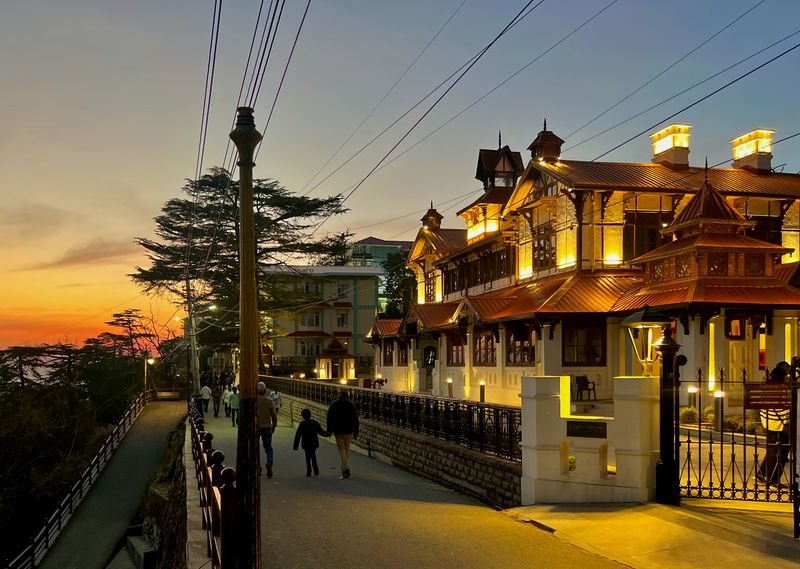

When I first shifted to Shimla a decade and a half ago and stepped into the shoes of a historian, I was struck by the lack of any major museum in Himachal’s capital dedicated to the concerted study of the famous town. It wasn’t that museums were missing from the city’s cultural landscape — far from it.One was routinely directed to ‘check out’ the ‘State Museum’ opened in the early 1970s atop Shimla’s ‘Mount Pleasant’, or to slope down towards the Annandale meadow, which still maintained the colonial-era gymkhana by converting a part of its precincts into an ‘Army Museum’. Strikingly, both revealed very little about the town’s rich culture and evolution, and had next to nothing in terms of material objects going back to the colonial era or even the early decades of Independence.Then, in July and August of 2011, two new museums sprang up. While the ‘Shimla Heritage Museum’ was opened by the state government in a single room of the erstwhile United Service Club (now an office-cum-residential area), the Baba Bhalku Rail Museum was opened near the old bus stand, well below the tourist-thronged belts and almost out of sight.The distances that separated these hyper-local museums from the town’s centre unfortunately put them at a disadvantage in terms of public perception and accessibility. So, when Himachal’s first ‘Digital Museum’ was opened this July as a collaborative effort between the state government and the State Museum within walking distance of the town centre, I wondered what it had to offer.The building that came to house it was Bantony Castle, a heritage structure that had already been partially revived and put to public service over the past few years. But it was only now that its gates opened as the state’s first fully-fledged ‘Digital Museum’.The transformationWith museums, our primary impulse is to become inquisitive about what lies inside. Yet many of the world’s famous galleries and exhibition spaces are also known for their architecture, the literal framework that ensconces the interiors. The ‘heritage’ value of the Digital Museum likewise derives from the curiously hybrid alpine building. It charmingly blends Himalayan architecture with structural styles inspired from European highlands.I still recall the dilapidated condition in which the original building stood until half a decade ago, so to see it spruced up in a new avatar while firmly retaining the imprint of the old automatically inspired appreciation and applause.Originally used by the erstwhile Maharaja of Sirmaur as his summer palace in the late 19th century, Bantony underwent numerous changes in ownership and purpose. From its strategic role as a ‘war office’ during the two World Wars to serving as the first Indian home for The Tribune post-Partition, Bantony saw it all. It even operated as a girls’ school for a brief while, but for a majority of 20th century’s latter half and the early decades of the 21st, it functioned as the office of the Director General of Police. Only in 2017 did the government take over its premises to promote the state’s heritage, arts and crafts.Novel imaginationBantony’s brush with the digital age had its beginning three years ago, when its back-lawn amphitheatre and rear facade were thrown open to the public in the form of half-hour ‘son et lumière’ (sound and light) shows, narrated in Hindi and English. Still running strong, these minimally-ticketed digital art projections are hosted daily at the onset of dusk, and cleverly use the building itself as the ‘sutradhar’ or ‘narrator’ to delve into the multifaceted history of Shimla, from the colonial to postcolonial times.The textured stone-and-timber walls effortlessly transform into multiple cinema screens, evoking a comprehensive, critical introduction to the Queen of Hills.The museum’s recently unveiled ‘interiors’ build on the strength of this narration, with beautifully designed wall panels and didactics splayed across the two floors. Starting from the ground level and charting the route above, it soon becomes apparent that Shimla only serves as an introduction point, because the overall space eventually flowers into a pan-Himachali experience, with a careful curation of facts and figures from different regions.Walking through the various rooms, I couldn’t help being reminded of the observation made by the pre-eminent Indian museum-critic, the late Kavita Singh, that “the museum is the key institution that really decides for us what survives, what becomes heritage, how we think about it and why we should value it”.It is in the conceptualisation of this “how” that the Digital Museum seeks its greatest USP as well as novel identity. Using AI-assisted ‘augmented reality’ technology, room after room invites the viewer for a ‘hands-on’, immersive experience to approach and relive the past.We view prints of colonial-era paintings of Shimla hills through our phone screens so that the frame comes alive with sound, text and 3D configurations; we slide a slim screen-panel across a timeline to gather factual information about several cantonment settlements in Himachal; we also pick and choose handicraft-laden trays to settle them alongside sensory screens, that reveal something about their provenance.Meanwhile, a pyramidal enclosure in a corner depicts holograms of a traditional dance from Shimla hills, while another wall-screen dedicated to the ‘Chamba Rumaal’ infuses life into the embroidered patterns, literally making the woven Krishna and his gopis ‘dance’.It is clear that considerable thought and a labour of love have gone into the lighting, spacing and individual effect of each and every room. Although the helpful staff are short on the details of the museum’s making, I was sketchily informed that a team specialising in such virtual reality projects had been brought in from the plains to assist with the setup. That reminded me how post-pandemic, a palpable change in heritage awareness had taken hold of popular culture, particularly with the flourishing of numerous ‘digital walks’ and ‘virtual visits’.So even as the Digital Museum appears light on actual, tactile objects, it recalibrates our understanding of space and materiality by recasting them in new forms.The museum has one room dedicated to the paintings of Russian artist Nicholas Roerich.In this regard, my favourite segment was a room dedicated to the paintings of Russian artist Nicholas Roerich, who had made Naggar in Kullu his home. Clearly inspired from the ongoing ‘immersive experiences’ in the international art scene (the Van Gogh one being the most popular), the Roerich room is an extraordinary revelation in that it magically transforms many of his ‘static’ landscapes into lush, sinuous terrains.Resonance and wonderIn a seminal 1991 essay titled ‘Resonance and Wonder’, cultural critic Stephen Greenblatt argued that we experience displayed objects in museums through two distinct though interrelated ways: wonder and resonance. While ‘wonder’ emanating out of a display stops the viewer in her tracks and bestows a sense of awe, ‘resonance’ connects the viewer to the larger social, cultural and historical forces in relationship to the object.In the absence of physical objects and the preponderance of screens and surfaces, the Digital Museum excels at evoking the wondrous and the spectacular. The lynchpin is of course the ‘interactivity’ or ‘hyperactivity’ of the senses, allowing a greater interface between the person and the built environment as against the usual (and frequently lamented) ‘dead’ spaces of displays.Sensory stimulation, novelty, storytelling and dazzling cognitive amazement all come together to make history and culture attractive and accessible. And yet a part of me couldn’t help feeling that whereas the museum gains much on wonder, it also flattens out the historical resonance of objects. The paintings, after all, exist as ‘prints’ and ‘QR codes’, whose value only comes alive in the act of phone-viewing. But historically, colonial-era artworks also indexed a whole system and politics of creation and representation that demand another kind of interpretation and curation.The thrust towards interactive information is understandable, but it is equally important to find new ways of preserving and elucidating ‘inert’ objects from the state’s past (besides the usual devta-masks and musical instruments that are very much included).Care and humility must also be exercised. Having worked with some of the world’s most well-recognised museums in the UK and Germany (both as an artist and curator), I am rather struck to notice a sentence such as ‘Welcome to the World’s Leading Museum of Modern Art’ on the website of Himachal’s State Museum. Not only is such a proclamation factually incorrect, it also ends up jeopardising the appeal of whatever attractions the museum houses.Further on, we may wish to think of ways where the digital does not overpower the analogue but works along with it. Otherwise, there is the danger of the digital turning gimmicky. If the Shimla Heritage Museum of 2011 now lies in a state of shambles, does that mean that this is the end of ‘traditional’ museums? Or is the predicament more a comment on bureaucratic incompetence and politics of upkeep? And if so, what can be done about it? Can there be ways to solicit actual colonial and postcolonial objects from the state’s old houses and estates, which can then be put alongside the digital screens for another kind of hybrid experience?In other words, can museums strike a balance between ‘digital’ and ‘real’ life? Or are the two already and inescapably inseparable?— Siddharth Pandey is a writer, cultural historian and artist hailing from Shimla