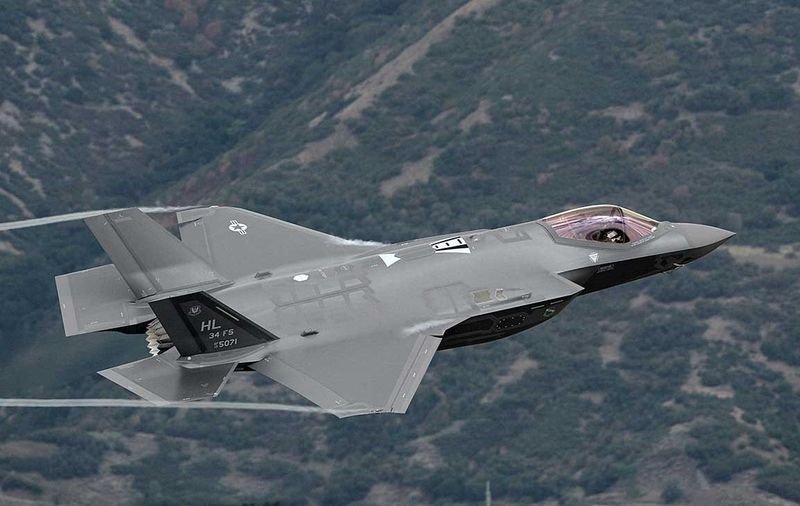

The multinational air exercise Tarang Shakti, which started at Jodhpur on Saturday, provides the Indian Air Force (IAF) a window on having a better understanding of how fifth-generation fighter jets operate.The US-made F-35, a fifth-generation fighter, is here on Indian soil for the first time as part of a military exercise. None among the NATO allies, or Japan, which use the plane, have ferried it to India. Russian Sukhoi-57 is another fifth-generation jet, but it has never participated in drills with the IAF. India does not conduct military exercises with China.These exercises provide exposure to tactics possible only on such fifth-generation platforms. The F-35, made by Lockheed Martin, has seen conflict during recent West Asia crisis and is now operating from Indian soil, adding a new dimension to the IAF’s interaction with the aircraft.IAF Vice-Chief Air Marshal Ashutosh Dixit told a media conference last week: “Tarang Shakti is not an aircraft display, it is about what happens when these aircraft operate together along with people behind the machine”.Recent conflicts, he said, had demonstrated the importance of precision, speed, integrated air defence, unmanned systems, electronic warfare, information, space- enabled capabilities and the ability to bring multiple domains together.The US Air Force’s F-35 performed at the Aero India show in Bengaluru in 2025. However, an exercise on Indian soil provides a closer look at the aircraft’s operations and enables professional military-to-military interaction.The IAF also operated alongside F-35s during the multinational Exercise Pitch Black in Australia in July. In 2021 the IAF had its first exposure to the F-35B, the Marine Corps version, over the Arabian Sea when the aircraft operated from the UK aircraft carrier HMS Queen Elizabeth. The F-35B has capabilities that distinguish it from the conventional F-35A, like vertical landing.Realistic exerciseTarang Shakti will see five air bases along the western frontier getting activated to simulate a realistic scenario.The exercise starts off at Jodhpur, but adjoining bases will also be used by participating forces. As in any military exercise, the forces will be divided into two teams operating from separate bases to replicate the conditions of a ‘real conflict’.Operational lessons derived during Operation Sindoor against Pakistan last year will also be applied into the exercise, Air Marshal Dixit said earlier this week.“Operation Sindoor gives us lessons. Our partners bring their own operational experience. Bringing these together in a realistic training environment allows us to test assumptions, challenge procedures, understand different methods of employing air power and improve interoperability,” he said.The IAF is expected to field the Rafale and Russian-origin Sukhoi-30MKI, while the F-35 is set to make its exercise debut in India.Sources said that while flying alongside Western aircraft like the US F-35 and French Air Force’s Rafale, the IAF uses ‘tactical data links’ to bridge the technological and operational gap between Western and Russian-origin hardware. The IAF relies on indigenous data-link networks and tactical software to enable the Sukhoi-30MKIs to receive mission data, radar tracks and targeting details directly into their cockpits from the central command network without compromising the software source code.The US, France, Germany, the UAE, Bangladesh, Australia and Sri Lanka are among the eight countries that have sent air assets for the exercise. Another 32 countries are participating as observers.China’s 5th-generation growthIndia, in the past few years, has observed China expand its fleet of fifth-generation fighter jets, like the J-35 and J-20. Beijing has promised to give 40 J-35 jets to Pakistan, although deliveries have not started. Analysts have attributed the delay to several possible factors, including concerns about the aircraft being closely studied by the US and other countries if operated by Pakistan.The acquisition of the J-35 by Pakistan would also potentially provide India with an opportunity to observe how a Chinese fifth-generation fighter is operated in the region. However, the extent of any such opportunity would depend on the aircraft’s eventual deployment and the information available through India’s surveillance and intelligence capabilities.India’s indigenous fifth-generation fighter programme, the Advanced Medium Combat Aircraft (AMCA), is still under development. Against this backdrop, exercises such as Tarang Shakti provide an opportunity for Indian personnel to gain practical exposure to fifth-generation aircraft.What is fifth-generation jetFifth-generation fighters are fundamentally backed by hi-tech computing nodes which synthesise data from separate sensors – the AESA radars, electronic warfare suites, and infrared search-and-track systems—to offer pilots a unified, real-time battlespace picture.The air-frame features a reduced radar cross-sections (RCS) through advanced composite airframes, internal weapons bays, and radar-absorbent materials. This ensures survivability in contested airspace.Manohar Parikkar Institute of Defence Studies and Analyses (MP-IDSA), a think-tank backed by the Ministry of Defence , in an ‘ask an expert’ explanation on its website says: “A low RCS is achieved by having an aircraft design with oblique surfaces and avoiding vertical surfaces to produce a weak radar reflection. It carries weapons internally, applies special paints to absorb radars signals and uses composites to reduce detection.Advanced avionics, stealthy sensors and secure communication including low-probability of intercept radar (LPIR) provide better battlefield awareness while protecting its capability to detect, identify and neutralise adversaries, says the MP-IDSA website.“This could mean a difference between getting shot down and winning an aerial combat or making a safe exit after striking a target in dense air defence environment,” the MP-IDSA says.